Curriculum
AP PHYSICS 2
9. Thermodynamics
0/13
10. Electric Force, Field, and Potential
0/15
11. Electric Circuits
0/17
12. Magnetism and Electromagnetism
0/9
13. Geometric Optics
0/9
14. Waves, Sound, and Physical Optics
0/19
-
14. Waves, Sound, and Physical Optics
 Preview
-
14.1 Properties of Wave Pulses and Waves
Preview
-
14.1 Properties of Wave Pulses and Waves - Check yourself
 Preview
-
14.2 Periodic Waves
Preview
-
14.2 Periodic Waves - Check yourself
Preview
-
14.3 Boundary Behavior of Waves and Polarization
Preview
-
14.3 Boundary Behavior of Waves and Polarization - Check yourself
Preview
-
14.4 Electromagnetic Waves
Preview
-
14.4 Electromagnetic Waves - Check yourself
Preview
-
14.5 The Doppler Effect
Preview
-
14.5 The Doppler Effect - Check yourself
Preview
-
14.6 Wave Interference and Standing Waves
Preview
-
14.6 Wave Interference and Standing Waves - Check yourself
Preview
-
14.7 Diffraction
Preview
-
14.7 Diffraction - Check yourself
Preview
-
14.8 Double-Slit Interference and Diffraction Gratings
Preview
-
14.8 Double-Slit Interference and Diffraction Gratings - Check yourself
Preview
-
14.9 Thin-Film Interference
Preview
-
14.9 Thin-Film Interference - Check yourself
Preview
15. Modern Physics
0/17
Text lesson
14.8 Double-Slit Interference and Diffraction Gratings
14.8 Double-Slit Interference and Diffraction Gratings — AP PHYSICS 2: ALGEBRA-BASED notes: You will be able to explain the pattern from two slits as interference of wavefronts superimposed on a single-slit diffraction envelope, use d sin θ = mλ and the small-angle approximation to find the positions of the maxima, explain Young’s double-slit experiment as evidence for the wave nature of light, and describe how a diffraction grating disperses white light into its colours.
1
When monochromatic light of wavelength λ is incident on two slits a distance d apart, the pattern on a distant screen is produced by a combination of wave diffraction and wave interference.
2
Each slit spreads the light by diffraction, and the light from the two slits then interferes.
3
Considering interference alone, a double slit creates a pattern of uniformly spaced maxima, with bright bands where the wavefronts from the two slits arrive in phase and dark bands where they arrive out of phase.
4
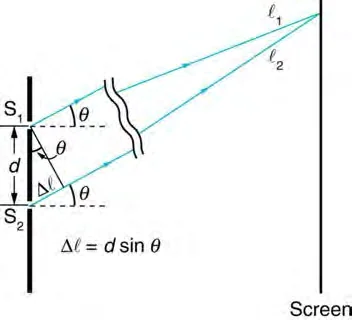
The amount of interference between two wavefronts depends on their path length difference, Δ.
5
For the light from two slits separated by d, the path length difference at an angle θ from the normal to the slits is Δ = d sin θ.
6
Constructive interference, and so a bright band, occurs when this difference is a whole number of wavelengths:
Where d is the slit separation in metres (m), λ is the wavelength in metres and m is the order of the maximum.
Destructive interference, and so a dark band, lies between adjacent maxima.
1
Where L is the distance from the slits to the screen in metres.
2
The maxima are therefore uniformly spaced on the screen, and the distance between adjacent bright fringes is
1
These maxima are superimposed on a broad envelope produced by the single-slit diffraction of each slit, so the bright fringes are brightest near the centre and fade toward the edges of the pattern.
1
The interference pattern produced by light passing through a double slit shows that light has wave properties.
2
Thomas Young’s double-slit experiment of the early nineteenth century was the source of this discovery.
3
A pattern of bright and dark bands could not be explained if light were made only of particles that travelled in straight lines, because two particle beams would not produce regions of darkness where the light from the two slits meets.
4
The dark bands arise because waves from the two slits cancel each other.
5
Visual representations of double-slit patterns are useful in determining the physical properties of the slits and of the interacting waves.
6
From the spacing of the fringes, the wavelength can be found if the slit separation and the screen distance are known, and the slit separation can be found if the wavelength is known.
1
It produces an interference pattern that is the combination of numerous diffraction patterns superimposed on each other.
2
The maxima of a grating occur at the same angles as those of a double slit with the same slit separation, given by d sin θ = mλ.
3
Because a grating has many slits, its bright maxima are much narrower and sharper than those of a double slit, and the dark regions between them are darker.
4
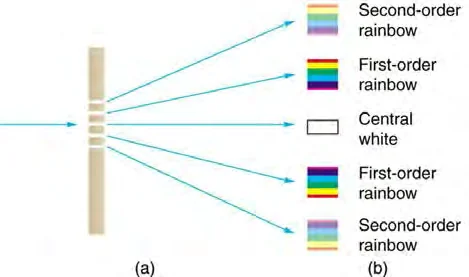
When white light is incident on a diffraction grating, the central maximum is white, because all the wavelengths meet in phase there.
5
Each higher-order maximum disperses white light into a rainbow of colours, because the angle of each maximum depends on the wavelength.
6
Red light, which has the longest wavelength, appears farthest from the central maximum, and violet light, which has the shortest wavelength, appears closest to it.
7
Gratings are therefore used in spectrometers to separate light into its component wavelengths.
Example 1
Fringe spacing in a double-slit experiment
1
Δy = λL/d = (6.00 × 10⁻⁷ m)(1.5 m)/(2.0 × 10−4 m) = 4.5 × 10⁻³ m.
Answer
4.5 mm between adjacent bright fringes.
Example 2
Angle of the first maximum of a grating
1
The slit separation is d = 1/(600 mm−1) = 1/(6.00 × 105 m−1) = 1.67 × 10⁻⁶ m.
2
For m = 1, sin θ = λ/d = (5.00 × 10⁻⁷ m)/(1.67 × 10−6 m) = 0.300.
3
Then θ = sin−1(0.300) = 17.5°.
Answer
17.5° from the normal to the grating.
Example 3
Third-order maximum for red light
1
sin θ = mλ/d = 3(6.50 × 10⁻⁷ m)/(2.5 × 10−6 m) = 0.780.
2
Then θ = sin−1(0.780) = 51.3°.
3
Since sin θ is less than 1, the maximum exists.
Answer
51.3°. The third-order maximum is observed, because a maximum of order m exists only when mλ/d is no greater than 1. The small-angle approximation is not used here, because the angle is larger than 10°.
Using the single-slit minimum condition a sin θ = mλ for the bright maxima of a double slit
Bright maxima use the slit separation d in d sin θ = mλ.
Thinking that a double-slit pattern is a single broad bright band
The pattern is a set of evenly spaced maxima under a single-slit envelope.
Assuming that red light appears closest to the central maximum of a grating
Red has the longest wavelength and appears farthest from the centre.
Forgetting to convert the grating line density into a slit separation in metres
The separation is the reciprocal of the number of lines per metre.
Avoid
Using the slit width instead of the slit separation in ym = mλL/d, or mixing up the two in a single question