Curriculum
Course: AP PHYSICS 2
Login

Curriculum

AP PHYSICS 2

Text lesson

10.1 Electric Charge and Electric Force

10.1 Electric Charge and Electric Force — AP PHYSICS 2: ALGEBRA-BASED notes: You will be able to describe the electric force between charged objects, calculate the magnitude and direction of that force with Coulomb’s law, compare electric and gravitational forces, and account for the effect of a material’s electric permittivity on the force.

1Electric charge and its carriers2Electric charge and its carriers3Electric charge and its carriers
Electric charge and its carriers
Electric charge is a fundamental property of all matter. Charge is described as either positive or negative, and objects with equal amounts of positive and negative charge are electrically neutral.
The elementary charge e = 1.60 × 10⁻¹⁹ C is the magnitude of the charge of one electron or one proton, and it is the smallest indivisible amount of charge.
1 / 3Next ▶
Electric charge and its carriers
1

The electron has charge −
2

e
3

, the proton has charge +
4

, and the neutron has no electric charge.
5

Because every charge is a whole number of elementary charges, the net charge of any object is a whole-number multiple of
6

.
◀ Previous2 / 3Next ▶
Electric charge and its carriers
A point charge is a model in which the physical size of a charged object is negligible compared with the distances in the situation being analysed. This model lets us treat a charged sphere, a particle or an atom as a single point at its centre.
◀ Previous3 / 3
1Coulomb’s law2Coulomb’s law3Coulomb’s law4Coulomb’s law5Coulomb’s law6Coulomb’s law
Coulomb’s law
Coulomb’s law
Coulomb’s law describes the electrostatic force between two point charges.
1 / 6Next ▶
Coulomb’s law
1

The force is directly proportional to the magnitude of each charge and inversely proportional to the square of the distance between them:
2

F
3

=
4

k
5

|
6

q
◀ Previous2 / 6Next ▶
Coulomb’s law
1

1
2

2
3

|/
4

r
5

.
6

Here
◀ Previous3 / 6Next ▶
Coulomb’s law
Coulomb’s law
is the magnitude of the force in newtons (N),
and
are the charges in coulombs (C),
is the separation of the charges in metres (m),
and k = 9.0 × 10⁹ N·m2/C2 is the Coulomb constant.
The direction of the electric force is along the line joining the two charges.
◀ Previous4 / 6Next ▶
Coulomb’s law
1

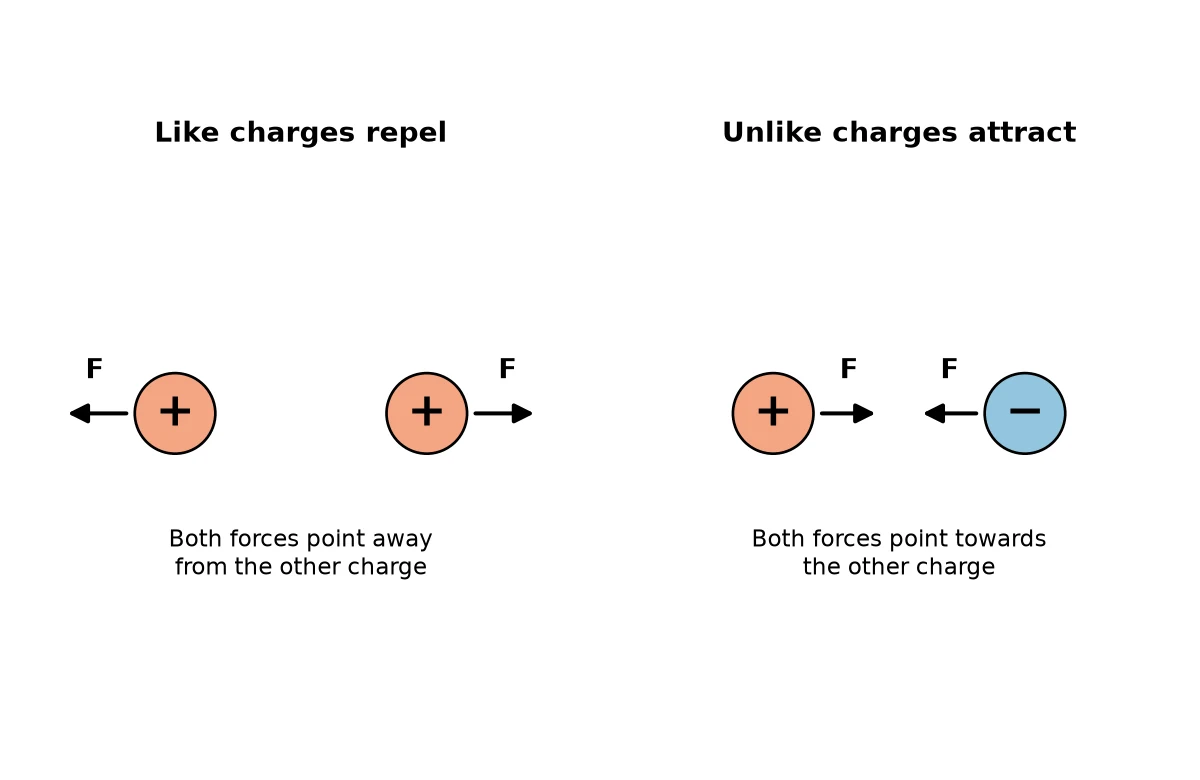
Two charges of the same sign repel each other, and two charges of opposite sign attract each other.
2

The force that object 1 exerts on object 2 is equal in magnitude and opposite in direction to the force that object 2 exerts on object 1,
3

which is Newton’s third law applied to electric forces.
4

Because the force is a vector, the direction must be stated separately from the magnitude. In calculations, the magnitude of the force is found from the absolute values of the charges, and the sign of the charges is then used only to decide whether the force is attractive or repulsive.
◀ Previous5 / 6Next ▶
Two side-by-side panels: like charges pushing apart with outward arrows, unlike charges pulling together with inward arrows
Coulomb’s law
◀ Previous6 / 6
About this chapter: A child touches a plastic slide and the hair stands on end. Sliding stripped electrons from the child’s body, so the hair strands carry the same positive charge and repel one another.
Electric forces in everyday objects
About this chapter: A child touches a plastic slide and the hair stands on end. Sliding stripped electrons from the child’s body, so the hair strands carry the same positive charge and repel one another." loading= - Dr Khaled Dabour Academy⤢ Enlarge
Electric forces in everyday objects
Electric forces act between the electrons and nuclei of all atoms and molecules. Their combined effect gives the familiar forces of everyday life. The normal force that a table exerts on a book, the friction between two surfaces and the tension in a string all arise from electric interactions between particles at the atomic scale.
Because the number of particle interactions in a macroscopic object is very large, it is more convenient to describe these effects with contact forces such as the normal force, friction and tension, rather than by summing every electric interaction.
1Electric and gravitational forces compared2Electric and gravitational forces compared3Electric and gravitational forces compared4Electric and gravitational forces compared5Electric and gravitational forces compared
Electric and gravitational forces compared
Both electric and gravitational forces are inverse-square forces that act at a distance.
1 / 5Next ▶
Electric and gravitational forces compared
1

Electrostatic forces can be attractive or repulsive

while gravitational forces are always attractive.
2

The gravitational force between two masses
3

m
4

1
5

and
6

2
◀ Previous2 / 5Next ▶
Electric and gravitational forces compared
is
F
g
=
G
/
◀ Previous3 / 5Next ▶
Electric and gravitational forces compared
1

r
2

, with
3

= 6.67 × 10
4

−11
5

N·m
6

/kg
◀ Previous4 / 5Next ▶
Electric and gravitational forces compared
.
For a pair of particles such as an electron and a proton, the electric force is much larger than the gravitational force.
This is why electric forces control the structure of atoms and molecules.
At large scales the situation is reversed: most objects are electrically neutral,
so their electric forces cancel and gravity,
which is always attractive, dominates the motion of planets and stars.
◀ Previous5 / 5
1Electric permittivity of matter2Electric permittivity of matter3Electric permittivity of matter4Electric permittivity of matter
Electric permittivity of matter
Electric permittivity measures how strongly a material or medium becomes polarised in the presence of an electric field. Free space has a constant permittivity, ε0 = 8.85 × 10⁻¹² C2/(N·m2), and the Coulomb constant is related to it by k = 1/(4πε0).
Matter has a different permittivity from free space because of its composition and arrangement.
1 / 4Next ▶
Electric permittivity of matter
1

Inside a material, the electric field of a charge makes electrons shift slightly within their atoms or molecules, separating positive and negative charge.
2

This induced separation weakens the force between charges placed in the material.
3

In a medium of permittivity
4

ε
5

, Coulomb’s law becomes
6

F
◀ Previous2 / 4Next ▶
Electric permittivity of matter
1

= |
2

q
3

1
4

2
5

|/(4π
6

r
◀ Previous3 / 4Next ▶
Electric permittivity of matter
).
The ease with which electrons can change their configuration decides how a material responds. In a conductor, charge carriers move easily through the material. In an insulator, charge carriers cannot move easily

so the material can be polarised but not conducted through.
◀ Previous4 / 4
1Forces from several charges2Forces from several charges
Forces from several charges
When a charge interacts with several other charges, the total electric force on it is the vector sum of the individual forces from each charge.
1 / 2Next ▶
Forces from several charges
Each force is calculated separately with Coulomb’s law

and then the components along each axis are added.
For AP Physics 2, you should be able to find the net electric force from up to four interacting charges.
Configurations of more charges can be analysed only in situations of high symmetry.
A useful method is to choose a coordinate axis, write each force as a signed component along that axis, and add the components. A force toward the positive axis is positive, and a force toward the negative axis is negative.
◀ Previous2 / 2
1Example 1: Force between two point charges · Example 2: Elec2Worked examples3Worked examples4Worked examples5Worked examples6Example 3: Net force from three charges on a line7Example 3: Net force from three charges on a line8Example 3: Net force from three charges on a line9Example 3: Net force from three charges on a line10Example 3: Net force from three charges on a line
Example 1: Force between two point charges · Example 2: Electric force and gravitational force in a hydrogen atom
Example 1: Force between two point charges
A charge of +3.0 μC and a charge of −2.0 μC are separated by 0.30 m in a vacuum. Find the magnitude and direction of the electric force on each charge.
Working: The magnitude is F = k|q1q2|/r2 = (9.0 × 10⁹ N·m2/C2)(3.0 × 10−6 C)(2.0 × 10⁻⁶ C)/(0.30 m)2 = (9.0 × 10⁹)(6.0 × 10⁻¹²)/0.090 = 0.60 N. The charges have opposite signs

so the force is attractive: each charge is pulled toward the other, along the line joining them.
Answer: 0.60 N. The force on the positive charge points toward the negative charge, and the force on the negative charge points toward the positive charge, with equal magnitudes.
Example 2: Electric force and gravitational force in a hydrogen atom
In a hydrogen atom the electron and proton are about 5.3 × 10⁻¹¹ m apart. The electron mass is 9.11 × 10⁻³¹ kg and the proton mass is 1.67 × 10⁻²⁷ kg. Find the electric force, the gravitational force, and the ratio of the electric force to the gravitational force.
Working: The electric force is Fe = (9.0 × 10⁹)(1.60 × 10⁻¹⁹)2/(5.3 × 10−11)2 = 8.2 × 10⁻⁸ N

which is attractive.
1 / 10Next ▶
Worked examples
1

The gravitational force is
2

F
3

g
4

= (6.67 × 10
5

−11
6

)(9.11 × 10
◀ Previous2 / 10Next ▶
Worked examples
1

−31
2

)(1.67 × 10
3

−27
4

)/(5.3 × 10
5

)
6

2
◀ Previous3 / 10Next ▶
Worked examples
Worked examples
= 3.6 × 10
−47
N.
The ratio is 8.2 × 10
−8
/3.6 × 10
◀ Previous4 / 10Next ▶
Worked examples
1

= 2.3 × 10
2

39
3

.
4

Answer: The electric force is 8.2 × 10⁻⁸ N and the gravitational force is 3.6 × 10−47 N. The electric force is about 2 × 1039 times larger

so gravity is negligible at atomic scales.
◀ Previous5 / 10Next ▶
Example 3: Net force from three charges on a line
Along the x-axis, a charge q1 = +2.0 μC is at x = 0, a charge q2 = −3.0 μC is at x = 0.50 m, and a charge q3 = +1.0 μC is at x = 0.20 m. Find the net electric force on q3.
Working: The force from q1 is repulsive

because both charges are positive.
1
It points in the +x direction and has magnitude
13
= (9.0 × 10
◀ Previous6 / 10Next ▶
Example 3: Net force from three charges on a line
9
)(2.0 × 10
−6
)(1.0 × 10
)/(0.20 m)
= 0.45 N.
◀ Previous7 / 10Next ▶
Example 3: Net force from three charges on a line
1

The force from
2

q
3

is attractive, and
4

lies in the +x direction from
5

3
6

so this force also points in +x.
◀ Previous8 / 10Next ▶
Example 3: Net force from three charges on a line
1

Its magnitude is
2

23
3

)(3.0 × 10
4

)/(0.30 m)
5

= 0.30 N.
6

4
◀ Previous9 / 10Next ▶
Example 3: Net force from three charges on a line
The net force is +0.45 N + 0.30 N = +0.75 N.
Answer: The net electric force on q3 is 0.75 N in the +x direction.
◀ Previous10 / 10
Key terms
Term Meaning
Electric charge A fundamental property of matter that is either positive or negative and gives rise to electric forces, measured in coulombs.
Elementary charge (e) The magnitude of the charge of one electron or proton, 1.60 × 10⁻¹⁹ C.
Point charge A model of a charged object whose physical size is negligible in the situation being analysed.
Coulomb’s law The law stating that the electrostatic force between two point charges is F = k|q1q2|/r2.
Coulomb constant (k) The constant 9.0 × 10⁹ N·m2/C2 that appears in Coulomb’s law in a vacuum.
Electric permittivity A measure of how strongly a material or medium becomes polarised in the presence of an electric field.
Polarisation The separation of positive and negative charge within a material caused by an external electric field.
Conductor A material in which charge carriers move easily through the material.
Insulator A material in which charge carriers cannot move easily through the material.
Contact force A nonfundamental force, such as the normal force, friction or tension, that results from electric interactions between particles.
1Avoid these mistakes2Avoid these mistakes3Avoid these mistakes
Avoid these mistakes
1Avoid this
Putting the signs of the charges into the magnitude of the force.Avoid this
Use the absolute values in F = k|q1q2|/r2, and use the signs only to decide whether the force is attractive or repulsive.Avoid this
2Avoid this
Using the centre-to-centre distance incorrectly, or using the distance from a charge to the midpoint of the pair when the separation is required.Avoid this
3Avoid this
1 / 3Next ▶
Avoid these mistakes
Assuming that a neutral object exerts no electric force. A neutral object can be polarised by a nearby charge and then attracts it.Avoid this
4Avoid this
Forgetting that the electric force is a vector and that a force from several charges must be added as a vector, not as a simple sum of magnitudes.Avoid this
5Avoid this
Thinking that gravity is more important than the electric force for atoms.Avoid this
The electric force between an electron and a proton is about 1039 times larger than the gravitational force.Avoid this
◀ Previous2 / 3Next ▶
Avoid these mistakes
6Avoid this
Using the Coulomb constantAvoid this
kAvoid this
for a medium other than a vacuum.Avoid this
In a medium, use the permittivity of that medium, or account for it through the dielectric constant.Avoid this
◀ Previous3 / 3
Accepted payment methods