Curriculum
AP PHYSICS 2
9. Thermodynamics
0/13
10. Electric Force, Field, and Potential
0/15
-
10. Electric Force, Field, and Potential
 Preview
-
10.1 Electric Charge and Electric Force
Preview
-
10.1 Electric Charge and Electric Force - Check yourself
 Preview
-
10.2 Conservation of Electric Charge and the Process of Charging
Preview
-
10.2 Conservation of Electric Charge and the Process of Charging - Check yourself
Preview
-
10.3 Electric Fields
Preview
-
10.3 Electric Fields - Check yourself
Preview
-
10.4 Electric Potential Energy
Preview
-
10.4 Electric Potential Energy - Check yourself
Preview
-
10.5 Electric Potential
Preview
-
10.5 Electric Potential - Check yourself
Preview
-
10.6 Capacitors
Preview
-
10.6 Capacitors - Check yourself
Preview
-
10.7 Conservation of Electric Energy
Preview
-
10.7 Conservation of Electric Energy - Check yourself
Preview
11. Electric Circuits
0/17
12. Magnetism and Electromagnetism
0/9
13. Geometric Optics
0/9
14. Waves, Sound, and Physical Optics
0/19
15. Modern Physics
0/17
Text lesson
10. Electric Force, Field, and Potential
Unit 10 Electric Force, Field, and Potential — AP PHYSICS 2: ALGEBRA-BASED notes: You will be able to connect the seven topics of Unit 10 by explaining how charge produces forces, fields and potentials, how these lead to stored energy in charges and capacitors, and how the conservation of energy describes the motion of charged objects.
1Charge, electric force and permittivity2Charge, electric force and permittivity3Charge, electric force and permittivity4Charge, electric force and permittivity
1Electric fields and electric potential energy2Electric fields and electric potential energy3Electric fields and electric potential energy
Electric fields and electric potential energy
Electric fields and electric potential energy
An electric field is the force per unit charge, E = FE/q, and a point charge produces the field E = k|q|/r2 directed away from positive charges and toward negative charges (topic 10.3).
1 / 3Next ▶
Electric fields and electric potential energy
1
Fields from several charges are added as vectors.
2
Field lines and field maps describe the field, and inside a conductor in electrostatic equilibrium the field is zero.
3
The electric potential energy of two point charges is UE = kq1q2/r, measured relative to infinity (topic 10.4).
4
It is positive for like charges and negative for opposite charges,
5
and the total energy of a system is found by summing the energies of all of its pairs.
6
The potential energy of a set of charges is the work needed to bring them together from infinitely far apart.
◀ Previous2 / 3Next ▶
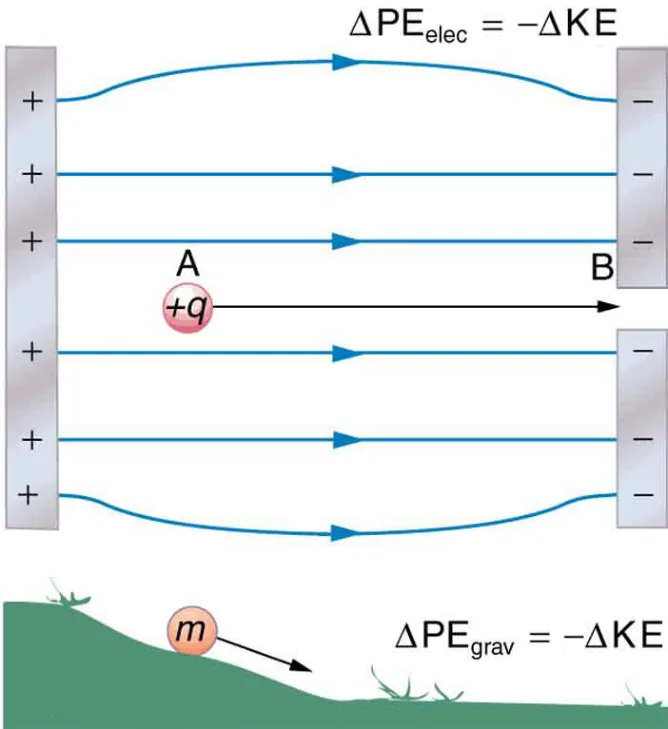
Electric potential energy: A charge accelerated by an electric field loses potential energy and gains kinetic energy, just as a mass going down a hill does.
Electric fields and electric potential energy
◀ Previous3 / 3
1Electric potential and potential difference2Electric potential and potential difference3Electric potential and potential difference4Electric potential and potential difference5Electric potential and potential difference6Electric potential and potential difference
Electric potential and potential difference
Electric potential and potential difference
Electric potential is the electric potential energy per unit charge at a point, V = UE/q, measured in volts.
1 / 6Next ▶
Electric potential and potential difference
Electric potential and potential difference
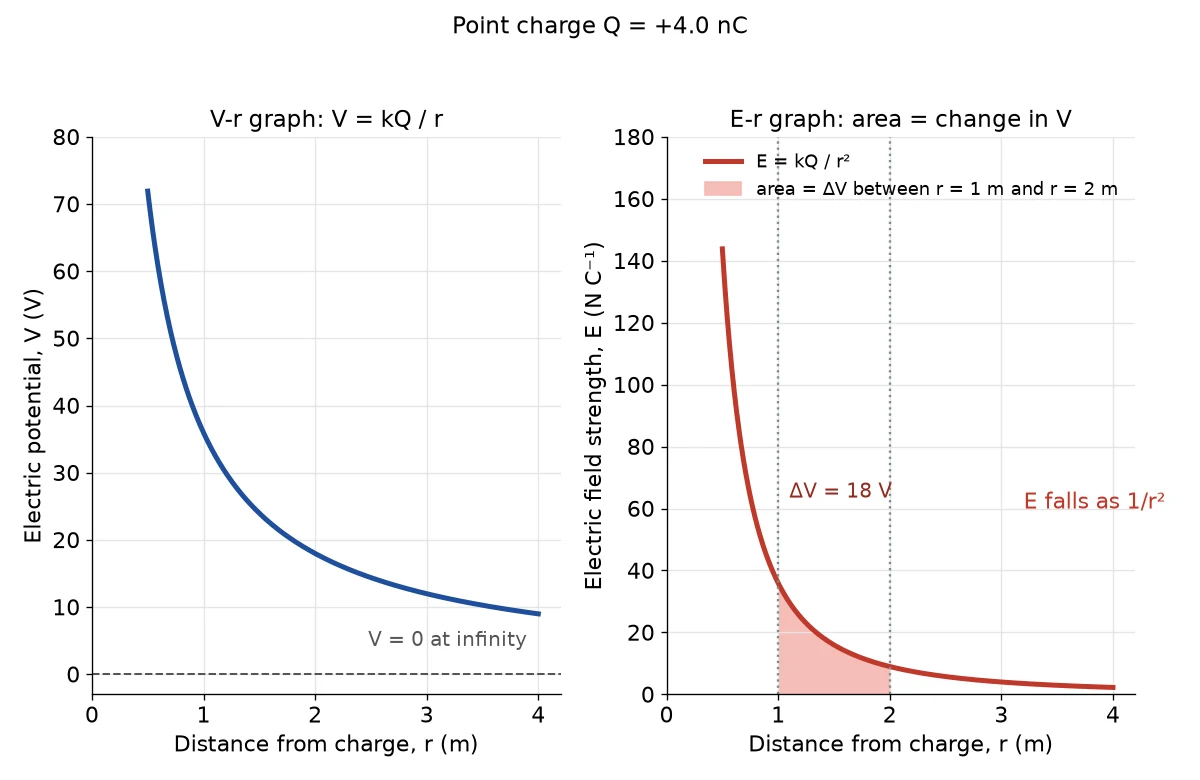
A point charge produces the potential
V
=
k
q
/
◀ Previous2 / 6Next ▶
Electric potential and potential difference
Electric potential and potential difference
r
, and the potentials of several charges add as scalars (topic 10.5).
The potential difference Δ
between two points gives the average field between them,
E
avg
◀ Previous3 / 6Next ▶
Electric potential and potential difference
1
= Δ
2
/Δ
3
d
4
.
5
The field points toward lower potential, and equipotential lines are always perpendicular to the field.
6
The potential energy of a charge changes by ΔU = qΔV when it moves between two points (topic 10.7).
◀ Previous4 / 6Next ▶
Electric potential and potential difference
1
Energy conservation then gives the change in kinetic energy as Δ
2
K
3
= −
4
Δ
5
This is the reason a positive charge released from rest moves toward lower potential and gains speed,
6
while a negative charge moves toward higher potential.
◀ Previous5 / 6Next ▶
Two graphs for a point charge: potential against distance falling as 1/r, and field strength against distance falling as 1/r squared with shaded area equal to the potential change
Electric potential and potential difference
◀ Previous6 / 6
1Capacitors and stored energy2Capacitors and stored energy3Capacitors and stored energy4Capacitors and stored energy5Capacitors and stored energy
Capacitors and stored energy
Capacitors and stored energy
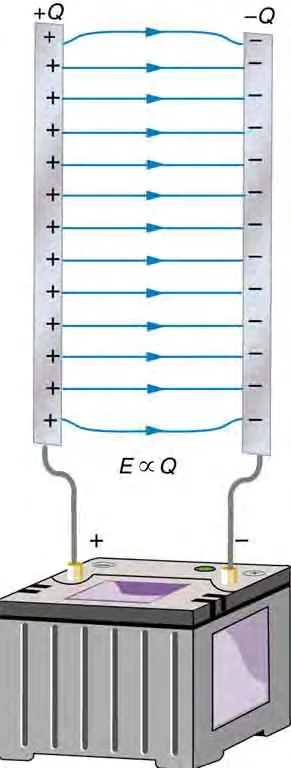
A parallel-plate capacitor holds equal and opposite charges on its two plates.
1 / 5Next ▶
Capacitors and stored energy
Capacitors and stored energy
Its capacitance,
C
=
Q
/Δ
V
◀ Previous2 / 5Next ▶
Capacitors and stored energy
Capacitors and stored energy
, depends on the area and separation of the plates and on the dielectric between them, through
κ
ε
0
A
/
◀ Previous3 / 5Next ▶
Capacitors and stored energy
1
d
2
(topic 10.6).
3
The field between the plates is uniform, with
4
E
5
= Δ
6
, and a charged particle between the plates accelerates like a projectile in gravity.
◀ Previous4 / 5Next ▶
Parallel-plate capacitors: field, potential and capacitance: Field lines run straight between the plates of a charged parallel-plate capacitor.
Capacitors and stored energy
 ⤢ Enlarge
Capacitors and stored energy
The energy stored in a capacitor is UC = ½QΔV = ½CΔV2. A dielectric increases the capacitance by the factor κ. It induces a field that opposes the field between the plates
which lowers the potential difference for a fixed charge.
◀ Previous5 / 5
1How the topics connect2How the topics connect3How the topics connect4How the topics connect
Key equations of Unit 10
| Equation | Symbols and SI units | Topic |
|---|---|---|
| F = k|q1q2|/r2 | F electric force (N); q charges (C); r separation (m); k = 9.0 × 10⁹ N·m2/C2 | 10.1 |
| Fg = Gm1m2/r2 | Fg gravitational force (N); m masses (kg); G = 6.67 × 10⁻¹¹ N·m2/kg2 | 10.1 |
| E = FE/q | E electric field (N/C); FE force (N); q test charge (C) | 10.3 |
| E = k|q|/r2 | E field magnitude (N/C); q source charge (C); r distance (m) | 10.3 |
| UE = kq1q2/r | UE electric potential energy (J); charges with signs (C); r separation (m) | 10.4 |
| V = kq/r and V = UE/q | V electric potential (V); q charge (C); r distance (m) | 10.5 |
| ΔV = ΔUE/q | ΔV potential difference (V); ΔUE change in potential energy (J); q charge (C) | 10.5 |
| Eavg = ΔV/Δd | Eavg average field (V/m or N/C); Δd distance along the field (m) | 10.5 |
| ΔU = qΔV and ΔK = −qΔV | ΔU change in potential energy (J); ΔK change in kinetic energy (J); q charge (C) | 10.7 |
| C = Q/ΔV | C capacitance (F); Q charge on each plate (C); ΔV potential difference (V) | 10.6 |
| C = κε0A/d | κ dielectric constant (no unit); ε0 = 8.85 × 10⁻¹² F/m; A plate area (m2); d separation (m) | 10.6 |
| E = ΔV/d between parallel plates | E field (V/m); ΔV potential difference (V); d plate separation (m) | 10.6 |
| UC = ½QΔV = ½CΔV2 = Q2/(2C) | UC energy stored (J); Q charge (C); ΔV (V); C (F) | 10.6 |
Constants used in Unit 10
| Constant | Value and unit |
|---|---|
| Elementary charge, e | 1.60 × 10⁻¹⁹ C |
| Coulomb constant, k | 9.0 × 10⁹ N·m2/C2 |
| Permittivity of free space, ε0 | 8.85 × 10⁻¹² C2/(N·m2), or F/m |
| Electron mass | 9.11 × 10⁻³¹ kg |
Key terms
| Term | Meaning |
|---|---|
| Point charge | A model of a charged object whose size is negligible in the situation being analysed. |
| Electric field | The electric force per unit charge at a point, a vector measured in N/C. |
| Electric potential | The electric potential energy per unit charge at a point, a scalar measured in volts. |
| Potential difference | The change in electric potential energy per unit charge between two points, in volts. |
| Equipotential line | A line of constant electric potential, always perpendicular to the electric field. |
| Capacitance | The ratio of the charge on a capacitor’s plate to the potential difference between its plates, in farads. |
| Dielectric | An insulating material between the plates of a capacitor that increases its capacitance. |
| Polarisation | The separation of charge in a material by an electric field, which underlies both permittivity and induced charge. |
1Avoid these mistakes2Avoid these mistakes3Avoid these mistakes4Avoid these mistakes5Avoid these mistakes