Curriculum
AP PHYSICS 2
9. Thermodynamics
0/13
10. Electric Force, Field, and Potential
0/15
-
10. Electric Force, Field, and Potential
 Preview
-
10.1 Electric Charge and Electric Force
Preview
-
10.1 Electric Charge and Electric Force - Check yourself
 Preview
-
10.2 Conservation of Electric Charge and the Process of Charging
Preview
-
10.2 Conservation of Electric Charge and the Process of Charging - Check yourself
Preview
-
10.3 Electric Fields
Preview
-
10.3 Electric Fields - Check yourself
Preview
-
10.4 Electric Potential Energy
Preview
-
10.4 Electric Potential Energy - Check yourself
Preview
-
10.5 Electric Potential
Preview
-
10.5 Electric Potential - Check yourself
Preview
-
10.6 Capacitors
Preview
-
10.6 Capacitors - Check yourself
Preview
-
10.7 Conservation of Electric Energy
Preview
-
10.7 Conservation of Electric Energy - Check yourself
Preview
11. Electric Circuits
0/17
12. Magnetism and Electromagnetism
0/9
13. Geometric Optics
0/9
14. Waves, Sound, and Physical Optics
0/19
15. Modern Physics
0/17
Text lesson
10.4 Electric Potential Energy
10.4 Electric Potential Energy — AP PHYSICS 2: ALGEBRA-BASED notes: You will be able to explain electric potential energy as the work needed to assemble charges, calculate the potential energy of two and of up to four point charges, and sketch and interpret how that energy changes with separation.
1Potential energy of a system of two charges2Potential energy of a system of two charges3Potential energy of a system of two charges4Potential energy of a system of two charges
Potential energy of a system of two charges
Potential energy of a system of two charges
Electric potential energy is the energy stored in a system of charged objects because of their positions relative to one another.
1 / 4Next ▶
Potential energy of a system of two charges
1
The electric potential energy of a system of two point charges equals the work required for an external force to bring the charges to their present positions from infinitely far apart.
2
The reference point is chosen to be infinity
where the potential energy is taken as zero.
3
For two point charges q1 and q2 separated by a distance r, the electric potential energy is UE = kq1q2/r. Here UE is the potential energy in joules (J), q1 and q2 are the charges in coulombs (C) with their signs, r is the separation in metres (m), and k = 9.0 × 10⁹ N·m2/C2.
4
The sign of the potential energy comes from the signs of the charges.
5
If both charges have the same sign, the product
6
q
◀ Previous2 / 4Next ▶
Potential energy of a system of two charges
Potential energy of a system of two charges
1
2
is positive, so
U
E
is positive.
◀ Previous3 / 4Next ▶
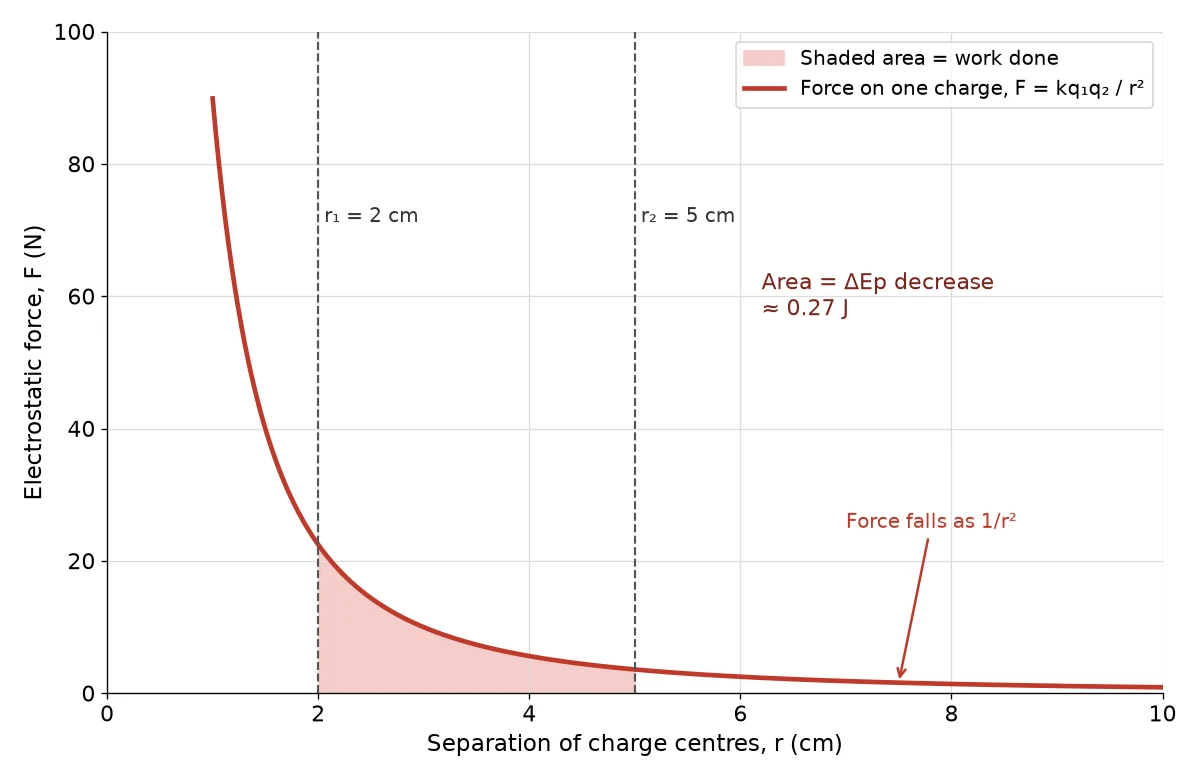
Force against separation for two like charges, with the shaded area between 2 cm and 5 cm giving the work done
Potential energy of a system of two charges
 ⤢ Enlarge
Potential energy of a system of two charges
An external force must do positive work to push like charges together, and that work is stored as potential energy.
If the charges have opposite signs,
is negative, and the system is at a lower energy when the charges are close together.
◀ Previous4 / 4
1How the energy depends on separation2How the energy depends on separation3How the energy depends on separation4How the energy depends on separation
How the energy depends on separation
How the energy depends on separation
Because UE is proportional to 1/r, the potential energy changes most rapidly when the charges are close together.
1 / 4Next ▶
How the energy depends on separation
1
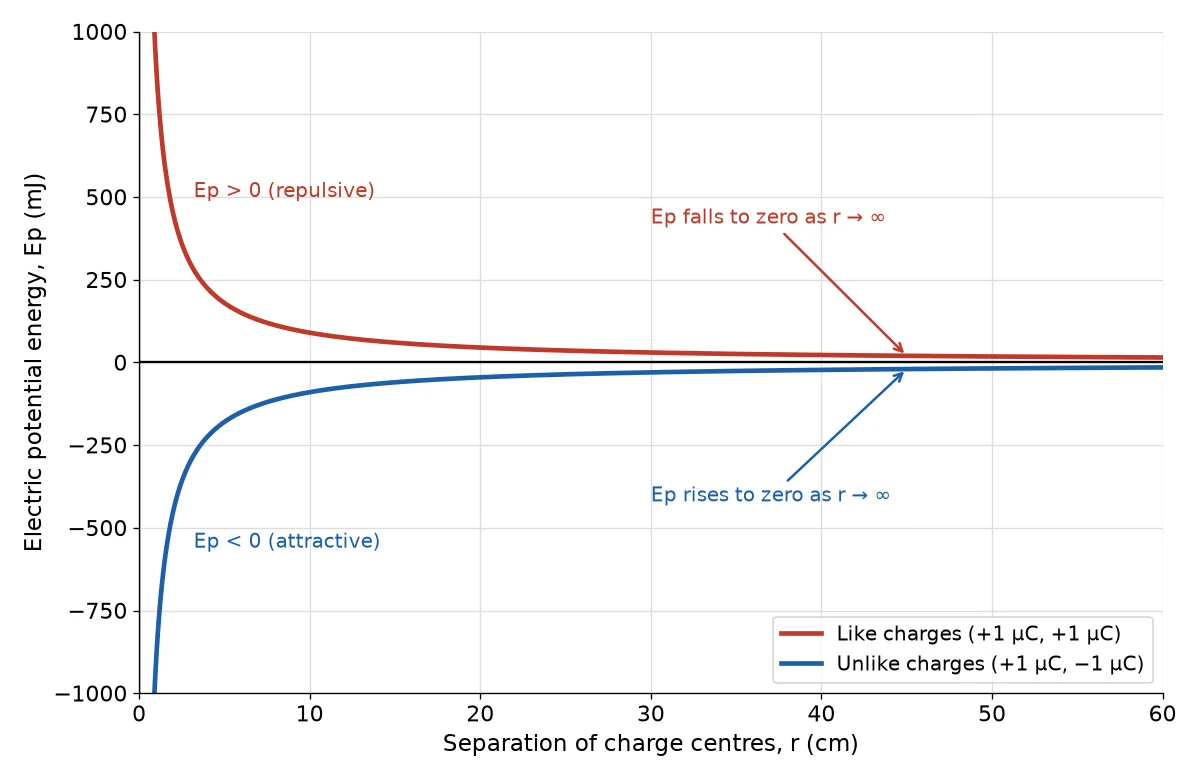
For like charges,
2
U
3
E
4
is positive and decreases toward zero as
5
r
6
increases to infinity.
◀ Previous2 / 4Next ▶
How the energy depends on separation
How the energy depends on separation
For opposite charges,
is negative and increases toward zero as
increases.
The graph of
against
is a curve shaped like a hyperbola
which is steep at small separation and flattens at large separation.
◀ Previous3 / 4Next ▶
Electric potential energy against separation for like charges (positive, falling to zero) and unlike charges (negative, rising to zero)
How the energy depends on separation
 ⤢ Enlarge
How the energy depends on separation
When charges are released from rest, the electric force does positive work on them, the kinetic energy increases and the potential energy decreases by the same amount. Like charges move apart and opposite charges move together. The total mechanical energy of the system, kinetic plus potential, stays constant when only electric forces act.
◀ Previous4 / 4
1Potential energy of several charges2Potential energy of several charges3Potential energy of several charges4Potential energy of several charges5Potential energy of several charges6Potential energy of several charges
1Using energy to find speeds2Using energy to find speeds3Using energy to find speeds
1Example 1: Potential energy of an attracting pair · Example 2Example 3: Potential energy of three charges on a line3Worked examples4Worked examples5Worked examples
Key terms
| Term | Meaning |
|---|---|
| Electric potential energy (UE) | The energy stored in a system of charges because of their relative positions, equal to the work needed to assemble them from infinitely far apart. |
| Reference point of zero potential energy | Infinity, where two point charges are taken to have zero electric potential energy. |
| Conservative force | A force for which the work done depends only on the starting and ending positions, so that mechanical energy is conserved. |
| Like charges | Two charges of the same sign, which repel and have positive electric potential energy. |
| Opposite charges | Two charges of opposite sign, which attract and have negative electric potential energy. |
| Pair of charges | Two charges in a system, whose interaction energy is counted once in the total potential energy of the system. |
| Work done by an external force | The work needed to move charges against their electric force, which is stored as electric potential energy. |
| Mechanical energy | The sum of the kinetic energy and the potential energy of a system. |
1Avoid these mistakes2Avoid these mistakes3Avoid these mistakes4Avoid these mistakes