Curriculum
AP PHYSICS 2
9. Thermodynamics
0/13
10. Electric Force, Field, and Potential
0/15
-
10. Electric Force, Field, and Potential
 Preview
-
10.1 Electric Charge and Electric Force
Preview
-
10.1 Electric Charge and Electric Force - Check yourself
 Preview
-
10.2 Conservation of Electric Charge and the Process of Charging
Preview
-
10.2 Conservation of Electric Charge and the Process of Charging - Check yourself
Preview
-
10.3 Electric Fields
Preview
-
10.3 Electric Fields - Check yourself
Preview
-
10.4 Electric Potential Energy
Preview
-
10.4 Electric Potential Energy - Check yourself
Preview
-
10.5 Electric Potential
Preview
-
10.5 Electric Potential - Check yourself
Preview
-
10.6 Capacitors
Preview
-
10.6 Capacitors - Check yourself
Preview
-
10.7 Conservation of Electric Energy
Preview
-
10.7 Conservation of Electric Energy - Check yourself
Preview
11. Electric Circuits
0/17
12. Magnetism and Electromagnetism
0/9
13. Geometric Optics
0/9
14. Waves, Sound, and Physical Optics
0/19
15. Modern Physics
0/17
Text lesson
10.5 Electric Potential
10.5 Electric Potential — AP PHYSICS 2: ALGEBRA-BASED notes: You will be able to define electric potential and potential difference, calculate the potential of point charges by superposition, relate the average electric field to the potential difference between two points, and use equipotential lines to describe a field.
It is a property of the location, and it does not depend on the charge placed there: V = UE/q.
Here V is the electric potential in volts (V), where 1 V = 1 J/C, UE is the potential energy of the test charge in joules, and q is the test charge in coulombs.
Potential V
The electric potential created by a single point charge q at a distance r is V = kq/r, with the reference point at infinity where V = 0.
The potential has the sign of the charge that produces it: it is positive near a positive charge and negative near a negative charge.
For charges q1, q2, … at distances r1, r2, …, the total potential is V = k(q1/r1 + q2/r2 + …).
Because potential is a scalar, no components are needed.
This is the main advantage of working with potential rather than with electric field: a negative sign in a potential sum reduces the total, and the vector directions of the fields do not need to be considered.
The potential difference is measured in volts, and it describes the energy available to each unit of charge that moves between the points.
A battery creates a potential difference by chemical processes that separate positive and negative charges, so that one terminal has a higher potential than the other.
Battery
The potential difference across the battery terminals is the energy per unit charge supplied to charges that move through the external circuit.
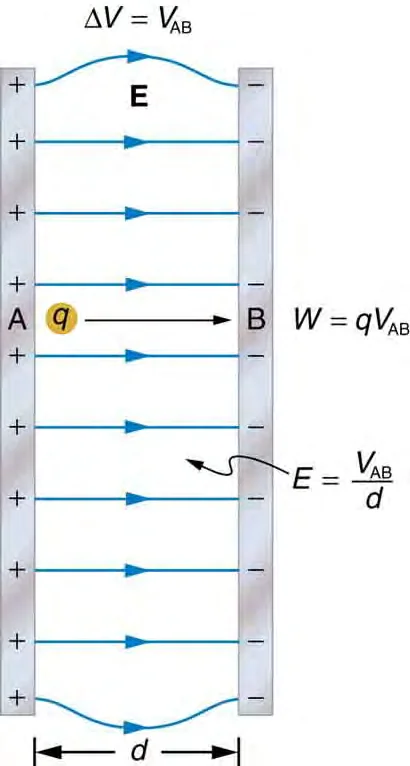
Here Eavg is in volts per metre (V/m), which is the same unit as newtons per coulomb (N/C).
The distance Δd is measured along the direction of the field.
The electric field vector points in the direction of decreasing electric potential.
A positive charge released in an electric field moves toward lower potential, and a negative charge moves toward higher potential.
Equipotential lines in two dimensions and equipotential surfaces in three dimensions show where the potential is the same.
Around a single point charge, the equipotential surfaces are concentric spheres.
Equipotential lines are always perpendicular to the electric field vectors, because there is no component of the electric field along an isoline.
Equipotentials
A field vector map can be used to draw the isolines, and an isoline map can be used to draw the field lines.
Where the isolines are close together, the field is strong.
When charged conductors are in electrical contact, electrons are redistributed until the surfaces of the conductors are at the same electric potential.
Question
Find the electric potential at a point 0.30 m from an isolated point charge of −6.0 μC
1
V = kq/r = (9.0 × 10⁹ N·m2/C2)(−6.0 × 10−6 C)/(0.30 m) = −1.8 × 10⁵ V.
Answer
−1.8 × 10⁵ V. The potential is negative because the charge is negative.
Question
A point P is 0.20 m from a charge of +3.0 μC and 0.40 m from a charge of −5.0 μC. Find the electric potential at P.
1
By superposition, VP = k(q1/r1 + q2/r2) = (9.0 × 10⁹)[(+3.0 × 10⁻⁶)/0.20 + (−5.0 × 10⁻⁶)/0.40] = (9.0 × 10⁹)[1.5 × 10⁻⁵ − 1.25 × 10⁻⁵] = (9.0 × 10⁹)(2.5 × 10⁻⁶) = 2.3 × 10⁴ V.
Answer
2.3 × 10⁴ V. Each term is added with its own sign, and the positive contribution is larger than the negative one.
Question
Two parallel plates are 0.040 m apart, and a potential difference of 120 V is maintained between them. An electron is released from rest at the negative plate. Find the electric field between the plates and the speed of the electron when it reaches the positive plate. The electron mass is 9.11 × 10⁻³¹ kg.
1
The average field is E = ΔV/Δd = 120 V/0.040 m = 3.0 × 10³ V/m.
2
The electron’s loss of potential energy as it moves across the potential difference is |q|ΔV = (1.60 × 10⁻¹⁹ C)(120 V) = 1.92 × 10⁻¹⁷ J.
3
This energy becomes kinetic energy, so ½mv2 = 1.92 × 10⁻¹⁷ J and v = √[2(1.92 × 10⁻¹⁷ J)/(9.11 × 10−31 kg)] = 6.5 × 10⁶ m/s.
Answer
The field is 3.0 × 10³ V/m (or N/C) from the positive plate toward the negative plate, and the electron’s speed at the positive plate is 6.5 × 10⁶ m/s. The electron moves against the field, which is the direction of increasing potential, because its charge is negative.
Treating electric potential as a vector.
Potential is a scalar, so potentials from several charges are added with signs and no components.
Forgetting the sign of the charge when calculating V = kq/r
A negative charge gives a negative potential.
Stating that the electric field points toward higher potential.
The field points in the direction of decreasing electric potential.
Using Δd as the straight-line distance between two points that are not along the field direction.
The relation E = ΔV/Δd uses the distance measured along the field.
Assuming that equipotential lines can cross the electric field lines at an angle other than 90°.
Isolines are always perpendicular to the field.
Confusing electric potential with electric potential energy.
Potential is energy per unit charge, so the potential energy of a charge is UE = qV.