Curriculum
AP PHYSICS 2
9. Thermodynamics
0/13
10. Electric Force, Field, and Potential
0/15
11. Electric Circuits
0/17
-
11. Electric Circuits
 Preview
-
11.1 Electric Current
Preview
-
11.1 Electric Current - Check yourself
 Preview
-
11.2 Simple Circuits
Preview
-
11.2 Simple Circuits - Check yourself
Preview
-
11.3 Resistance, Resistivity, and Ohm’s Law
Preview
-
11.3 Resistance, Resistivity, and Ohm’s Law - Check yourself
Preview
-
11.4 Electric Power
Preview
-
11.4 Electric Power - Check yourself
Preview
-
11.5 Compound Direct Current (DC) Circuits
Preview
-
11.5 Compound Direct Current (DC) Circuits - Check yourself
Preview
-
11.6 Kirchhoff’s Loop Rule
Preview
-
11.6 Kirchhoff’s Loop Rule - Check yourself
Preview
-
11.7 Kirchhoff’s Junction Rule
Preview
-
11.7 Kirchhoff’s Junction Rule - Check yourself
Preview
-
11.8 Resistor-Capacitor (RC) Circuits
Preview
-
11.8 Resistor-Capacitor (RC) Circuits - Check yourself
Preview
12. Magnetism and Electromagnetism
0/9
13. Geometric Optics
0/9
14. Waves, Sound, and Physical Optics
0/19
15. Modern Physics
0/17
Text lesson
11.4 Electric Power
11.4 Electric Power — AP PHYSICS 2: ALGEBRA-BASED notes: You will be able to calculate the power dissipated by a circuit element from its current and potential difference, use the forms P = I2R and P = (ΔV)2/R, and predict qualitatively which bulb in a circuit is brighter.
1Power as the rate of energy transfer2Power as the rate of energy transfer
Power as the rate of energy transfer
Power as the rate of energy transfer
Electric power is the rate at which energy is transferred, converted or dissipated by a circuit element. It is defined as
P = ΔE / Δt
where P is the power in watts (W), ΔE is the energy transferred in joules (J), and Δt is the time interval in seconds (s). One watt is equal to one joule per second
so 1 W = 1 J/s. A bulb rated at 60 W converts 60 J of electrical energy into light and thermal energy every second.
In a circuit, energy is supplied by a battery or other source, and it is transferred to the circuit elements that carry the current. A resistor, a filament or a motor each take in electrical energy and convert it to other forms
so the power of each element can be found separately.
1 / 2Next ▶
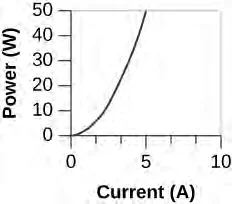
Power in a resistor: Power dissipated in a resistor grows with the square of the current.
Power as the rate of energy transfer
◀ Previous2 / 2
Power from current and potential difference
Power from current and potential difference
The rate at which energy is transferred by a circuit element depends on the current in the element and the electric potential difference across it. The power is
P = IΔV
where I is the current in amperes (A) and ΔV is the potential difference across the element in volts (V). The current and the potential difference must belong to the same element. A battery’s terminal voltage is not the potential difference across a resistor elsewhere in the circuit.
For an ohmic resistor, Ohm’s law V = IR can be substituted into this expression to give two further forms:
P = I2R and P = (ΔV)2/R
Here R is the resistance in ohms (Ω). The first form is useful when the current is known
the second is useful when the potential difference is known. Both forms are derived from P = IΔV and apply only to elements that obey Ohm’s law.
Choosing the right form of the power equation
Choosing the right form of the power equation
Every form of the power equation gives the same result for a given element. The choice depends on which quantities are given. If the current and potential difference are known, use P = IΔV. If the current and resistance are known, use P = I2R. If the potential difference and resistance are known, use P = (ΔV)2/R.
Because the power depends on the square of the current or the square of the potential difference, small changes in either quantity can produce large changes in power. Doubling the current through a fixed resistor multiplies the power by four, and doubling the potential difference across a fixed resistor also multiplies the power by four.
Brightness of bulbs in a circuit
1
The brightness of a bulb increases with the power it dissipates
so the power can be used to predict qualitatively which of two bulbs will be brighter. Power is not the same as the brightness of the light outputbut in a simple comparison the bulb with the larger power is the brighter one.
2
In a series connection the same current flows through every element. Because P = I2R, the element with the larger resistance dissipates more power and is brighter. In a parallel connection the same potential difference is applied across every branch. Because P = (ΔV)2/R, the element with the smaller resistance dissipates more power and is brighter.
Energy transferred in a circuit
1
The total energy transferred by an element over a time interval is the product of its power and the time:
2
E = Pt
3
where E is the energy in joules (J) when P is in watts and t is in seconds. Electrical energy bills are often given in kilowatt-hours (kWh)
where 1 kWh = 3.6 × 10⁶ J. An element that dissipates 1000 W for one hour transfers 1 kWh of energy.
1Example 1: Power and energy of a bulb · Example 2: Power of 2Worked examples3Worked examples4Example 3: Two bulbs in series and in parallel
Key terms
| Term | Meaning |
|---|---|
| Electric power (P) | The rate at which energy is transferred, converted or dissipated by a circuit element, measured in watts (W). |
| Watt (W) | The SI unit of power, equal to one joule per second. |
| Energy transferred (E) | The energy moved into, out of or within a circuit element, given by E = Pt and measured in joules (J). |
| Potential difference (ΔV) | The change in electric potential between two points, measured across a circuit element in volts (V). |
| Dissipated power | Power transferred from electrical energy into thermal energy or other forms in a circuit element, such as a resistor. |
| Brightness of a bulb | A qualitative measure of light output, which increases with the power dissipated by the bulb. |
| Kilowatt-hour (kWh) | A unit of energy equal to 1000 W acting for one hour, or 3.6 × 10⁶ J. |
| Series connection | An arrangement in which the same current flows through every element. |
| Parallel connection | An arrangement in which every element has the same potential difference across it. |
1Avoid these mistakes2Avoid these mistakes3Avoid these mistakes