Curriculum
AP PHYSICS 2
9. Thermodynamics
0/13
10. Electric Force, Field, and Potential
0/15
11. Electric Circuits
0/17
12. Magnetism and Electromagnetism
0/9
13. Geometric Optics
0/9
14. Waves, Sound, and Physical Optics
0/19
15. Modern Physics
0/17
-
15. Modern Physics
 Preview
-
15.1 Quantum Theory and Wave-Particle Duality
Preview
-
15.1 Quantum Theory and Wave-Particle Duality - Check yourself
 Preview
-
15.2 The Bohr Model of Atomic Structure
Preview
-
15.2 The Bohr Model of Atomic Structure - Check yourself
Preview
-
15.3 Emission and Absorption Spectra
Preview
-
15.3 Emission and Absorption Spectra - Check yourself
Preview
-
15.4 Blackbody Radiation
Preview
-
15.4 Blackbody Radiation - Check yourself
Preview
-
15.5 The Photoelectric Effect
Preview
-
15.5 The Photoelectric Effect - Check yourself
Preview
-
15.6 Compton Scattering
Preview
-
15.6 Compton Scattering - Check yourself
Preview
-
15.7 Fission, Fusion, and Nuclear Decay
Preview
-
15.7 Fission, Fusion, and Nuclear Decay - Check yourself
Preview
-
15.8 Types of Radioactive Decay
Preview
-
15.8 Types of Radioactive Decay - Check yourself
Preview
Text lesson
15.3 Emission and Absorption Spectra
15.3 Emission and Absorption Spectra — AP PHYSICS 2: ALGEBRA-BASED notes: You will be able to explain how an atom absorbs or emits a photon whose energy equals the difference between two atomic energy states, use λ = hc/ΔE to find wavelengths, read emission and absorption spectra, and draw and interpret energy level diagrams for single-electron atoms.
1
For this purpose the atom is modelled as a system consisting of a nucleus and an electron.
2
The atom can only have certain energy states, and a change in the energy state of the atom corresponds to a change in the interaction energy between the electron and the nucleus.
3
Energy can only be absorbed or emitted by an atom if the energy of the photon corresponds exactly to the difference between two atomic energy states.
4
For a transition between a higher energy state Ehigh and a lower energy state Elow, the photon has energy:
Here h = 6.63 × 10⁻³⁴ J·s, f is the frequency of the photon in hertz (Hz), and the energies are in joules (J).
Because c = fλ, the wavelength of the photon is:
1
Here λ is the wavelength in metres (m), c = 3.00 × 10⁸ m/s, and ΔE = Ehigh − Elow is the energy difference in joules.
2
Each transition between two states emits or absorbs a photon of a single frequency and therefore a single wavelength.
An atom in a given energy state may absorb a photon of exactly the right energy and move to a higher energy state.
If the photon has an energy that does not match any difference between two allowed states, it is not absorbed.
An atom in an excited state, which has more energy than its ground state, may emit a photon of the appropriate energy and spontaneously move to a lower energy state.
Each emission is a single transition to a lower state, and the emitted photon carries away the energy difference between the two states.
The transition need not be to the next level down, as the n = 3 to n = 1 transition in the quiz shows.
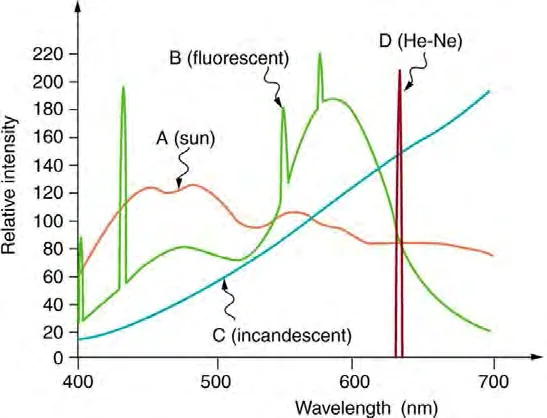
Because only particular photon energies can be absorbed or emitted, a gas of atoms produces light at only certain wavelengths.
This is why spectra consist of separate lines rather than a continuous band of colours.
1
An emission spectrum is produced when the light from an excited gas is passed through a spectroscope.
2
It consists of bright lines on a dark background, and each line has the wavelength of one transition.
3
An absorption spectrum is produced when white light passes through a cool gas and then a spectroscope.
4
It consists of dark lines on a continuous coloured background, and the dark lines are at the same wavelengths as the bright lines of the emission spectrum of the same gas.
5
Atoms of each element have a unique set of allowed energy levels, and so a unique set of absorption and emission frequencies.
6
The unique set of frequencies is the element’s spectrum, and it acts as a fingerprint.
7
An emission spectrum can be used to identify the elements in a source of light, such as a star.
8
An absorption spectrum can be used to identify the elements in a substance by observing which light the substance has absorbed.
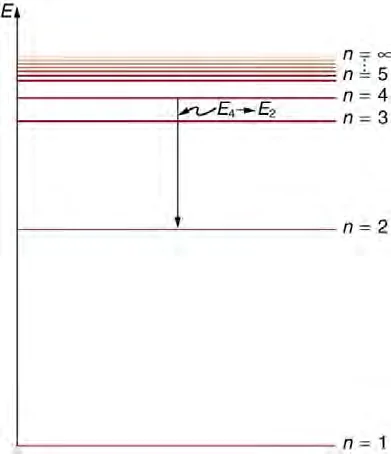
1
Upward arrows show absorption and downward arrows show emission.
2
The lowest line is the ground state, which is the state with the lowest energy.
3
In AP Physics 2, energy level diagrams are considered only for atoms with a single electron, such as hydrogen.
4
For hydrogen, the energy of state n is En = −13.6 eV/n2, so the energy levels become closer together as n increases.
5
The binding energy of an atom is the energy required to remove an electron from it, which leaves the atom ionized.
6
An atom in the ground state requires the greatest amount of energy to remove an electron, because the ground state is the most tightly bound state.
7
For hydrogen, the binding energy of the ground state is 13.6 eV.
Example 1
Wavelength of the photon emitted by hydrogen
1
E3 = −13.6/32 = −1.51 eV and E2 = −13.6/22 = −3.40 eV.
2
The energy of the photon is ΔE = E3 − E2 = −1.51 eV − (−3.40 eV) = 1.89 eV.
3
In joules, ΔE = (1.89 eV)(1.60 × 10⁻¹⁹ J/eV) = 3.02 × 10⁻¹⁹ J.
4
Then λ = hc/ΔE = (6.63 × 10⁻³⁴ J·s)(3.00 × 10⁸ m/s)/(3.02 × 10−19 J) = 6.58 × 10⁻⁷ m.
Answer
The photon energy is 1.89 eV (3.02 × 10⁻¹⁹ J) and its wavelength is 6.58 × 10⁻⁷ m, or 658 nm. This is red light, a line in the emission spectrum of hydrogen.
Example 2
Photon needed to ionize hydrogen from the ground state
1
The binding energy of the ground state is 13.6 eV, which is 13.6 × 1.60 × 10−19 J = 2.18 × 10⁻¹⁸ J.
2
Then λ = hc/E = (6.63 × 10⁻³⁴ J·s)(3.00 × 10⁸ m/s)/(2.18 × 10−18 J) = 9.14 × 10⁻⁸ m.
Answer
9.14 × 10⁻⁸ m, which is in the ultraviolet region of the spectrum. A photon of longer wavelength has less energy and cannot ionize the atom.
Example 3
Which photon can be absorbed?
1
The energy needed to move from n = 1 to n = 2 is E2 − E1 = (−3.40 eV) − (−13.6 eV) = 10.2 eV.
2
The 10.2 eV photon matches this difference exactly, so it is absorbed.
3
The 11.0 eV photon does not match any difference between allowed states, so it is not absorbed.
Answer
The 10.2 eV photon is absorbed, and the atom is left in the n = 2 state.
Thinking that an atom can absorb any photon whose energy is larger than a transition energy
The photon energy must match the energy difference exactly.
Subtracting the energy levels in the wrong order
For emission, ΔE = Ehigh − Elow is positive, so use the larger energy first.
Stating that the ground state has the highest energy
The ground state has the lowest energy, so it requires the greatest energy to ionize.
Avoid
Forgetting to convert electron volts to joules before using λ = hc/ΔE, which requires SI units
Avoid
Confusing the bright lines of an emission spectrum with the dark lines of an absorption spectrum, or assuming that they occur at different wavelengths for the same gas