Curriculum
AP PHYSICS 2
9. Thermodynamics
0/13
10. Electric Force, Field, and Potential
0/15
11. Electric Circuits
0/17
-
11. Electric Circuits
 Preview
-
11.1 Electric Current
Preview
-
11.1 Electric Current - Check yourself
 Preview
-
11.2 Simple Circuits
Preview
-
11.2 Simple Circuits - Check yourself
Preview
-
11.3 Resistance, Resistivity, and Ohm’s Law
Preview
-
11.3 Resistance, Resistivity, and Ohm’s Law - Check yourself
Preview
-
11.4 Electric Power
Preview
-
11.4 Electric Power - Check yourself
Preview
-
11.5 Compound Direct Current (DC) Circuits
Preview
-
11.5 Compound Direct Current (DC) Circuits - Check yourself
Preview
-
11.6 Kirchhoff’s Loop Rule
Preview
-
11.6 Kirchhoff’s Loop Rule - Check yourself
Preview
-
11.7 Kirchhoff’s Junction Rule
Preview
-
11.7 Kirchhoff’s Junction Rule - Check yourself
Preview
-
11.8 Resistor-Capacitor (RC) Circuits
Preview
-
11.8 Resistor-Capacitor (RC) Circuits - Check yourself
Preview
12. Magnetism and Electromagnetism
0/9
13. Geometric Optics
0/9
14. Waves, Sound, and Physical Optics
0/19
15. Modern Physics
0/17
Text lesson
11.7 Kirchhoff’s Junction Rule
11.7 Kirchhoff’s Junction Rule — AP PHYSICS 2: ALGEBRA-BASED notes: You will be able to apply Kirchhoff’s junction rule to a junction in a circuit, relating the currents that enter and leave the junction, and use it to find an unknown current.
The paths that leave a junction are called branches.
A branch is a section of the circuit that carries the same current from one junction to the next, so the current is constant along a single branch that contains no junction.
Current is the rate at which charge passes a cross-section of a wire, given by I = ΔQ/Δt, where I is the current in amperes (A), ΔQ is the charge that passes in coulombs (C), and Δt is the time in seconds (s).
Junction
Although current has a direction, it is not a vector.
The direction of conventional current is the direction in which positive charge would move, even though the charge carriers in most common circuits are electrons moving the other way.
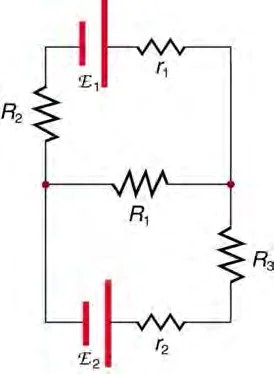
Charge cannot be created or destroyed at a junction, so the charge that arrives at a junction in a given time must leave it in the same time.
Charge is not stored at the junction itself.
Kirchhoff’s junction rule states that the total current entering a junction equals the total current leaving that junction: ΣIin = ΣIout.
Here each I is a current in amperes (A) through a branch connected to the junction, and Σ means the sum over all such branches.
An equivalent form is that the algebraic sum of the currents at a junction is zero when currents entering are taken as positive and currents leaving as negative.
The rule applies to currents, not to potential differences.
It says nothing about how the current divides between branches; that division depends on the resistance of each branch, as later examples show.
1
To use the rule, first mark every branch that meets at the junction and give each current a direction.
2
If a direction is chosen wrongly, the calculated current will come out negative, which means the true current flows in the opposite direction.
3
Then write the sum of the currents in and the sum of the currents out, and solve for the unknown.
4
The junction rule is also applied to parallel branches.
5
When two or more resistors are connected in parallel between two junctions, the potential difference across each branch is the same, while the currents in the branches add to the total current entering the group.
6
For a battery of emf ε in volts (V) connected to resistors in parallel, the current from the battery is the sum of the branch currents, and each branch current equals the potential difference across it divided by its resistance.
7
The junction rule is a statement about charge, so the same rule holds whatever the elements in the branches are, including batteries, bulbs, capacitors and resistors.
8
It is one of the two Kirchhoff rules, together with the loop rule, which is a statement about energy.
Question
A junction has a current of 3.0 A entering it. Two branches carry 1.2 A and 0.9 A away from the junction. Find the current in the third branch, which also carries current away from the junction.
1
ΣIin = 3.0 A. ΣIout = 1.2 A + 0.9 A + I3.
2
Setting the two sums equal gives 3.0 A = 2.1 A + I3, so I3 = 0.9 A.
Answer
0.9 A leaves the junction in the third branch.
Question
Currents of 4.0 A and 2.5 A enter a junction. Three branches leave it, carrying 1.5 A and 2.0 A, and a third current Ix. Find Ix.
1
ΣIin = 4.0 A + 2.5 A = 6.5 A. ΣIout = 1.5 A + 2.0 A + Ix = 3.5 A + Ix.
2
So 6.5 A = 3.5 A + Ix, which gives Ix = 3.0 A.
Answer
3.0 A leaves the junction in the third branch. The result is positive, so the chosen direction was correct.
Question
A battery of emf 6.0 V with negligible internal resistance is connected across three resistors in parallel, of 6.0 Ω, 3.0 Ω and 2.0 Ω. Find the current in each branch and check the total with the junction rule.
1
Each resistor has 6.0 V across it.
2
Branch currents are I = ΔV/R 6.0 V/6.0 Ω = 1.0 A, 6.0 V/3.0 Ω = 2.0 A, and 6.0 V/2.0 Ω = 3.0 A.
3
The total current from the battery is 1.0 A + 2.0 A + 3.0 A = 6.0 A.
4
The equivalent resistance is 6.0 V/6.0 A = 1.0 Ω, which agrees with 1/Req = 1/6.0 + 1/3.0 + 1/2.0 = 1.0 Ω−1.
Answer
The branch currents are 1.0 A, 2.0 A and 3.0 A. Their sum, 6.0 A, equals the current entering the junction from the battery, as the junction rule requires. The smallest resistor carries the largest current.
Applying the junction rule to potential differences.
The rule applies to currents, which must be summed on each side of the junction.
Leaving out a branch when writing the sum of currents
Every wire meeting the junction must appear on one side or the other.
Putting a current on the wrong side.
A current entering the junction is added to the left side and a current leaving it is added to the right side of the equation.
Treating a negative answer as an error.
A negative current means the true direction of that current is opposite to the direction you assumed.
Assuming the current in each parallel branch is the same.
Branches with different resistances carry different currents, and their sum equals the total current.
Applying the junction rule to a series circuit with no junction.
A single path has the same current throughout, so there is no junction to analyse.