Curriculum
AP PHYSICS 2
9. Thermodynamics
0/13
10. Electric Force, Field, and Potential
0/15
11. Electric Circuits
0/17
12. Magnetism and Electromagnetism
0/9
-
12. Magnetism and Electromagnetism
 Preview
-
12.1 Magnetic Fields
Preview
-
12.1 Magnetic Fields - Check yourself
 Preview
-
12.2 Magnetism and Moving Charges
Preview
-
12.2 Magnetism and Moving Charges - Check yourself
Preview
-
12.3 Magnetism and Current-Carrying Wires
Preview
-
12.3 Magnetism and Current-Carrying Wires - Check yourself
Preview
-
12.4 Electromagnetic Induction and Faraday’s Law
Preview
-
12.4 Electromagnetic Induction and Faraday’s Law - Check yourself
Preview
13. Geometric Optics
0/9
14. Waves, Sound, and Physical Optics
0/19
15. Modern Physics
0/17
Text lesson
12.1 Magnetic Fields
12.1 Magnetic Fields — AP PHYSICS 2: ALGEBRA-BASED notes: You will be able to describe the properties of a magnetic field as a vector field, explain the magnetic behaviour of materials in terms of their magnetic dipoles, and describe magnetic permeability and its value in vacuum.
The poles behave like electric charges in one respect like poles repel each other and unlike poles attract each other.
A magnetic dipole is a system with a north pole and a south pole, and every magnet is a dipole.
A magnetic monopole, a single isolated north or south pole, has never been found.
If a bar magnet is broken in half, each half is a new magnet with its own north pole and south pole.
This continues down to the atomic level, where the smallest magnetic units are dipoles.
Magnetic dipoles come from the circular or rotational motion of electric charges.
In magnetic materials, the dominant source is the motion of electrons, both their orbital motion around nuclei and their intrinsic spin.
A magnetic dipole therefore has a structure that comes from moving charge, not from a separate kind of charge.
At every point in space it has a magnitude and a direction, and it can be used to find the magnetic force on moving electric charges, on electric currents and on magnetic materials.
The direction of the field at a point is the direction in which the north-seeking end of a small compass needle points when placed at that point.
A magnetic field is represented by magnetic field lines, which are drawn tangent to the field direction.
Magnetic field lines always form closed loops.
Outside a bar magnet, the field lines leave the north pole, curve around the outside of the magnet and return to the south pole.
Field B
Inside the magnet the lines run from the south pole back to the north pole, so the lines form complete loops.
The SI unit of magnetic field is the tesla (T).
One tesla equals one newton per ampere metre, 1 T = 1 N/(A·m).
The magnetic field at Earth’s surface is about 5 × 10⁻⁵ T, which is small compared with the fields of common laboratory magnets.
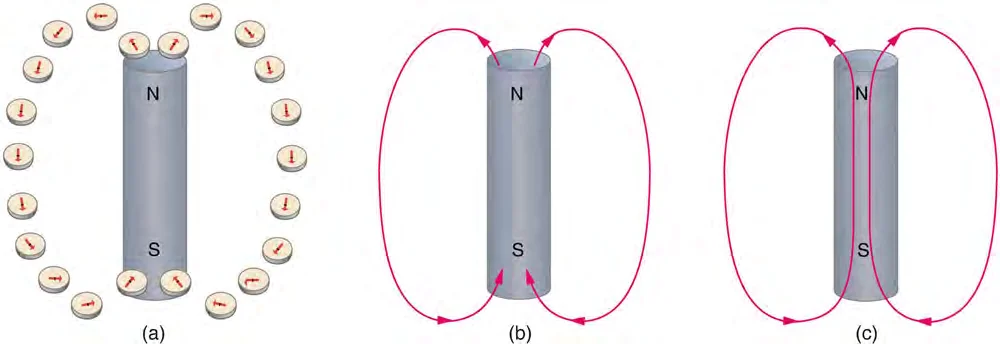
A point close to a magnet has a stronger field than a point far from it, and the field lines are closest together near the poles, where the field is strongest.
A magnetic dipole placed in an external magnetic field tends to align with that field.
A compass needle is a small magnetic dipole, and it rotates until it lies along the local field direction.
For this reason a compass can be used to map a field.
Earth’s magnetic field may be approximated as the field of a single magnetic dipole located near the centre of the planet.
The magnetic axis of this dipole is tilted relative to the rotation axis.
Because the north-seeking end of a compass is attracted to a magnetic south pole, the compass needle points toward a magnetic south pole that lies near Earth’s geographic North Pole.
1
The magnetic behaviour of a material depends on how its magnetic dipoles are arranged. Permanent magnetism and induced magnetism are both system properties that result from the alignment of magnetic dipoles within a system. In a permanent magnet the alignment remains after the external field is removed, while in an induced magnetisation the alignment exists only while the external field is present.
2
Ferromagnetic materials, such as iron, nickel and cobalt, can be permanently magnetised by an external field. Inside these materials the atomic dipoles are grouped into magnetic domains. When an external field causes the domains to line up, and they stay lined up, the material becomes a permanent magnet. The strength of a ferromagnet is therefore much greater than the strength of the materials in the other two groups.
3
Paramagnetic materials, such as aluminium, titanium and magnesium, interact weakly with an external magnetic field. Their dipoles turn to align with the field while it is present, but they do not stay aligned once the external field is removed.
4
All materials are diamagnetic. The electronic structure of a diamagnetic material produces a weak alignment of its dipole moments in the direction opposite to the external field. In most materials this effect is much weaker than the effect of the ferromagnetic or paramagnetic behaviour, so it is only noticed when no other effect is present.
A material with a large permeability becomes strongly magnetised in a given field, and a material with a small permeability becomes only weakly magnetised.
Free space has a constant value of permeability, called the vacuum permeability, written as μ0.
Its value is μ0 = 4π × 10−7 T·m/A.
This constant appears in the equations for magnetic fields produced by currents and by moving charges.
The permeability of a material, μ, has a value different from that of free space and depends on the composition and arrangement of the material.
Permeability
It is not a constant for a given material.
It varies with temperature, with the orientation of the material and with the strength of the external field.
The relative permeability, μr = μ/μ0, is a dimensionless number that compares a material with free space.
Ferromagnetic materials have relative permeabilities far greater than 1, while the relative permeabilities of paramagnetic and diamagnetic materials are close to 1.
Question
A material has a permeability of μ = 2.5 × 10⁻⁶ T·m/A. Find its relative permeability. Take μ0 = 4π × 10−7 T·m/A.
1
Μr = μ/μ0 = (2.5 × 10⁻⁶ T·m/A)/(1.257 × 10−6 T·m/A) = 1.99.
Answer
μr ≈ 2.0. The relative permeability is dimensionless. A value of 2.0 means the material is magnetised more than free space, but far less than a ferromagnetic material, whose relative permeability is much larger.
Question
A bar magnet is cut into four equal pieces. How many magnetic poles does the set of pieces have in total, and why?
1
Each piece of a magnet is a magnetic dipole, because no monopole can be isolated.
2
Each of the four pieces therefore has one north pole and one south pole.
3
The total number of poles is 4 × 2 = 8.
Answer
There are 8 poles in total, four north poles and four south poles. Cutting a magnet never separates its poles.
Question
A compass is placed on the north side of a bar magnet, with the magnet’s north pole nearest to the compass. Describe the direction the north-seeking end of the compass needle points.
1
The compass needle aligns with the local magnetic field, tangent to the field line through its position.
2
The field of the bar magnet near its north pole points away from that pole.
3
The north-seeking end of the needle therefore points away from the magnet’s north pole, along the field line, because like poles repel.
Answer
The north-seeking end of the needle points away from the magnet’s north pole, along the field line through the compass position.
Drawing a single north pole or a single south pole on its own.
Every magnetic source is a dipole, and breaking a magnet always leaves each piece with two poles.
Drawing magnetic field lines that start and stop at the poles.
Field lines form closed loops, and outside a bar magnet they run from north to south.
Assuming that a compass points to geographic north because of the geographic North Pole.
The north-seeking end of a compass is attracted to a magnetic south pole near that location.
Treating permeability as one fixed value for all materials.
Only the permeability of free space, μ0, is a constant; the permeability of a material varies with temperature, orientation and the external field.
Believing that paramagnetic materials stay magnetised after the field is removed.
Only ferromagnetic materials keep a permanent magnetisation.
Thinking that diamagnetism is found only in certain materials.
All materials are diamagnetic, but the effect is usually very weak.