Curriculum
AP PHYSICS 2
9. Thermodynamics
0/13
10. Electric Force, Field, and Potential
0/15
11. Electric Circuits
0/17
12. Magnetism and Electromagnetism
0/9
-
12. Magnetism and Electromagnetism
 Preview
-
12.1 Magnetic Fields
Preview
-
12.1 Magnetic Fields - Check yourself
 Preview
-
12.2 Magnetism and Moving Charges
Preview
-
12.2 Magnetism and Moving Charges - Check yourself
Preview
-
12.3 Magnetism and Current-Carrying Wires
Preview
-
12.3 Magnetism and Current-Carrying Wires - Check yourself
Preview
-
12.4 Electromagnetic Induction and Faraday’s Law
Preview
-
12.4 Electromagnetic Induction and Faraday’s Law - Check yourself
Preview
13. Geometric Optics
0/9
14. Waves, Sound, and Physical Optics
0/19
15. Modern Physics
0/17
Text lesson
12.3 Magnetism and Current-Carrying Wires
12.3 Magnetism and Current-Carrying Wires — AP PHYSICS 2: ALGEBRA-BASED notes: You will be able to describe and calculate the magnetic field produced by a long straight wire and by a current loop, add the fields of several wires as vectors, and calculate and give the direction of the magnetic force on a current-carrying wire.
1
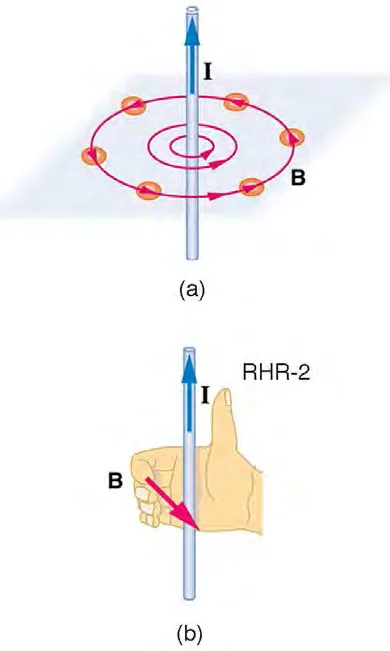
For a long, straight wire, the field lines are concentric circles centred on the wire.
2
The field has no component toward or away from the wire, and no component parallel to the wire.
3
A small compass placed near the wire lines up tangent to one of these circles.
4
At a point in space, the magnitude of the magnetic field due to a long, straight, current-carrying wire is proportional to the current I in the wire and inversely proportional to the perpendicular distance r from the central axis of the wire to the point.
5
The equation is B = μ0I/(2πr), where B is in tesla (T), I is in amperes (A), r is in metres (m) and μ0 = 4π × 10−7 T·m/A.
6
Doubling the current doubles the field, and doubling the distance halves it.
7
The direction of the field is found with the right-hand rule grasp the wire with the right hand so that the thumb points in the direction of the current. The fingers then curl in the direction of the magnetic field at each point around the wire.
Each small part of a current-carrying loop produces a circular field around itself.
Near the centre of the loop these contributions add together to give one concentrated field that points along the axis of the loop, perpendicular to the plane of the loop.
The direction is found with the right-hand rule if the fingers curl in the direction of the current around the loop, the thumb points along the axis in the direction of the field.
For a loop of radius r with N turns, the field at the centre is B = μ0NI/(2r).
The field is increased by the number of turns, by a smaller radius, and by a core of higher permeability.
A loop stretched out into a long spiral is a solenoid.
Inside a long solenoid the field is nearly uniform and is given by B = μ0NI/L, where N is the number of turns and L is the length of the solenoid in metres.
The direction of the field is along the axis, given by the right-hand rule with the fingers curled in the direction of the current.
1
The magnetic field at a location near two or more current-carrying wires is the vector sum of the fields produced by each wire at that location.
2
Each field is found separately, with its own magnitude and direction, and then the vectors are added by components or by drawing them tip to tail.
3
The fields can reinforce each other, partly cancel each other, or cancel completely at a particular point.
4
A point where the two fields cancel is one where the two contributions have equal magnitudes and opposite directions.
5
Between two wires carrying currents in the same direction, the fields from the two wires point in opposite directions, so there is a point between them where the net field is zero if the currents are equal.
1
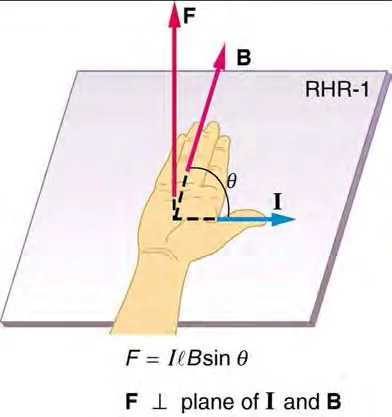
The magnitude of the force is proportional to the current, to the length of the part of the wire inside the magnetic field, and to the magnitude of the field.
2
It also depends on the angle θ between the direction of the current and the direction of the field, so F = ILB sinθ.
3
Here F is in newtons (N), I is in amperes (A), L is in metres (m) and B is in tesla (T).
4
The force is largest when the wire is perpendicular to the field, and zero when the wire is parallel to it.
5
The direction of the force is given by the right-hand rule point the fingers along the direction of the current, curl them toward the magnetic field, and the thumb points in the direction of the force on the wire.
6
Because one wire produces a magnetic field, a current in one wire can exert a force on a current in another wire.
7
Two long, parallel wires that carry currents in the same direction attract each other.
8
Two wires carrying currents in opposite directions repel each other.
9
For two parallel wires separated by a distance r, the force per unit length is F/L = μ0I1I2/(2πr).
10
This follows from the field of one wire acting on the current in the other.
Example 1
Field near a long straight wire
1
B = μ0I/(2πr) = (4π × 10−7 T·m/A)(5.0 A)/[2π(0.10 m)] = (2 × 10⁻⁷ T·m/A)(5.0 A)/(0.10 m) = 1.0 × 10⁻⁵ T.
Answer
1.0 × 10⁻⁵ T. The field is tangent to a circle of radius 0.10 m around the wire.
Example 2
Field at the centre of a loop
1
B = μ0NI/(2r) = (4π × 10−7 T·m/A)(20)(2.0 A)/[2(0.10 m)] = (1.257 × 10⁻⁶)(40)/(0.20) T = 2.5 × 10⁻⁴ T.
Answer
2.5 × 10⁻⁴ T, directed along the axis of the coil. The direction is given by the right-hand rule applied to the current.
Example 3
Force on a wire in a magnetic field
1
The wire is perpendicular to the field, so sinθ = 1.
2
F = ILB sinθ = (4.0 A)(0.50 m)(0.30 T)(1) = 0.60 N.
Answer
0.60 N. The force is perpendicular to both the wire and the field, and it is found by the right-hand rule with the fingers along the current and curled toward the field.
Example 4
Force between two parallel wires
1
F/L = μ0I1I2/(2πr) = (2 × 10⁻⁷ T·m/A)(10 A)(10 A)/(0.050 m) = 4.0 × 10⁻⁴ N/m.
Answer
4.0 × 10⁻⁴ N for each metre of wire, and the wires attract because the currents are in the same direction.
Using B = μ0I/(2πr) for a point on the axis of a loop or inside a solenoid
Those points need the loop or solenoid equations.
Using the distance from the centre of the wire without converting centimetres to metres
The distance r must be in metres.
Drawing the field of a straight wire as radial lines or as lines parallel to the wire
The field lines are concentric circles around the wire.
Forgetting that the field at a point is a vector sum
Two fields of equal magnitude do not add to twice the value when they point in different directions.
Stating that parallel wires with opposite currents attract
Opposite currents repel, and currents in the same direction attract.
Applying F = ILB with the angle measured between the field and the wire in the wrong way
The formula uses sinθ, so the force is zero when the wire is parallel to the field.