Curriculum
AP PHYSICS 2
9. Thermodynamics
0/13
10. Electric Force, Field, and Potential
0/15
11. Electric Circuits
0/17
12. Magnetism and Electromagnetism
0/9
-
12. Magnetism and Electromagnetism
 Preview
-
12.1 Magnetic Fields
Preview
-
12.1 Magnetic Fields - Check yourself
 Preview
-
12.2 Magnetism and Moving Charges
Preview
-
12.2 Magnetism and Moving Charges - Check yourself
Preview
-
12.3 Magnetism and Current-Carrying Wires
Preview
-
12.3 Magnetism and Current-Carrying Wires - Check yourself
Preview
-
12.4 Electromagnetic Induction and Faraday’s Law
Preview
-
12.4 Electromagnetic Induction and Faraday’s Law - Check yourself
Preview
13. Geometric Optics
0/9
14. Waves, Sound, and Physical Optics
0/19
15. Modern Physics
0/17
Text lesson
12. Magnetism and Electromagnetism
Unit 12 Magnetism and Electromagnetism — AP PHYSICS 2: ALGEBRA-BASED notes: You will be able to connect the four topics of Unit 12 by explaining how magnetic dipoles and moving charges produce magnetic fields, how those fields exert forces on moving charges and currents, and how a changing magnetic flux induces an emf.
1Magnetic fields and their sources2Magnetic fields and their sources3Magnetic fields and their sources4Magnetic fields and their sources
Magnetic fields and their sources
Magnetic fields and their sources
A magnetic field is a vector field, B, that has a direction at every point and is measured in tesla (topic 12.1).
1
Its field lines form closed loops, running from north to south outside a magnet.
2
Magnetic fields come from magnetic dipoles
which result from the circular motion of electric charges, and no magnetic monopole has ever been found.
3
1 / 4Next ▶
Magnetic fields and their sources
1
Magnetic materials respond differently to an external field: ferromagnetic materials can be permanently magnetised, paramagnetic materials align weakly while the field is present,
2
and all materials show weak diamagnetism.
3
4
4
Magnetic permeability describes how strongly a material magnetises, and the permeability of free space is
5
μ
6
0
◀ Previous2 / 4Next ▶
Magnetic fields and their sources
Magnetic fields and their sources
= 4
π
× 10
-7
T·m/A.
A single moving charge produces a magnetic field whose magnitude depends on its speed and on the distance from the charge, and whose direction is perpendicular to both the velocity and the position vector (topic 12.2).
◀ Previous3 / 4Next ▶
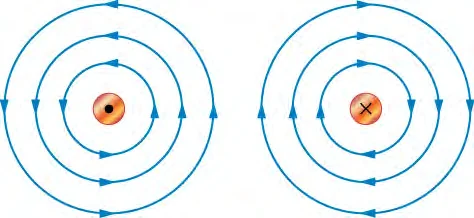
Magnetic fields of currents: Circular magnetic field lines around two straight wires, one with current out of the page and one into it.
Magnetic fields and their sources
 ⤢ Enlarge
Magnetic fields and their sources
A current in a long straight wire produces concentric circular field lines,
and a current loop produces a field along its axis that is strongest at its centre (topic 12.3).
In every case the field is found with a right-hand rule.
◀ Previous4 / 4
1Forces on moving charges and current-carrying wires2Forces on moving charges and current-carrying wires3Forces on moving charges and current-carrying wires4Forces on moving charges and current-carrying wires
Forces on moving charges and current-carrying wires
1
A magnetic field exerts a force on a moving charge and on a current-carrying wire.
2
1
3
The force on a charge has magnitude |
4
q
5
|
6
vB
1 / 4Next ▶
Forces on moving charges and current-carrying wires
1
sin
2
θ
3
,
4
and it is always perpendicular to the velocity,
5
so it changes the direction of motion but does no work (topic 12.2).
6
2
◀ Previous2 / 4Next ▶
Forces on moving charges and current-carrying wires
Forces on moving charges and current-carrying wires
A charge moving perpendicular to a uniform field moves in a circle.
3
When an electric field and a magnetic field are both present, the two forces act independently and add as vectors.
4
The Hall effect follows from the same force: the charges are pushed to one side of a conductor and produce a potential difference across it.
The force on a straight wire of length L carrying a current I is ILB sinθ (topic 12.3). Because each current-carrying wire produces a field, two wires exert forces on each other: parallel currents attract and antiparallel currents repel. The field at a point near several wires is the vector sum of their individual fields.
◀ Previous3 / 4Next ▶
Magnetic force on a current-carrying conductor: A straight wire carrying current sits across the gap of a U-shaped magnet, and the magnetic field pushes the wire upward.
Forces on moving charges and current-carrying wires

◀ Previous4 / 4
1Electromagnetic induction2What the symbols mean:3What the symbols mean:4What the symbols mean:
Electromagnetic induction
Electromagnetic induction
Magnetic flux, Φ = BA cosθ, measures the field passing through an area, and it is measured in webers (topic 12.4).
What the symbols mean:
Φ = magnetic flux (Wb) · B = magnetic flux density (T) · A = area at right angles to the field (m
2
)
An emf is induced whenever the flux through a circuit changes.
1 / 4Next ▶
What the symbols mean:
What the symbols mean:
Faraday’s law gives the size of the emf,
ε
= −
N
Δ
Φ
◀ Previous2 / 4Next ▶
What the symbols mean:
1
/Δ
2
t
3
,
4
and it depends on the rate of change of flux rather than the flux itself.What the symbols mean: ε = induced e.m.f. (V) · N = number of turns · ΔΦ = change of flux (Wb) · Δt = time taken (s)
the minus sign is Lenz’s law
5
Lenz’s law gives the direction: the induced current creates a field that opposes the change in flux
which is a consequence of conservation of energy.
6
The rod on rails is the standard example of motional emf. Because the rod changes the area of the circuit as it moves, it produces an emf ε = BLv. The induced current then creates a force that opposes the motion
so the rod must be pushed to keep its speed.
◀ Previous3 / 4Next ▶
Applications of electromagnetic induction: A device on a baby’s head induces a current in a receiver under the skin, showing how induction carries signals through tissue.
What the symbols mean:

◀ Previous4 / 4
1How the topics connect2How the topics connect3How the topics connect
Key equations of Unit 12
| Quantity | Equation | Topic |
|---|---|---|
| Vacuum permeability | μ0 = 4π × 10-7 T·m/A | 12.1 |
| Relative permeability | μr = μ/μ0 | 12.1 |
| Magnetic field of a moving charge | B = (μ0/4π)|q|v sinθ/r2 | 12.2 |
| Magnetic force on a moving charge | F = |q|vB sinθ | 12.2 |
| Radius of circular motion | r = mv/(|q|B) | 12.2 |
| Velocity selector | v = E/B | 12.2 |
| Hall voltage | VH = vBw | 12.2 |
| Field of a long straight wire | B = μ0I/(2πr) | 12.3 |
| Field at the centre of a loop | B = μ0NI/(2r) | 12.3 |
| Field inside a solenoid | B = μ0NI/L | 12.3 |
| Magnetic force on a current-carrying wire | F = ILB sinθ | 12.3 |
| Force per unit length between parallel wires | F/L = μ0I1I2/(2πr) | 12.3 |
| Magnetic flux | Φ = BA cosθ | 12.4 |
| Faraday’s law | ε = −NΔΦ/Δt | 12.4 |
| Motional emf of a rod on rails | ε = BLv | 12.4 |
| Induced current and force on the rod | I = ε/R; F = ILB = B2L2v/R | 12.4 |
1Example 1: Selecting a speed, then finding a radius2Worked examples3Worked examples4Worked examples · Example 2: Induced current and its directi
Key terms
| Term | Meaning |
|---|---|
| Magnetic dipole | A system with a north pole and a south pole, produced by the circular motion of electric charges. |
| Magnetic field (B) | A vector field that exerts forces on moving charges, currents and magnetic materials, measured in tesla (T). |
| Magnetic permeability (μ) | A measure of the magnetisation a material acquires in response to an external magnetic field. |
| Magnetic force | The force exerted by a magnetic field on a moving charge or a current-carrying wire, perpendicular to the velocity or the wire. |
| Right-hand rule | A rule for finding the direction of magnetic fields, forces and induced currents from the directions of the other vectors. |
| Hall effect | The potential difference produced across a conductor, perpendicular to the current, by a magnetic field. |
| Magnetic flux (Φ) | The amount of magnetic field passing through an area, measured in webers (Wb). |
| Induced emf (ε) | The potential difference induced in a circuit by a change in magnetic flux. |
| Faraday’s law | The induced emf equals the negative of the number of turns times the rate of change of magnetic flux. |
| Lenz’s law | An induced current flows in the direction that opposes the change in flux that produced it. |
1Avoid these mistakes2Avoid these mistakes3Avoid these mistakes