Curriculum
AP PHYSICS 2
9. Thermodynamics
0/13
10. Electric Force, Field, and Potential
0/15
11. Electric Circuits
0/17
12. Magnetism and Electromagnetism
0/9
-
12. Magnetism and Electromagnetism
 Preview
-
12.1 Magnetic Fields
Preview
-
12.1 Magnetic Fields - Check yourself
 Preview
-
12.2 Magnetism and Moving Charges
Preview
-
12.2 Magnetism and Moving Charges - Check yourself
Preview
-
12.3 Magnetism and Current-Carrying Wires
Preview
-
12.3 Magnetism and Current-Carrying Wires - Check yourself
Preview
-
12.4 Electromagnetic Induction and Faraday’s Law
Preview
-
12.4 Electromagnetic Induction and Faraday’s Law - Check yourself
Preview
13. Geometric Optics
0/9
14. Waves, Sound, and Physical Optics
0/19
15. Modern Physics
0/17
Text lesson
12.2 Magnetism and Moving Charges
12.2 Magnetism and Moving Charges — AP PHYSICS 2: ALGEBRA-BASED notes: You will be able to describe the magnetic field produced by a moving charge, calculate and give the direction of the magnetic force on a charge moving perpendicular to a magnetic field, and explain the Hall effect.
1
The magnetic field at a point produced by a moving charge depends on the object’s velocity and on the distance between the point and the charge.
2
For a charge q moving with speed v, the magnitude of the field at a distance r is B = (μ0/4π)|q|v sinθ/r2.
3
Here B is in tesla (T), q is in coulombs (C), v is in metres per second (m/s), r is in metres (m), θ is the angle between the velocity vector and the position vector from the charge to the point, and μ0 = 4π × 10−7 T·m/A.
4
The magnitude of the field is largest when the velocity vector and the position vector are perpendicular, which corresponds to θ = 90°, because sinθ = 1 then.
5
Along the line of motion, where θ = 0° or 180°, the field produced at that point is zero.
6
A charge that is not moving produces no magnetic field, only an electric field.
At any point, the magnetic field produced by a moving charge is perpendicular to both the velocity of the charge and the position vector from the charge to that point.
Its direction is found with the right-hand rule point the thumb of the right hand in the direction of the velocity, and the fingers curl in the direction of the magnetic field.
For a positive charge, the field circles around the line along which the charge moves.
A useful way to check a sketch is to confirm that the field vector is perpendicular to two things at once, the velocity and the line joining the charge to the point.
If a field vector were drawn along either of these lines, the sketch would be wrong.
1
A magnetic field may exert a force on a charged object that is moving in that field.
2
Magnetic forces are therefore interactions between moving charged objects: a moving charge produces a magnetic field, and that field exerts a force on a second moving charge.
3
The magnitude of the force is proportional to the magnitude of the charge, to the speed of the charge and to the magnitude of the magnetic field.
4
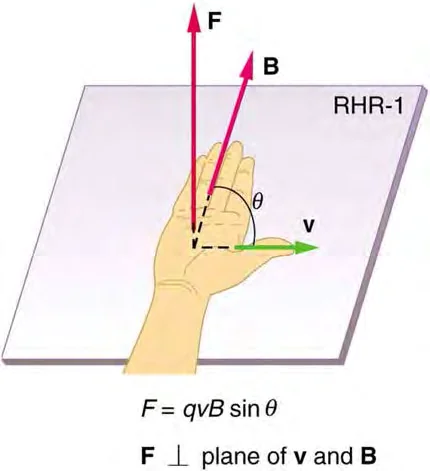
It also depends on the angle θ between the velocity and the magnetic field, so that F = |q|vB sinθ.
5
Here F is the force in newtons (N), q is the charge in coulombs (C), v is the speed in metres per second (m/s), and B is the magnetic field in tesla (T).
6
The force is zero when the charge moves parallel to the field (θ = 0° or 180°) and is largest when the charge moves perpendicular to the field (θ = 90°).
7
For this course, quantitative calculations are limited to these three angles.
8
For other angles, only a qualitative description is required the force is smaller than the maximum and increases as the angle moves away from zero.
9
The force direction is perpendicular to both the velocity and the field.
10
The right-hand rule gives it point the fingers along the magnetic field and the thumb along the velocity, and the open palm then pushes in the direction of the force on a positive charge.
11
For a negative charge the force is in the opposite direction.
12
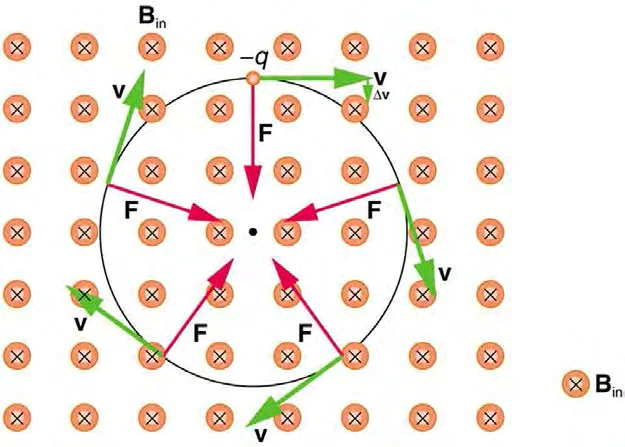
Because the force is always perpendicular to the velocity, it changes the direction of motion but not the speed, and it does no work on the charge.
1
The particle therefore moves in a circle with constant speed.
2
Setting the magnetic force equal to the centripetal force gives the radius of the circle, r = mv/(|q|B), where m is the mass of the particle in kilograms (kg).
3
In a region that contains both an electric field and a magnetic field, a moving charge experiences two independent forces.
4
The electric force is qE and the magnetic force is qv × B, and the total force is their vector sum.
5
A velocity selector uses this fact.
6
If the electric and magnetic forces are equal and opposite, the net force is zero and the charge moves in a straight line at the speed that satisfies |q|E = |q|vB, which gives v = E/B.
The Hall effect describes the potential difference created across a conductor by an external magnetic field that has a component perpendicular to the direction of the moving charges in the conductor.
Consider a flat conductor carrying a current along its length, with a magnetic field applied perpendicular to the flat face.
The magnetic force pushes the moving charges toward one side of the conductor, so charge builds up on that side and the other side becomes oppositely charged.
The charge separation creates an electric field across the width w of the conductor, and this field grows until its force on the moving charges balances the magnetic force.
At equilibrium |q|EH = |q|vB.
The Hall potential difference is VH = EHw, so VH = vBw.
Here v is the drift speed of the charge carriers.
The sign of the Hall voltage shows the sign of the charge carriers, because positive and negative carriers pile up on opposite sides of the conductor.
Example 1
Magnetic force on a proton
1
The velocity is perpendicular to the field, so sinθ = 1.
2
The force magnitude is F = |q|vB sinθ = (1.60 × 10⁻¹⁹ C)(3.0 × 10⁶ m/s)(0.50 T)(1) = 2.4 × 10⁻¹³ N.
Answer
2.4 × 10⁻¹³ N. The force is perpendicular to both the velocity and the field, and it is directed by the right-hand rule for a positive charge.
Example 2
Velocity selector
1
For no deflection the electric and magnetic forces are equal: |q|E = |q|vB.
2
The charge cancels, so v = E/B = (2.0 × 10⁴ V/m)/(0.40 T) = 5.0 × 10⁴ m/s.
3
Note that 1 V/m = 1 T·m/s, so the units agree.
Answer
5.0 × 10⁴ m/s. Only particles with this speed pass straight through the selector.
Example 3
Radius of a circular path
1
Setting the magnetic force equal to the centripetal force, |q|vB = mv2/r, so r = mv/(|q|B) = (9.11 × 10⁻³¹ kg)(4.0 × 10⁶ m/s)/[(1.60 × 10−19 C)(0.20 T)] = 3.64 × 10⁻²⁴/3.20 × 10−20 m = 1.1 × 10⁻⁴ m.
Answer
1.1 × 10⁻⁴ m, or 0.11 mm.
Example 4
Hall voltage
1
At equilibrium VH = vBw = (2.0 × 10⁻⁴ m/s)(0.50 T)(0.040 m) = 4.0 × 10⁻⁶ V.
Answer
4.0 × 10⁻⁶ V, or 4.0 μV.
Using F = |q|vB for any angle without checking it
The quantitative form is for θ = 0°, 90° or 180°; at 0° and 180° the force is zero.
Drawing the magnetic force parallel to the field or to the velocity
The force is always perpendicular to both.
Saying a magnetic force speeds up or slows down a charged particle
Because the force is perpendicular to the velocity, it does no work and does not change the speed.
Thinking that a stationary charge produces a magnetic field
Only a moving charge produces a magnetic field.
Avoid
Forgetting that the force on a negative charge is opposite to the force on a positive charge moving the same way in the same field
Avoid
Using the electric field equation E = F/q for a velocity selector while forgetting that both forces act on the same charge and must be equal and opposite