Curriculum
AP PHYSICS 2
9. Thermodynamics
0/13
10. Electric Force, Field, and Potential
0/15
11. Electric Circuits
0/17
12. Magnetism and Electromagnetism
0/9
13. Geometric Optics
0/9
14. Waves, Sound, and Physical Optics
0/19
15. Modern Physics
0/17
-
15. Modern Physics
 Preview
-
15.1 Quantum Theory and Wave-Particle Duality
Preview
-
15.1 Quantum Theory and Wave-Particle Duality - Check yourself
 Preview
-
15.2 The Bohr Model of Atomic Structure
Preview
-
15.2 The Bohr Model of Atomic Structure - Check yourself
Preview
-
15.3 Emission and Absorption Spectra
Preview
-
15.3 Emission and Absorption Spectra - Check yourself
Preview
-
15.4 Blackbody Radiation
Preview
-
15.4 Blackbody Radiation - Check yourself
Preview
-
15.5 The Photoelectric Effect
Preview
-
15.5 The Photoelectric Effect - Check yourself
Preview
-
15.6 Compton Scattering
Preview
-
15.6 Compton Scattering - Check yourself
Preview
-
15.7 Fission, Fusion, and Nuclear Decay
Preview
-
15.7 Fission, Fusion, and Nuclear Decay - Check yourself
Preview
-
15.8 Types of Radioactive Decay
Preview
-
15.8 Types of Radioactive Decay - Check yourself
Preview
Text lesson
15. Modern Physics
Unit 15 Modern Physics — AP PHYSICS 2: ALGEBRA-BASED notes: You will be able to connect the eight topics of Unit 15 by explaining how quantum ideas describe light and matter, how the photon and the electron explain atomic spectra, the photoelectric effect and Compton scattering, and how the same conservation laws govern nuclear reactions and radioactive decay.
1Quantum theory and the photon2Quantum theory and the photon3Quantum theory and the photon
1Atoms, energy levels and spectra2Atoms, energy levels and spectra3Atoms, energy levels and spectra
Atoms, energy levels and spectra
Atoms, energy levels and spectra
An atom has a small, positively charged nucleus surrounded by electrons, and the mass of the atom is dominated by its protons and neutrons (topic 15.2).
1 / 3Next ▶
Atoms, energy levels and spectra
1
In the Bohr model, an electron moves in a circular orbit under the Coulomb force,
2
and the standing-wave condition 2πr = nλ allows only certain energy states.
3
An atom absorbs or emits a photon only when the photon energy equals the difference between two allowed states (topic 15.3).
4
This is why each element has a unique spectrum,
5
which acts as a fingerprint and can be used to identify the elements in a source of light or in a substance.
◀ Previous2 / 3Next ▶
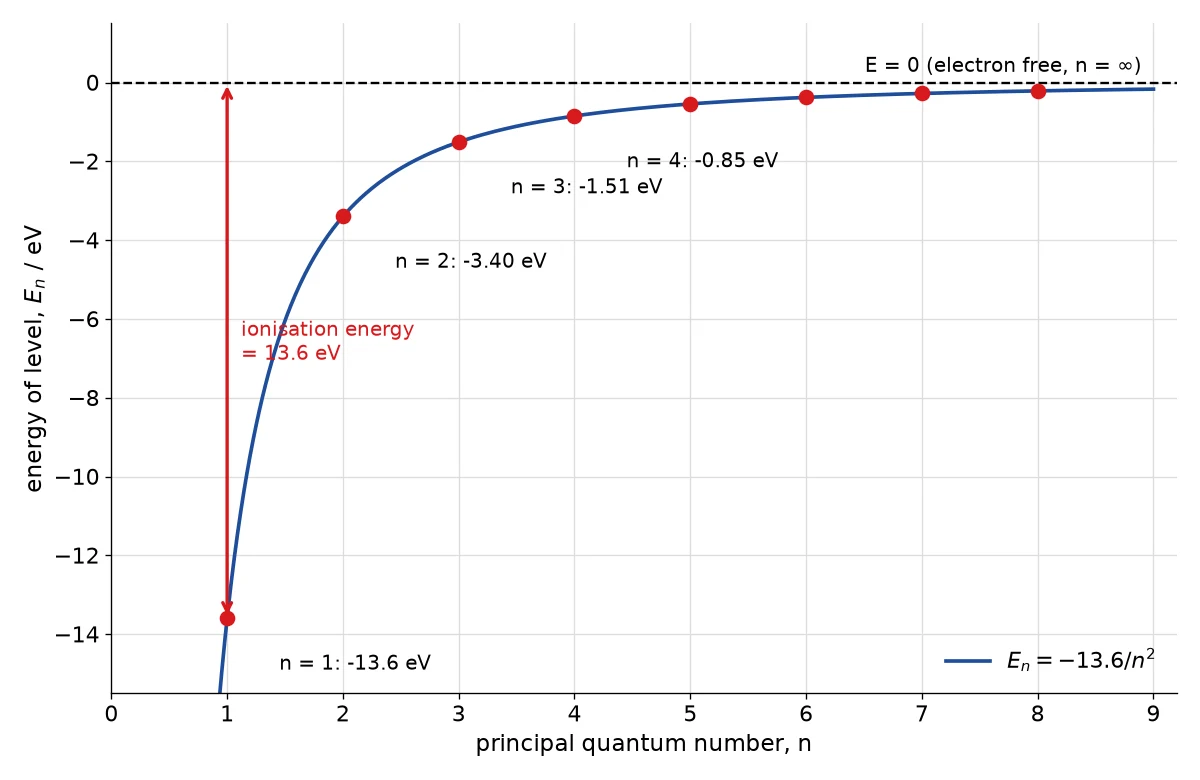
Graph of hydrogen energy level En against principal quantum number n, with ionisation energy marked
Atoms, energy levels and spectra
◀ Previous3 / 3
1Light interacting with matter2Light interacting with matter3Light interacting with matter4Light interacting with matter
1Nuclear reactions and radioactive decay2Nuclear reactions and radioactive decay3Nuclear reactions and radioactive decay4Nuclear reactions and radioactive decay
Nuclear reactions and radioactive decay
1
The strong force holds nucleons together at nuclear scales.
2
1
3
Nuclear reactions obey conservation of nucleon number, charge and momentum,
4
and they release energy when the products have less mass than the reactants,
5
because of mass–energy equivalence (topic 15.7).
6
2
1 / 4Next ▶
Nuclear reactions and radioactive decay
1
Fission splits a heavy nucleus and fusion joins light nuclei, and both release energy.
2
3
3
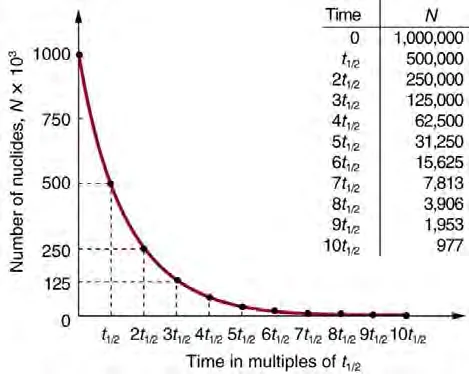
Radioactive decay is spontaneous and is described by probability: the number of nuclei remaining follows
4
N
5
=
6
0
◀ Previous2 / 4Next ▶
Nuclear reactions and radioactive decay
Nuclear reactions and radioactive decay
e
−λ
t
with λ = ln 2/
1/2
.
◀ Previous3 / 4Next ▶
Radioactive decay and probability: Exponential fall of the number of radioactive nuclei, halving with each half-life.
Nuclear reactions and radioactive decay
 ⤢ Enlarge
1
4
2
Alpha, beta-minus, beta-plus and gamma decays are each balanced by the conservation of nucleon number, lepton number and charge (topic 15.8).
◀ Previous4 / 4
1How the topics connect2How the topics connect3How the topics connect
Key equations of Unit 15
| Equation | Symbols and SI units | Topic |
|---|---|---|
| E = hf | E photon energy (J); h = 6.63 × 10⁻³⁴ J·s; f frequency (Hz) | 15.1 |
| c = fλ | c = 3.00 × 10⁸ m/s; λ wavelength (m); f frequency (Hz) | 15.1, 15.3 |
| v = c/n | v speed in a medium (m/s); n index of refraction (no unit) | 15.1 |
| λ = h/p = h/(mv) | λ de Broglie wavelength (m); p momentum (kg·m/s); m mass (kg); v speed (m/s) | 15.1, 15.2 |
| F = k|q1q2|/r2 | F electric force (N); k = 9.0 × 10⁹ N·m2/C2; q charges (C); r distance (m) | 15.2 |
| Fnet = mv2/r | Fnet net centripetal force (N); m mass (kg); v speed (m/s); r radius (m) | 15.2 |
| 2πr = nλ, so mvr = nh/(2π) | n = 1, 2, 3, … (principal quantum number); r orbital radius (m) | 15.2 |
| En = −13.6 eV/n2 | En energy of hydrogen state n (eV) | 15.2, 15.3 |
| hf = Ehigh − Elow, λ = hc/ΔE | ΔE energy difference between states (J); λ photon wavelength (m) | 15.3 |
| λmaxT = 2.90 × 10⁻³ m·K | λmax peak wavelength (m); T absolute temperature (K) | 15.4 |
| P = σAT4 | P power (W); σ = 5.67 × 10⁻⁸ W/(m2·K4); A area (m2); T temperature (K) | 15.4 |
| Kmax = hf − φ; f0 = φ/h | Kmax maximum kinetic energy (J); φ work function (J); f0 threshold frequency (Hz) | 15.5 |
| eVs = Kmax | Vs stopping potential (V); e = 1.60 × 10⁻¹⁹ C | 15.5 |
| p = h/λ = E/c | p photon momentum (kg·m/s) | 15.6 |
| Δλ = (h/(mec))(1 − cos θ) | Δλ change in wavelength (m); h/(mec) = 2.43 × 10⁻¹² m; θ scattering angle | 15.6 |
| E = mc2, ΔE = Δmc2 | E energy (J); m mass (kg); 1 u = 931.5 MeV/c2 | 15.7 |
| λ = ln 2/t1/2 | λ decay constant (s-1); t1/2 half-life (s) | 15.7 |
| N = N0e−λt = N0(1/2)t/t1/2 | N0 initial number of nuclei; N number remaining at time t (s) | 15.7 |
Example 1: Following one photon through the unit
Example 1: Following one photon through the unit
An electron in hydrogen falls from n = 3 to n = 2. The photon emitted has energy 1.89 eV (topic 15.3)
so its wavelength is 6.58 × 10⁻⁷ m. The same photon energy would eject electrons from a metal with work function below 1.89 eV (topic 15.5), and if it struck a free electron it would be scattered with a wavelength change of at most 4.86 × 10⁻¹² m (topic 15.6).
Answer: The energy and wavelength of the transition connect the atomic, photoelectric and Compton topics through the single relation E = hc/λ.
Key terms
| Term | Meaning |
|---|---|
| Photon | A massless, neutral quantum of light with energy hf. |
| de Broglie wavelength | The wavelength associated with a particle, λ = h/p. |
| Energy state | An allowed energy of a bound system such as an atom, which may be absorbed or emitted only as a whole photon energy. |
| Blackbody | An idealized body that absorbs all incident radiation, whose emitted spectrum depends only on its temperature. |
| Work function (φ) | The minimum energy needed to emit an electron from a material. |
| Compton scattering | The scattering of a photon by a free electron, in which the photon loses energy and its wavelength increases. |
| Strong force | The force that holds nucleons together at nuclear scales. |
| Half-life (t1/2) | The time for half of the nuclei in a radioactive sample to decay. |
| Alpha, beta and gamma decay | The three main types of radioactive decay, which emit a helium nucleus, an electron or positron with a neutrino, and a photon respectively. |
1Avoid these mistakes2Avoid these mistakes3Avoid these mistakes4Avoid these mistakes