Curriculum
AP PHYSICS 2
9. Thermodynamics
0/13
10. Electric Force, Field, and Potential
0/15
11. Electric Circuits
0/17
12. Magnetism and Electromagnetism
0/9
13. Geometric Optics
0/9
14. Waves, Sound, and Physical Optics
0/19
-
14. Waves, Sound, and Physical Optics
 Preview
-
14.1 Properties of Wave Pulses and Waves
Preview
-
14.1 Properties of Wave Pulses and Waves - Check yourself
 Preview
-
14.2 Periodic Waves
Preview
-
14.2 Periodic Waves - Check yourself
Preview
-
14.3 Boundary Behavior of Waves and Polarization
Preview
-
14.3 Boundary Behavior of Waves and Polarization - Check yourself
Preview
-
14.4 Electromagnetic Waves
Preview
-
14.4 Electromagnetic Waves - Check yourself
Preview
-
14.5 The Doppler Effect
Preview
-
14.5 The Doppler Effect - Check yourself
Preview
-
14.6 Wave Interference and Standing Waves
Preview
-
14.6 Wave Interference and Standing Waves - Check yourself
Preview
-
14.7 Diffraction
Preview
-
14.7 Diffraction - Check yourself
Preview
-
14.8 Double-Slit Interference and Diffraction Gratings
Preview
-
14.8 Double-Slit Interference and Diffraction Gratings - Check yourself
Preview
-
14.9 Thin-Film Interference
Preview
-
14.9 Thin-Film Interference - Check yourself
Preview
15. Modern Physics
0/17
Text lesson
14.2 Periodic Waves
14.2 Periodic Waves — AP PHYSICS 2: ALGEBRA-BASED notes: You will be able to define the period, frequency, wavelength and amplitude of a periodic wave, use the relationships T = 1/f and v = fλ to find an unknown quantity, describe a sinusoidal wave by its displacement as a function of time and of position, and explain how frequency relates to the energy and pitch of a wave.
1
The period T is the time for one complete oscillation of the wave, measured in seconds (s).
2
The frequency f is the rate at which the wave repeats, measured in hertz (Hz), which is one oscillation per second.
3
The two quantities are reciprocals of each other:
A wave with a frequency of 5.0 Hz has a period of 0.20 s, and a wave with a period of 0.50 s has a frequency of 2.0 Hz.
The period and the frequency are properties of the source of the wave and do not depend on the medium through which it travels.
What the symbols mean
T = period, the time for one complete wave (s) · f = frequency (Hz)
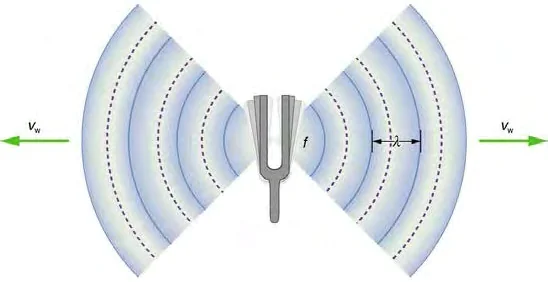
The wavelength λ of a periodic wave is the distance between successive corresponding positions on the wave, such as two adjacent crests or two adjacent troughs.
Its unit is the metre (m).
A periodic wave travels one wavelength in one period, so its speed is the distance divided by the time:
1
Here v is the speed of the wave in metres per second (m/s).
2
For a periodic wave, the wavelength is proportional to the speed of the wave and inversely proportional to its frequency, so λ = v/f.
3
When a wave enters a different medium, its frequency stays the same, but its speed and therefore its wavelength change.
What the symbols mean
v = wave speed (m s−1) · f = frequency (Hz) · λ = wavelength (m)
1
The amplitude of a wave is the maximum displacement from equilibrium, and it is independent of the period and the frequency of the wave.
2
A low-frequency wave can have a large amplitude, and a high-frequency wave can have a small amplitude.
3
Changing the frequency of a wave does not change its amplitude, and changing its amplitude does not change its frequency.
1
It can be described in two ways.
2
The displacement from equilibrium at a fixed location is a function of time: y(t) = A sin(2πft), where y is the displacement in metres, A is the amplitude and the argument of the sine is the phase in radians.
3
The displacement at a fixed time is a function of position y(x) = A sin(2πx/λ), where x is the position along the direction of propagation.
4
For a wave that travels in the positive x direction, the two are combined into a single expression: y(x, t) = A sin[2π(x/λ − t/T)].
5
This form lets a student find the displacement of any point on the wave at any time, as long as the amplitude, wavelength and period are known.
The energy of a wave increases with increasing frequency, so a wave with a higher frequency carries more energy than a wave of the same amplitude with a lower frequency.
This is why high-frequency radiation, such as ultraviolet light, can damage matter more than low-frequency radio waves.
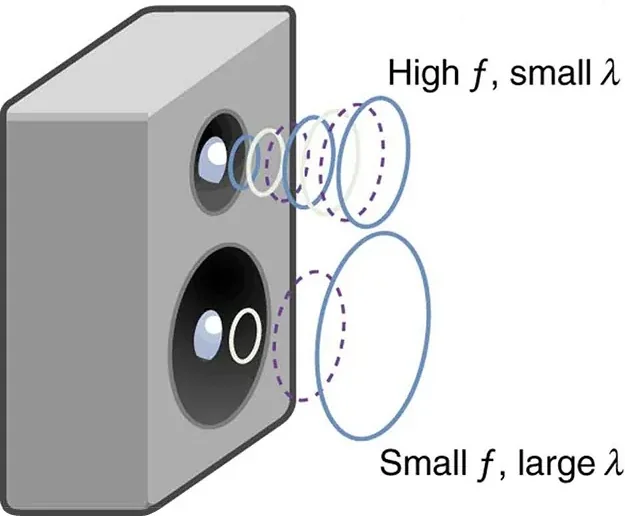
The frequency of a sound wave is related to its pitch.
A sound with a higher frequency is heard as higher in pitch, and a sound with a lower frequency is heard as lower in pitch.
Musical notes are identified by their frequencies, such as 440 Hz for the note A above middle C in standard tuning.
Example 1
Wavelength of a sound wave
1
λ = v/f = (343 m/s)/(440 Hz) = 0.7795 m.
Answer
0.78 m, to two significant figures. The wavelength is about 78 cm.
Example 2
Speed of a water wave
1
f = 1/T = 1/0.50 s = 2.0 Hz. v = fλ = (2.0 Hz)(2.5 m) = 5.0 m/s
Answer
The frequency is 2.0 Hz and the speed is 5.0 m/s
Example 3
Displacement of a point on a wave
1
y = A sin(2πft) = (0.040 m) sin[2π(5.0 Hz)(0.050 s)] = (0.040 m) sin(π/2) = (0.040 m)(1) = 0.040 m.
Answer
The displacement is +0.040 m, which is the maximum (crest) displacement, because a quarter of a period has passed and the phase is π/2.
Confusing the period and the frequency
The period is the time for one oscillation, so T = 1/f, and the period is not the frequency.
Using the wavelength in metres with the frequency in hertz and a speed in kilometres per hour without converting
Every quantity in v = fλ must be in SI units.
Assuming that the frequency of a wave changes when it enters a new medium
The frequency is fixed by the source, so the wavelength changes instead.
Saying that a larger amplitude means a higher frequency
The amplitude and the frequency are independent properties of a wave.
Measuring the wavelength from crest to trough
The wavelength is the distance between two corresponding points, such as two crests, which is a full cycle.
Avoid
Using degrees instead of radians when working out the phase in y = A sin(2πft) on a calculator, which gives a wrong displacement