Curriculum
AP PHYSICS 2
9. Thermodynamics
0/13
10. Electric Force, Field, and Potential
0/15
11. Electric Circuits
0/17
12. Magnetism and Electromagnetism
0/9
13. Geometric Optics
0/9
-
13. Geometric Optics
 Preview
-
13.1 Reflection
Preview
-
13.1 Reflection - Check yourself
 Preview
-
13.2 Images Formed by Mirrors
Preview
-
13.2 Images Formed by Mirrors - Check yourself
Preview
-
13.3 Refraction
Preview
-
13.3 Refraction - Check yourself
Preview
-
13.4 Images Formed by Lenses
Preview
-
13.4 Images Formed by Lenses - Check yourself
Preview
14. Waves, Sound, and Physical Optics
0/19
15. Modern Physics
0/17
Text lesson
13.3 Refraction
13.3 Refraction — AP PHYSICS 2: ALGEBRA-BASED notes: You will be able to describe refraction as a change in direction caused by a change in speed, calculate indices of refraction and refraction angles with Snell’s law, and determine when total internal reflection occurs beyond the critical angle.
1
Refraction happens because the speed of light changes when light enters a new medium.
2
The frequency of the light does not change at the boundary, so a decrease in speed means a decrease in wavelength.
3
If a ray meets the boundary at an angle, one side of the wavefront enters the new medium first and changes speed first.
4
The wavefront therefore turns, and the ray bends.
5
If a ray meets the boundary along the normal, the whole wavefront changes speed at the same moment, and the ray does not change direction.
The index of refraction of a medium is the ratio of the speed of light in a vacuum to the speed of light in that medium: n = c/v.
Here c = 3.00 × 10⁸ m/s is the speed of light in a vacuum, v is the speed of light in the medium in metres per second (m/s), and n is a pure number with no unit.
Because n is inversely proportional to v, a medium with a larger index of refraction slows light more.
The index of refraction of a vacuum is 1, and for any real medium n is greater than or equal to 1.
Typical values are 1.00 for air, 1.33 for water and about 1.50 for common glass.
What the symbols mean
n = refractive index (no unit) · c = speed of light in a vacuum (3.00 × 10⁸ m s−1) · v = speed of light in the material (m s−1)
1
Snell’s law relates the angles of incidence and refraction of a ray passing from one medium into another to the indices of refraction of the two media: n1 sin θ1 = n2 sin θ2.
2
Here n1 and θ1 are the index of refraction and angle of incidence in the first medium, and n2 and θ2 are the index of refraction and angle of refraction in the second medium.
3
Both angles are measured from the normal, in degrees.
What the symbols mean
n = refractive index (no unit) · i or θ1 = angle of incidence · r or θ2 = angle of refraction (both measured from the normal)
1
When a ray travels from a medium with a higher index of refraction into a medium with a lower index of refraction, it moves into a faster medium and refracts away from the normal, so θ2 is larger than θ1.
2
When a ray travels from a lower index into a higher index, it moves into a slower medium and refracts toward the normal, so θ2 is smaller than θ1.
3
Light that enters a medium along the normal, with θ1 = 0, is not refracted.
4
Its direction is unchanged, although its speed and wavelength still change.
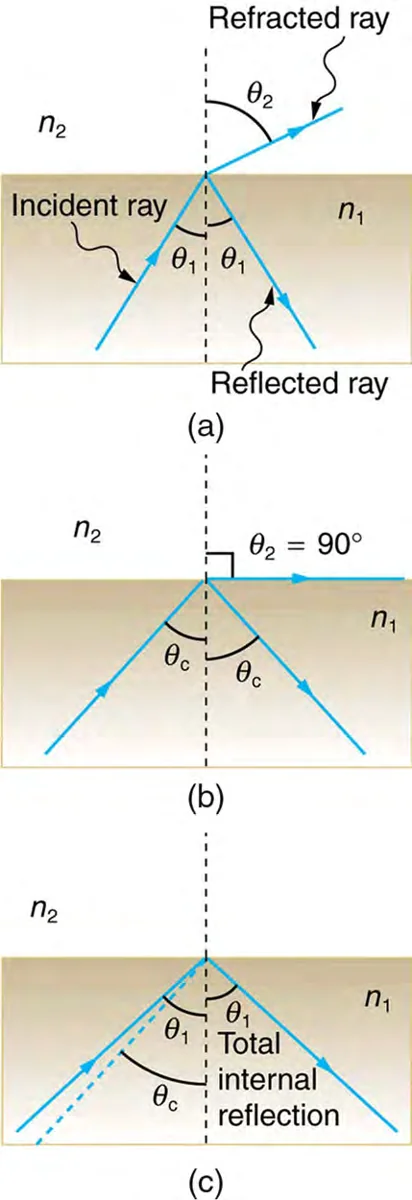
Total internal reflection may occur when light passes from a medium with a higher index of refraction into a medium with a lower index of refraction.
As the angle of incidence increases, the angle of refraction increases faster.
At a particular angle of incidence, called the critical angle θc, the refracted ray travels at 90° to the normal, so it runs along the surface of the material.
Setting θ2 = 90° in Snell’s law, where sin 90° = 1, gives the critical angle: sin θc = n2/n1, which applies only when n1 is greater than n2.
For any angle of incidence greater than θc, no light is transmitted into the second medium, and all of the light is reflected back into the first medium.
This effect is used in optical fibres, and it is the reason a diamond sparkles.
No critical angle exists when light travels from a lower index into a higher index, because the refracted angle is always less than 90°.
Example 1
Speed and index of refraction
1
n = c/v = (3.00 × 10⁸ m/s)/(2.0 × 108 m/s) = 1.5.
Answer
The index of refraction is 1.5. The light is slower in this liquid than in a vacuum by a factor of 1.5
Example 2
Refraction from air into water
1
Snell’s law gives sin θ2 = (n1/n2) sin θ1 = (1.00/1.33)(sin 40°) = (1.00/1.33)(0.6428) = 0.4833.
2
Then θ2 = sin−1(0.4833) = 28.9°.
Answer
The angle of refraction is 29° (28.9° to three significant figures). The ray bends toward the normal because it enters a slower medium.
Example 3
Critical angle for glass
1
sin θc = n2/n1 = 1.00/1.50 = 0.6667.
2
Then θc = sin−1(0.6667) = 41.8°.
Answer
The critical angle is 41.8°. Rays inside the glass that strike the surface at more than 41.8° are totally internally reflected
Example 4
Total internal reflection in water
1
The critical angle for water into air is sin θc = 1.00/1.33 = 0.7519, so θc = 48.8°.
2
Since 60° is greater than 48.8°, the ray is beyond the critical angle.
Answer
The ray does not emerge. Total internal reflection occurs, and all of the light is reflected back into the water
Using the index of refraction in the wrong position in Snell’s law
The index of the medium the light is leaving goes with θ1, and the index of the medium it enters goes with θ2.
Saying light bends toward the normal when entering a medium with a lower index
Light bends away from the normal when it passes into a medium with a lower index.
Calculating a critical angle when light travels from a lower index into a higher index
No critical angle exists in that case.
Saying the frequency of light changes when it enters a new medium
The speed and wavelength change; the frequency does not.
Avoid
Using the angles from the surface instead of the normal in Snell’s law
Avoid
Forgetting that a ray along the normal is not refracted, so its direction does not change even though its speed does