Curriculum
AP PHYSICS 2
9. Thermodynamics
0/13
10. Electric Force, Field, and Potential
0/15
11. Electric Circuits
0/17
-
11. Electric Circuits
 Preview
-
11.1 Electric Current
Preview
-
11.1 Electric Current - Check yourself
 Preview
-
11.2 Simple Circuits
Preview
-
11.2 Simple Circuits - Check yourself
Preview
-
11.3 Resistance, Resistivity, and Ohm’s Law
Preview
-
11.3 Resistance, Resistivity, and Ohm’s Law - Check yourself
Preview
-
11.4 Electric Power
Preview
-
11.4 Electric Power - Check yourself
Preview
-
11.5 Compound Direct Current (DC) Circuits
Preview
-
11.5 Compound Direct Current (DC) Circuits - Check yourself
Preview
-
11.6 Kirchhoff’s Loop Rule
Preview
-
11.6 Kirchhoff’s Loop Rule - Check yourself
Preview
-
11.7 Kirchhoff’s Junction Rule
Preview
-
11.7 Kirchhoff’s Junction Rule - Check yourself
Preview
-
11.8 Resistor-Capacitor (RC) Circuits
Preview
-
11.8 Resistor-Capacitor (RC) Circuits - Check yourself
Preview
12. Magnetism and Electromagnetism
0/9
13. Geometric Optics
0/9
14. Waves, Sound, and Physical Optics
0/19
15. Modern Physics
0/17
Text lesson
11.3 Resistance, Resistivity, and Ohm’s Law
11.3 Resistance, Resistivity, and Ohm’s Law — AP PHYSICS 2: ALGEBRA-BASED notes: You will be able to describe the resistance of a conductor from its material, length and cross-sectional area, apply Ohm’s law to a conductive element, and find the resistance of an ohmic element from the slope of a graph of current against potential difference.
When a potential difference is applied across a conductor, the charge carriers, usually electrons, move through the material and collide with its atoms.
Each collision transfers some of their energy to the material.
The more strongly the object opposes this motion, the smaller the current it carries for a given potential difference.
Resistance
Resistance R is measured in ohms (Ω).
One ohm is equal to one volt per ampere, so 1 Ω = 1 V/A.
Resistance is a property of a particular object or circuit element, not of a material alone.
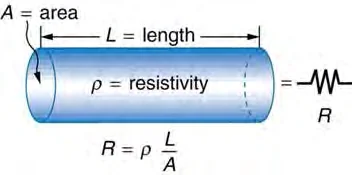
R = resistance (Ω)
ρ = resistivity (Ω m)
L = length (m)
A = cross-sectional area (m2)
Where R is the resistance in ohms (Ω), ρ (rho) is the resistivity in ohm metres (Ω·m), L is the length of the conductor in metres (m), and A is its cross-sectional area in square metres (m2).
Resistance is directly proportional to length, because a longer conductor gives charge carriers more collisions.
Resistance is inversely proportional to cross-sectional area, because a wider conductor gives charge carriers more parallel paths through the material.
Resistivity is a fundamental property of a material that depends on its atomic and molecular structure and quantifies how strongly the material opposes the motion of electric charge.
It does not depend on the size or shape of the sample.
Lengths must be in metres and areas in square metres before the formula is used.
A diameter d gives the area A = π(d/2)2.
Silver1.59 × 10−8
Copper1.69 × 10−8
Aluminium2.83 × 10−8
Tungsten5.6 × 10−8
Carbon3.5 × 10−5
Glassabout 1 × 10¹³
Resistivity ρ (Ω·m)
The table shows why metals are used as conductors and glass as an insulator: the resistivities differ by more than twenty orders of magnitude.
Good conductors have very small resistivities, and insulators have very large ones.
At higher temperatures the atoms of the material vibrate with greater amplitude, so charge carriers collide with them more often and their motion is impeded more strongly.
Resistivity values are normally quoted at 20 °C for this reason.
Temperature
Within an idealised ohmic model, the resistivity of the material is treated as constant regardless of temperature, so the resistance of the element depends only on its shape.
This model is only an approximation: real conductors show a temperature-dependent resistivity, and it should be used only over a range of temperatures where the resistance is effectively constant.
V = potential difference (V)
I = current (A)
R = resistance (Ω)
Here V is the potential difference across the element in volts (V), I is the current through it in amperes (A), and R is its resistance in ohms (Ω).
For a given resistor, doubling the potential difference doubles the current.
A material that obeys Ohm’s law has a constant resistance for all currents, and it is called an ohmic material.
A material or element that does not obey Ohm’s law has a resistance that changes with current or potential difference, and it is called nonohmic.
Filament lamps, semiconductors and liquid conductors are common nonohmic elements.
In a filament lamp the resistance increases as the filament heats up, so its current does not rise in proportion to the potential difference.
So the resistance is R = 1/slope.
For a line of slope 0.25 A/V, the resistance is 1/0.25 Ω = 4.0 Ω.
Graphs drawn the other way round, with potential difference on the vertical axis and current on the horizontal axis, have a slope equal to R itself.
For a nonohmic element the graph is curved or has a changing slope.
The resistance at any one point is then found from the ratio V/I at that point on the graph, not from a single slope.
This is why a resistor or a filament warms up when a current passes through it.
The thermal energy raises the temperature of the resistor and can also warm its surroundings.
Heating
Heating is therefore an unavoidable effect of resistance in any real conductor carrying a current, and it is the reason that a fuse or a heater works.
Question
A copper wire is 1.2 m long and has a cross-sectional area of 1.2 × 10⁻⁸ m2. Its temperature is 20 °C, so the resistivity of copper is 1.69 × 10⁻⁸ Ω·m. Find the resistance of the wire, and the current it carries when it is connected to a 10 V battery.
1
R = ρL/A = (1.69 × 10⁻⁸ Ω·m)(1.2 m)/(1.2 × 10−8 m2) = 1.69 Ω.
2
Then by Ohm’s law, I = V/R = 10 V / 1.69 Ω = 5.9 A.
Answer
The resistance is 1.7 Ω, and the current is 5.9 A.
Question
A copper wire of length 2.0 m has a diameter of 0.50 mm. Find its resistance. A second copper wire of the same length has twice the diameter. State the resistance of the second wire.
1
The radius is 0.25 mm = 2.5 × 10⁻⁴ m, so A = π(2.5 × 10⁻⁴ m)2 = 1.96 × 10⁻⁷ m2.
2
Then R = (1.69 × 10⁻⁸ Ω·m)(2.0 m)/(1.96 × 10−7 m2) = 0.17 Ω.
3
Doubling the diameter multiplies the area by 22 = 4, so the new resistance is 0.17 Ω / 4 = 0.043 Ω.
4
The first wire has a resistance of 0.17 Ω, and the second wire has a resistance of 0.043 Ω, one quarter of the first.
Question
A student measures the current through an ohmic resistor at two potential differences. At 2.0 V the current is 0.40 A, and at 6.0 V the current is 1.20 A. Find the resistance of the resistor.
1
The slope of the I–V graph is ΔI/ΔV = (1.20 A − 0.40 A)/(6.0 V − 2.0 V) = 0.80 A/4.0 V = 0.20 A/V.
2
Then R = 1/slope = 1/(0.20 A/V) = 5.0 Ω.
3
Check: V/I = 2.0 V/0.40 A = 5.0 Ω.
Answer
The resistance is 5.0 Ω. The two points agree, which is consistent with the resistor being ohmic.
Treating resistivity as if it depended on the length or area of the sample.
Resistivity is a property of the material only; resistance depends on ρ, L and A.
Writing resistance as proportional to the cross-sectional area.
Resistance is inversely proportional to A, so a wider wire has a smaller resistance.
Using the diameter of a wire in the formula for A.
The area is π(d/2)2, so the diameter must be halved to give the radius before the area is found.
Forgetting unit conversion.
Lengths in millimetres or areas in mm2 must be converted to metres and square metres before the formula is used.
Reading the slope of an I–V graph as R
For a current–potential difference graph the slope is 1/R, so R = 1/slope.
Assuming a filament lamp is ohmic
Its resistance rises as it heats, so it is nonohmic and its I–V graph is curved.