Curriculum
AP PHYSICS 2
9. Thermodynamics
0/13
10. Electric Force, Field, and Potential
0/15
11. Electric Circuits
0/17
12. Magnetism and Electromagnetism
0/9
13. Geometric Optics
0/9
14. Waves, Sound, and Physical Optics
0/19
-
14. Waves, Sound, and Physical Optics
 Preview
-
14.1 Properties of Wave Pulses and Waves
Preview
-
14.1 Properties of Wave Pulses and Waves - Check yourself
 Preview
-
14.2 Periodic Waves
Preview
-
14.2 Periodic Waves - Check yourself
Preview
-
14.3 Boundary Behavior of Waves and Polarization
Preview
-
14.3 Boundary Behavior of Waves and Polarization - Check yourself
Preview
-
14.4 Electromagnetic Waves
Preview
-
14.4 Electromagnetic Waves - Check yourself
Preview
-
14.5 The Doppler Effect
Preview
-
14.5 The Doppler Effect - Check yourself
Preview
-
14.6 Wave Interference and Standing Waves
Preview
-
14.6 Wave Interference and Standing Waves - Check yourself
Preview
-
14.7 Diffraction
Preview
-
14.7 Diffraction - Check yourself
Preview
-
14.8 Double-Slit Interference and Diffraction Gratings
Preview
-
14.8 Double-Slit Interference and Diffraction Gratings - Check yourself
Preview
-
14.9 Thin-Film Interference
Preview
-
14.9 Thin-Film Interference - Check yourself
Preview
15. Modern Physics
0/17
Text lesson
14.5 The Doppler Effect
14.5 The Doppler Effect — AP PHYSICS 2: ALGEBRA-BASED notes: You will be able to describe the Doppler effect as the change in observed frequency caused by the relative motion of a wave source and an observer, predict whether the observed frequency is greater than, less than or equal to the rest frequency, and explain why a greater relative velocity gives a greater shift in frequency.
1
The observed frequency is the frequency that an observer actually measures.
2
The Doppler effect is the relationship between these two frequencies and the relative velocity of the source and the observer.
3
When the source and the observer move relative to each other, the observed frequency differs from the rest frequency.
4
The Doppler effect applies to all waves, including sound, light and water waves.
5
The most familiar example is the change in pitch of a siren as an ambulance passes a stationary listener.
6
The pitch is high while the ambulance approaches, drops as it passes and becomes low as it moves away, even though the siren itself emits a constant frequency.
When a source moves toward an observer, each new wave crest is emitted from a position closer to the observer than the one before.
The crests arrive more often, so the observed frequency is greater than the rest frequency.
When a source moves away from an observer, each new crest is emitted from a position farther from the observer, so the crests arrive less often and the observed frequency is less than the rest frequency.
The same effect occurs when the observer moves and the source is at rest.
An observer who moves toward a stationary source meets the wave crests more often than a stationary observer would, and hears a higher frequency.
An observer who moves away from the source meets the crests less often and hears a lower frequency.
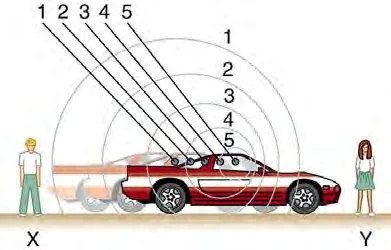
1
A greater relative velocity between the source and the observer produces a greater measured difference between the observed frequency and the rest frequency.
2
A car horn that approaches at 30 m/s is shifted by more than the same horn approaching at 10 m/s.
3
The difference depends on the relative motion of the two, so a source and an observer moving in the same direction at the same velocity give no shift.
4
For a wave source moving at the same velocity as the observer, the observed frequency is equal to the rest frequency.
5
For a source moving toward an observer, the observed frequency is greater than the rest frequency.
6
For a source moving away from an observer, the observed frequency is less than the rest frequency.
7
These three cases summarize the qualitative behaviour that AP Physics 2 requires.
1
Light from a galaxy that is moving away from the Earth is shifted toward longer wavelengths, which is called a redshift, and light from a galaxy moving toward the Earth is shifted toward shorter wavelengths.
2
The size of the shift tells astronomers how fast the galaxy is moving relative to the Earth.
3
Police radar guns and medical ultrasound machines also use the change in frequency of a reflected wave to measure the speed of a moving object or a moving part of the body.
Example 1
Comparing two sources
1
Both sources move toward the listener, so both observed frequencies are greater than the rest frequency.
2
Ambulance A has the greater relative velocity, so the difference between its observed frequency and the rest frequency is larger.
Answer
Ambulance A has the higher observed frequency. Its observed frequency is greater than that of ambulance B, and both are greater than the rest frequency.
Example 2
Source and observer moving together
1
The source and the observer have the same velocity, so their relative velocity is zero.
2
The Doppler effect depends only on the relative velocity, so there is no shift.
Answer
1000 Hz, which is equal to the rest frequency.
Example 3
Observer moving away from a source
1
The student moves away from the source, so the student meets the wave crests less often than a stationary listener.
2
The observed frequency is less than 500 Hz.
3
Walking faster increases the relative velocity, so the observed frequency becomes lower still, and the difference from 500 Hz increases
Answer
The student hears a frequency below 500 Hz, and the frequency falls further as the student walks faster
Saying that the source changes its frequency when it moves
The source still emits its rest frequency; the observed frequency changes because of the relative motion.
Predicting a higher observed frequency when the source moves away from the observer
A source moving away gives an observed frequency lower than the rest frequency.
Thinking that a source and an observer moving together in the same direction produce a shift
Only the relative velocity matters, and it is zero in this case.
Forgetting that the observer’s motion also causes a shift
The Doppler effect depends on the relative motion, whichever of the two is moving.
Assuming that the wave’s own speed changes with the source’s motion
The speed of the wave depends on the medium, not on the source.