Curriculum
AP PHYSICS 2
9. Thermodynamics
0/13
10. Electric Force, Field, and Potential
0/15
11. Electric Circuits
0/17
12. Magnetism and Electromagnetism
0/9
13. Geometric Optics
0/9
14. Waves, Sound, and Physical Optics
0/19
15. Modern Physics
0/17
-
15. Modern Physics
 Preview
-
15.1 Quantum Theory and Wave-Particle Duality
Preview
-
15.1 Quantum Theory and Wave-Particle Duality - Check yourself
 Preview
-
15.2 The Bohr Model of Atomic Structure
Preview
-
15.2 The Bohr Model of Atomic Structure - Check yourself
Preview
-
15.3 Emission and Absorption Spectra
Preview
-
15.3 Emission and Absorption Spectra - Check yourself
Preview
-
15.4 Blackbody Radiation
Preview
-
15.4 Blackbody Radiation - Check yourself
Preview
-
15.5 The Photoelectric Effect
Preview
-
15.5 The Photoelectric Effect - Check yourself
Preview
-
15.6 Compton Scattering
Preview
-
15.6 Compton Scattering - Check yourself
Preview
-
15.7 Fission, Fusion, and Nuclear Decay
Preview
-
15.7 Fission, Fusion, and Nuclear Decay - Check yourself
Preview
-
15.8 Types of Radioactive Decay
Preview
-
15.8 Types of Radioactive Decay - Check yourself
Preview
Text lesson
15.5 The Photoelectric Effect
15.5 The Photoelectric Effect — AP PHYSICS 2: ALGEBRA-BASED notes: You will be able to describe the photoelectric effect, explain why it needs a threshold frequency and why the maximum kinetic energy of emitted electrons depends on frequency rather than intensity, use Kmax = hf − φ to solve problems, and interpret a stopping-potential experiment.
1The photoelectric effect2The photoelectric effect
1Threshold frequency and the role of intensity2Threshold frequency and the role of intensity
Threshold frequency and the role of intensity
Threshold frequency and the role of intensity
Emission of electrons requires a minimum frequency of the incident light, called the threshold frequency f0. Light at or above the threshold frequency induces electron emission, regardless of how many photons strike the material. Light below the threshold frequency produces no emission, however intense it is and however long it shines.
Above the threshold, the intensity of the light
which is set by the number of photons arriving each second, determines the number of electrons emitted each second, and so the current.
1 / 2Next ▶
The photoelectric effect: Photoelectric effect: low-frequency photons cannot eject electrons, and above the threshold frequency the kinetic energy of ejected electrons grows linearly with photon energy.
Threshold frequency and the role of intensity
 ⤢ Enlarge
Threshold frequency and the role of intensity
Doubling the intensity doubles the number of emitted electrons.
It does not change the energy of each emitted electron.
This shows that light is a collection of discrete, quantized energy packets called photons, each of which can eject at most one electron.
◀ Previous2 / 2
1Photons, the work function and the maximum kinetic energy2Photons, the work function and the maximum kinetic energy3Photons, the work function and the maximum kinetic energy4Photons, the work function and the maximum kinetic energy5Photons, the work function and the maximum kinetic energy
Photons, the work function and the maximum kinetic energy
1
A photon of frequency f has energy E = hf.
2
1
3
When it is absorbed by an electron in the material, the electron receives the whole energy of the photon.
4
2
5
Some of this energy is used to escape from the material.
6
3
1 / 5Next ▶
Photons, the work function and the maximum kinetic energy
1
The work function, φ, is the minimum energy required to emit an electron from the atoms of a given material.
2
4
3
The maximum kinetic energy of an emitted electron is the energy that remains after this work has been done:
4
Kmax = hf − φ
5
Here Kmax is the maximum kinetic energy of an emitted electron in joules (J), h = 6.63 × 10⁻³⁴ J·s, f is the frequency of the incident light in hertz (Hz), and φ is the work function in joules.
◀ Previous2 / 5Next ▶
Photons, the work function and the maximum kinetic energy
Photons, the work function and the maximum kinetic energy
The threshold frequency is found by setting
K
max
= 0
which gives
f
0
◀ Previous3 / 5Next ▶
Photons, the work function and the maximum kinetic energy
1
= φ/
2
h
3
.
4
A graph of
5
against
6
is a straight line with slope
◀ Previous4 / 5Next ▶
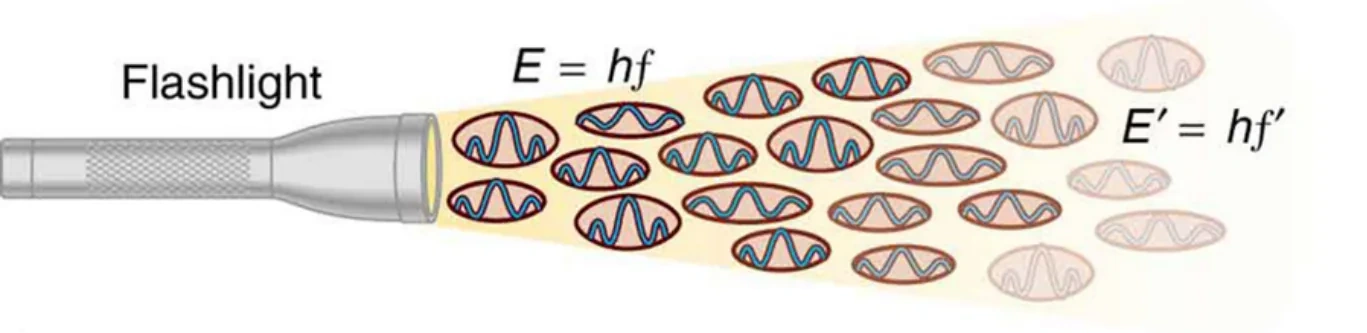
Einstein and the photon: A flashlight beam drawn as photons: each photon carries energy hf, and a higher intensity means more photons per unit area.
Photons, the work function and the maximum kinetic energy
 ⤢ Enlarge
Photons, the work function and the maximum kinetic energy
, a vertical intercept of −φ, and a horizontal intercept at
The energy of the emitted electrons depends on the frequency of the light and on the work function of the material
but not on the number of photons. Work functions are given on the exam where they are needed. Students are not expected to know the work function of any metal.
◀ Previous5 / 5
1The stopping-potential experiment2The stopping-potential experiment3The stopping-potential experiment
The stopping-potential experiment
The stopping-potential experiment
In a typical experiment to demonstrate the photoelectric effect and to determine the work function of a metal, two metal plates are placed in an evacuated chamber and connected to a variable source of potential difference.
1
One plate is illuminated by monochromatic light
which causes electrons to be ejected.
2
The potential difference between the plates is then adjusted until no current is measured.
3
1 / 3Next ▶
The stopping-potential experiment
1
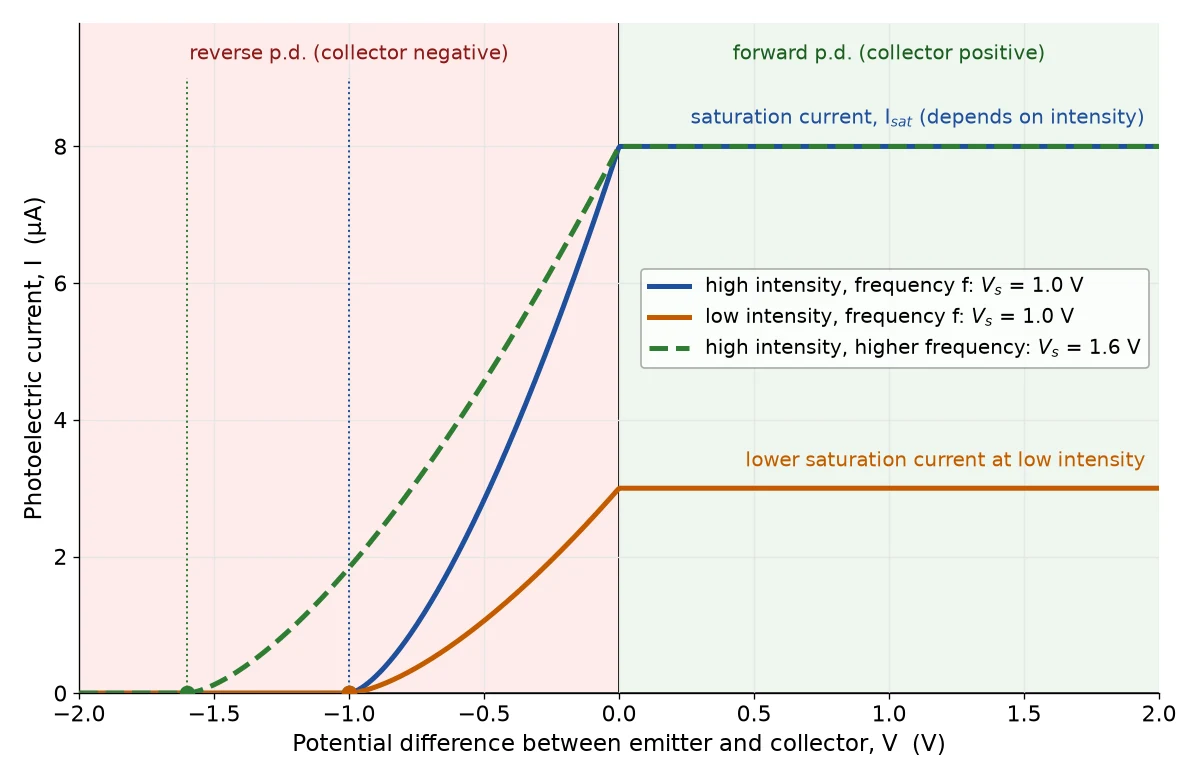
The potential difference at which the current just stops is the stopping potential,
2
V
3
s
4
.
5
4
6
At this point the most energetic electron just fails to reach the other plate, so:
◀ Previous2 / 3Next ▶
Photoelectric current against the potential difference between emitter and collector, showing saturation and cut-off at the stopping potential for two intensities and a higher frequency
The stopping-potential experiment
 ⤢ Enlarge
1
eVs = Kmax
2
Here e = 1.60 × 10⁻¹⁹ C and Vs is in volts (V). Measuring the stopping potential for several frequencies gives values of Kmax from which the work function and h can be determined.
◀ Previous3 / 3
1Example 1: Threshold frequency of a metal · Example 2: Maxim2Worked examples3Worked examples4Worked examples5Worked examples · Example 3: Light below threshold
Key terms
| Term | Meaning |
|---|---|
| Photoelectric effect | The emission of electrons when electromagnetic radiation is incident upon a photoactive material. |
| Photoactive material | A material whose electrons can be emitted when light of a suitable frequency falls on it. |
| Threshold frequency (f0) | The minimum frequency of incident light that can cause electron emission from a material. |
| Work function (φ) | The minimum energy required to emit an electron from the atoms of a material. |
| Maximum kinetic energy (Kmax) | The largest kinetic energy an emitted electron can have, given by Kmax = hf − φ. |
| Photoelectron | An electron emitted from a material by the photoelectric effect. |
| Stopping potential (Vs) | The potential difference that just stops the current of photoelectrons, so that eVs = Kmax. |
| Monochromatic light | Light of a single frequency, or a single wavelength. |
1Avoid these mistakes2Avoid these mistakes3Avoid these mistakes4Avoid these mistakes5Avoid these mistakes