Curriculum
AP PHYSICS 2
9. Thermodynamics
0/13
-
9. Thermodynamics
 Preview
-
9.1 Kinetic Theory of Temperature and Pressure
Preview
-
9.1 Kinetic Theory of Temperature and Pressure - Check yourself
 Preview
-
9.2 The Ideal Gas Law
Preview
-
9.2 The Ideal Gas Law - Check yourself
Preview
-
9.3 Thermal Energy Transfer and Equilibrium
Preview
-
9.3 Thermal Energy Transfer and Equilibrium - Check yourself
Preview
-
9.4 The First Law of Thermodynamics
Preview
-
9.4 The First Law of Thermodynamics - Check yourself
Preview
-
9.5 Specific Heat and Thermal Conductivity
Preview
-
9.5 Specific Heat and Thermal Conductivity - Check yourself
Preview
-
9.6 Entropy and the Second Law of Thermodynamics
Preview
-
9.6 Entropy and the Second Law of Thermodynamics - Check yourself
Preview
10. Electric Force, Field, and Potential
0/15
11. Electric Circuits
0/17
12. Magnetism and Electromagnetism
0/9
13. Geometric Optics
0/9
14. Waves, Sound, and Physical Optics
0/19
15. Modern Physics
0/17
Text lesson
9. Thermodynamics
Unit 9 Thermodynamics — AP PHYSICS 2: ALGEBRA-BASED notes: You will be able to connect the six topics of Unit 9 by explaining how atomic motion sets pressure and temperature, how the ideal gas law and the first law of thermodynamics describe gases, how energy moves between systems, and what the second law says about the direction of change.
Gas pressure, temperature and atomic motion
Gas pressure, temperature and atomic motion
Pressure and temperature are both explained by the motion of atoms.
Pressure is the force per unit area that the atoms of a gas exert on a surface when they collide with it (topic 9.1).
Temperature is the measure of the average kinetic energy of those atoms, given by (3/2)kBT per atom,
so the root-mean-square speed of the atoms rises with the square root of the absolute temperature.
The Maxwell–Boltzmann distribution shows that atoms in a gas have a range of speeds,
and that a higher temperature shifts the distribution to higher speeds.
1The ideal gas law2The ideal gas law
The ideal gas law
1
An ideal gas is a model in which atoms move randomly, occupy negligible volume and interact only through elastic collisions.
2
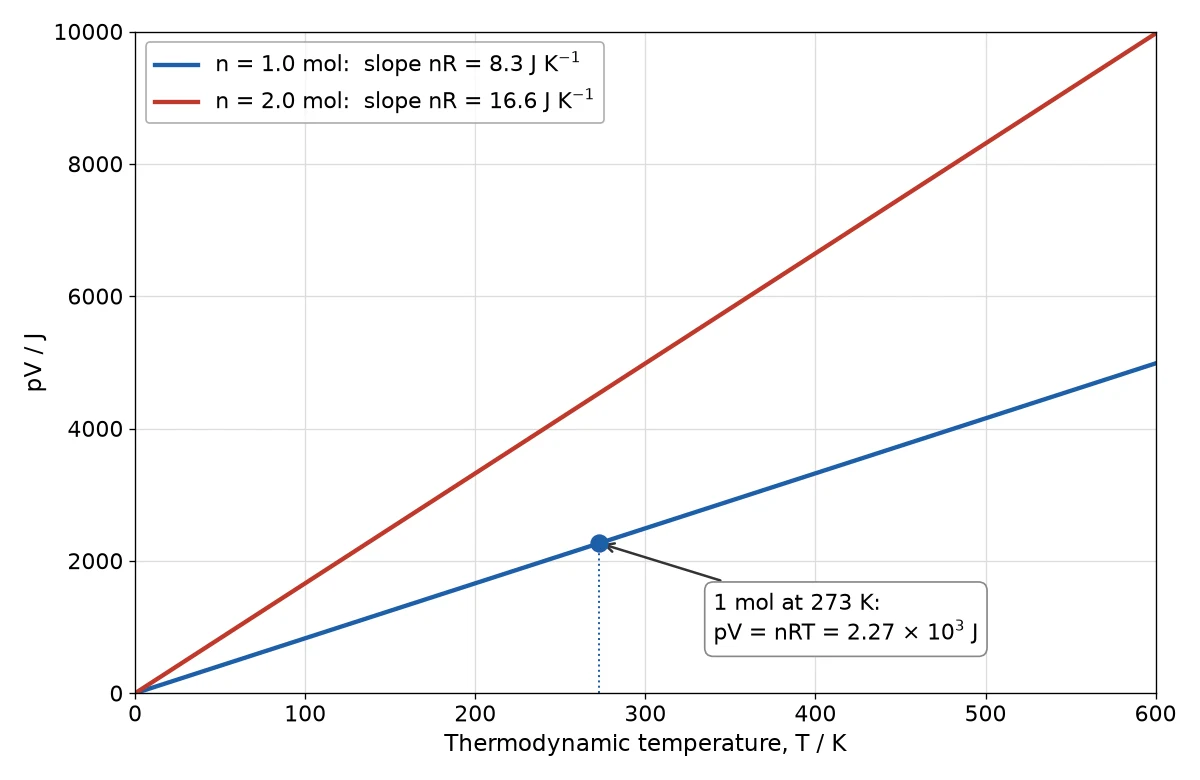
For such a gas, pressure, volume, amount of gas and absolute temperature are related by PV = nRT = NkBT (topic 9.2).
3
The law explains the graphs of gas behaviour,
including the fact that a pressure–temperature line at constant volume extrapolates to zero pressure at 0 K.
4
Every temperature in these relations must be in kelvins.
1 / 2Next ▶
Graph of pV against thermodynamic temperature for an ideal gas at 1 mol and 2 mol, two straight lines through the origin
The ideal gas law
◀ Previous2 / 2
Thermal contact and energy transfer
Thermal contact and energy transfer
Two systems in thermal contact exchange energy by thermal processes: conduction through solids, convection in fluids and radiation through electromagnetic waves (topic 9.3).
Energy always moves spontaneously from the higher-temperature system to the lower-temperature system,
and the exchange stops when both systems reach thermal equilibrium at the same temperature.
The energy transferred to heat a material is Q = mcΔT
where c is the specific heat (topic 9.5).
The rate of conduction through a slab is Q/Δt = kAΔT/L
where k is the thermal conductivity.
Both specific heat and thermal conductivity are intrinsic properties of the material.
1Internal energy and the first law2Internal energy and the first law
Internal energy and the first law
1
The internal energy of an ideal monatomic gas is U = (3⁄2)nRT
which is the sum of the kinetic energies of its atoms (topic 9.4).
2
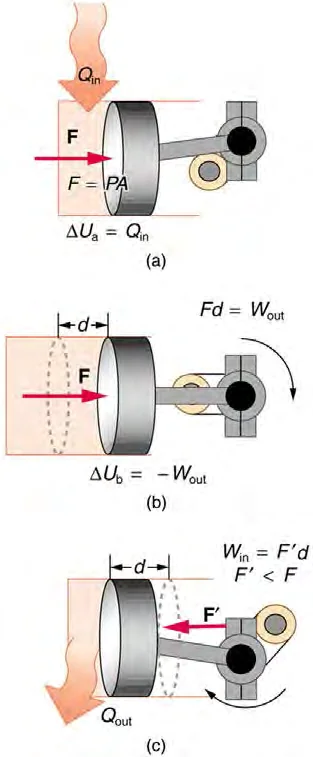
The first law of thermodynamics states that the change in internal energy of a closed system is ΔU = Q + W,
where Q is positive for energy entering by heating and W is positive for work done on the system.
3
For a constant external pressure, W = −PΔV, and the work done by a gas is the area under its curve on a PV diagram.
4
The four special processes follow from this law: isovolumetric (no work), isothermal (ΔU = 0 for an ideal gas), isobaric (constant pressure work) and adiabatic (no heat).
1 / 2Next ▶
The first law of thermodynamics: Heat added to a gas in a cylinder raises its internal energy or does work, and the cycle completes with heat rejected.
Internal energy and the first law
◀ Previous2 / 2
Entropy and the second law
Entropy and the second law
The second law of thermodynamics states that the total entropy of an isolated system can never decrease.
Entropy describes the spreading of energy and the unavailability of energy to do work.
It is a state function, and it is at its maximum when the system is in thermodynamic equilibrium (topic 9.6).
In AP Physics 2 the second law is treated qualitatively.
The entropy of a closed system can fall as it loses energy
but the total entropy of the system and its surroundings does not fall.
Key equations of Unit 9
| Equation | Symbols and SI units | Topic |
|---|---|---|
| P = F/A | P pressure (Pa); F perpendicular force (N); A area (m2) | 9.1 |
| KEaverage = (3⁄2)kBT | KE average kinetic energy per atom (J); kB = 1.38 × 10⁻²³ J/K; T absolute temperature (K) | 9.1 |
| (1/2)mvrms2 = (3⁄2)kBT, so vrms = √(3kBT/m) | m mass of one atom (kg); vrms root-mean-square speed (m/s) | 9.1 |
| PV = nRT = NkBT | V volume (m3); n amount (mol); R = 8.31 J/(mol·K); N number of atoms (no unit) | 9.2 |
| P1V1/T1 = P2V2/T2 (fixed amount of gas) | Subscripts 1 and 2 refer to two states; temperatures in K | 9.2 |
| U = (3⁄2)nRT = (3⁄2)NkBT | U internal energy of an ideal monatomic gas (J) | 9.4 |
| W = −PΔV | W work done on the system (J); P external pressure (Pa); ΔV change in volume (m3) | 9.4 |
| ΔU = Q + W | ΔU change in internal energy (J); Q energy transferred by heating (J) | 9.4 |
| Q = mcΔT | m mass (kg); c specific heat (J/(kg·K)); ΔT temperature change (K) | 9.5 |
| Q/Δt = kAΔT/L | Q/Δt rate of energy transfer (W); k thermal conductivity (W/(m·K)); A area (m2); L thickness (m) | 9.5 |
How the six topics connect
How the six topics connect
Topics 9.1 and 9.2 describe the same gas from two sides.
Topic 9.1 explains pressure and temperature through atomic collisions, and topic 9.2 gives the equation that links them to volume and amount.
Topic 9.3 explains why temperatures change,
because energy flows from hot to cold,and topic 9.5 gives the amount of energy and the rate at which it moves.
Topic 9.4 combines these ideas into energy accounting: the first law tells you how heat and work change the internal energy,
and the ideal gas formula for U links that energy back to temperature.
Topic 9.6 then explains the direction of all these processes: energy spreads out, and the total entropy of an isolated system does not decrease.
A useful way to revise the unit is to follow one sample of gas. Its temperature and pressure come from atomic motion
its state is given by the ideal gas lawheating and work change its internal energy through the first lawand its later behaviour is governed by the second law.
1Example: One mole of monatomic gas at constant pressure2Example: One mole of monatomic gas at constant pressure
Key terms
| Term | Meaning |
|---|---|
| Ideal gas | A model gas whose atoms move randomly, occupy negligible volume and interact only through elastic collisions. |
| Temperature | A measure of the average kinetic energy of the atoms in a system, measured in kelvins. |
| Internal energy | The sum of the kinetic energies of the objects in a system and the potential energy of their configuration. |
| First law of thermodynamics | The conservation of energy for a system, written as ΔU = Q + W. |
| Thermal equilibrium | The state in which two systems in thermal contact have no net energy transfer by thermal processes. |
| Specific heat | The energy needed to raise the temperature of one kilogram of a material by one kelvin. |
| Thermal conductivity | An intrinsic property of a material that determines the rate of energy conduction through it. |
| Entropy | A measure of the spreading of energy and the unavailability of energy to do work; a state function. |
| Second law of thermodynamics | The total entropy of an isolated system can never decrease. |
1Avoid these mistakes2Avoid these mistakes3Avoid these mistakes4Avoid these mistakes5Avoid these mistakes