Curriculum
AP PHYSICS 2
9. Thermodynamics
0/13
10. Electric Force, Field, and Potential
0/15
11. Electric Circuits
0/17
12. Magnetism and Electromagnetism
0/9
13. Geometric Optics
0/9
14. Waves, Sound, and Physical Optics
0/19
15. Modern Physics
0/17
-
15. Modern Physics
 Preview
-
15.1 Quantum Theory and Wave-Particle Duality
Preview
-
15.1 Quantum Theory and Wave-Particle Duality - Check yourself
 Preview
-
15.2 The Bohr Model of Atomic Structure
Preview
-
15.2 The Bohr Model of Atomic Structure - Check yourself
Preview
-
15.3 Emission and Absorption Spectra
Preview
-
15.3 Emission and Absorption Spectra - Check yourself
Preview
-
15.4 Blackbody Radiation
Preview
-
15.4 Blackbody Radiation - Check yourself
Preview
-
15.5 The Photoelectric Effect
Preview
-
15.5 The Photoelectric Effect - Check yourself
Preview
-
15.6 Compton Scattering
Preview
-
15.6 Compton Scattering - Check yourself
Preview
-
15.7 Fission, Fusion, and Nuclear Decay
Preview
-
15.7 Fission, Fusion, and Nuclear Decay - Check yourself
Preview
-
15.8 Types of Radioactive Decay
Preview
-
15.8 Types of Radioactive Decay - Check yourself
Preview
Text lesson
15.8 Types of Radioactive Decay
15.8 Types of Radioactive Decay — AP PHYSICS 2: ALGEBRA-BASED notes: You will be able to identify the particles emitted in alpha, beta-minus, beta-plus and gamma decay, write balanced nuclear equations using conservation of nucleon number, lepton number and charge, and explain how the type of decay depends on the isotope.
1
An alpha particle is a helium nucleus, which consists of two protons and two neutrons.
2
It has a charge of +2e and is written 42He.
3
In AP Physics 2, only helium-4 nuclei are considered as alpha particles.
4
A beta-minus particle is an electron, written 0−1e.
5
A positron, or antielectron, has an electric charge opposite to that of an electron and the same mass as an electron.
6
It is written 0+1e, or β+.
7
Neutrinos and antineutrinos are subatomic particles that have no electric charge and negligible mass.
8
They are written ν and ν̄, respectively.
9
They interact with ordinary matter only through the weak force and gravity, so they pass through matter with very little interaction.
10
Their detailed properties are beyond the scope of this course.
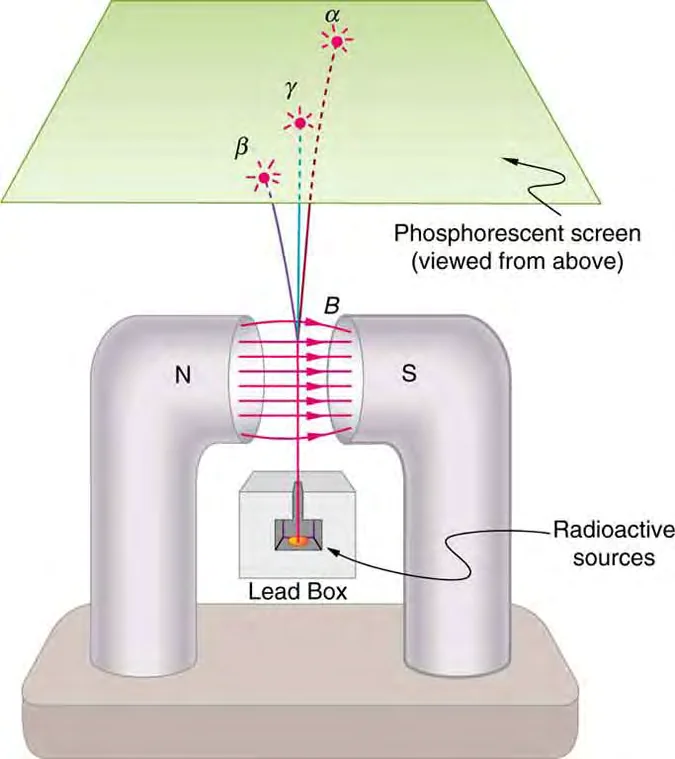
In alpha decay, a nucleus ejects an alpha particle.
The mass number falls by 4 and the atomic number falls by 2, because the alpha particle carries away two protons and two neutrons.
For example, uranium-238 decays to thorium-234:
1
Beta-minus decay occurs when a neutron changes into a proton by emitting an electron and an antineutrino.
2
The mass number does not change, and the atomic number increases by 1, because one neutron has become a proton.
3
For example, carbon-14 decays to nitrogen-14:
1
The mass number does not change, and the atomic number decreases by 1.
2
For example, carbon-11 decays to boron-11:
1
The excited nucleus drops to a lower energy state by emitting a photon of gamma-ray energy.
2
Gamma decay does not change the mass number or the atomic number of the nucleus.
3
It changes only the energy of the nucleus.
4
For example, barium-137 is left in an excited state after the beta-minus decay of caesium-137, and it then emits a gamma ray to reach its ground state:
In all nuclear decays, three quantities are conserved.
The nucleon number, which is the total number of neutrons and protons, is conserved.
The lepton number, which counts electrons and neutrinos as +1 and positrons and antineutrinos as −1, is conserved.
The total electric charge is conserved.
These rules are used to write and to check balanced nuclear equations: the sum of the mass numbers and the sum of the atomic numbers must be equal on both sides, and the missing particle is found from the difference.
The type of decay a nucleus undergoes is determined by the isotope of the element, which means its ratio of neutrons to protons.
The course does not require students to memorize which specific isotopes decay in which way, or the half-lives of specific isotopes.
Neutron emission and electron capture are not part of the AP Physics 2 framework.
Example 1
Finding the missing particle in alpha decay
1
Nucleon number: 226 = 222 + AX, so AX = 4.
2
Charge: 88 = 86 + ZX, so ZX = 2.
3
A particle with mass number 4 and atomic number 2 is a helium nucleus.
Answer
X = 42He, an alpha particle.
Example 2
Beta-minus decay with lepton number
1
The mass number is unchanged, and the atomic number increases by 1, so a neutron has become a proton.
2
The emitted particles are an electron, 0−1e, and an antineutrino, ν̄.
3
Check the charge: 55 = 56 + (−1) + 0 ✓
4
Check the nucleon number: 137 = 137 + 0 + 0 ✓
5
Check the lepton number: Before the decay it is 0, after the decay it is (+1) from the electron and (−1) from the antineutrino, a total of 0 ✓
Answer
X = 0−1e and Y = ν̄. The decay is beta-minus.
Example 3
Beta-plus decay
1
The mass number is unchanged and the atomic number decreases by 1, so a proton has become a neutron.
2
The emitted particles are a positron and a neutrino
3
Check the charge: 6 = 5 + (+1) + 0 ✓; The positron contributes −1 and the neutrino contributes +1, a total of 0, which matches the lepton number of 0 before the decay ✓
Answer
X = 0+1e (a positron) and Y = ν (a neutrino).
Changing the atomic number in the wrong direction
In beta-minus decay the atomic number increases by 1; in beta-plus decay it decreases by 1.
Writing a beta-minus particle as having a positive charge
The beta-minus electron has charge −1, so its atomic-number entry is −1.
Thinking that gamma decay changes the mass number or the atomic number
A gamma ray is only a photon released by the nucleus, so both numbers stay the same.
Forgetting the antineutrino in beta-minus decay, or the neutrino in beta-plus decay
These are required to conserve lepton number.
Assuming that an alpha particle is a single helium atom with its electrons
In nuclear equations it is a bare helium-4 nucleus, 42He.
Trying to balance a nuclear equation with chemical-style rules for molecules
Balance the mass numbers and atomic numbers separately, as sums on each side.