Curriculum
AP PHYSICS 2
9. Thermodynamics
0/13
10. Electric Force, Field, and Potential
0/15
11. Electric Circuits
0/17
12. Magnetism and Electromagnetism
0/9
13. Geometric Optics
0/9
14. Waves, Sound, and Physical Optics
0/19
-
14. Waves, Sound, and Physical Optics
 Preview
-
14.1 Properties of Wave Pulses and Waves
Preview
-
14.1 Properties of Wave Pulses and Waves - Check yourself
 Preview
-
14.2 Periodic Waves
Preview
-
14.2 Periodic Waves - Check yourself
Preview
-
14.3 Boundary Behavior of Waves and Polarization
Preview
-
14.3 Boundary Behavior of Waves and Polarization - Check yourself
Preview
-
14.4 Electromagnetic Waves
Preview
-
14.4 Electromagnetic Waves - Check yourself
Preview
-
14.5 The Doppler Effect
Preview
-
14.5 The Doppler Effect - Check yourself
Preview
-
14.6 Wave Interference and Standing Waves
Preview
-
14.6 Wave Interference and Standing Waves - Check yourself
Preview
-
14.7 Diffraction
Preview
-
14.7 Diffraction - Check yourself
Preview
-
14.8 Double-Slit Interference and Diffraction Gratings
Preview
-
14.8 Double-Slit Interference and Diffraction Gratings - Check yourself
Preview
-
14.9 Thin-Film Interference
Preview
-
14.9 Thin-Film Interference - Check yourself
Preview
15. Modern Physics
0/17
Text lesson
14.6 Wave Interference and Standing Waves
14.6 Wave Interference and Standing Waves — AP PHYSICS 2: ALGEBRA-BASED notes: You will be able to find the net displacement when two waves overlap by superposition, classify interference as constructive or destructive, calculate a beat frequency, and describe a standing wave with its nodes and antinodes, calculating the wavelengths and frequencies of its harmonics for a string or a pipe.
1
When wave pulses or waves meet, they pass through each other and continue on their original paths, rather than bouncing off each other.
2
During the overlap, the displacement of the medium at each point is the sum of the displacements that each wave would produce on its own.
3
This rule is called superposition.
4
When the displacements of the overlapping waves are in the same direction, the interaction is constructive interference, and the resultant displacement is larger than either wave alone.
5
When the displacements are in opposite directions, the interaction is destructive interference, and the resultant displacement is smaller.
6
Two identical pulses that meet with their displacements in the same direction produce a single pulse of twice the height at the moment they overlap.
7
Two identical pulses that are inverted relative to each other cancel at the moment of overlap.
8
Two or more waves can produce variations in amplitude along the resultant wave.
9
Where constructive interference occurs the amplitude is large, and where destructive interference occurs the amplitude is small.
10
Visual representations, such as drawing the two waves and adding their displacements point by point, are a reliable way to find the result.
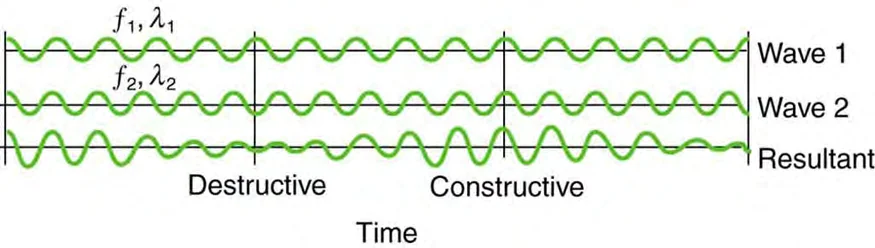
Beats arise from the addition of two waves of slightly different frequency.
When the two waves are in phase they reinforce each other, and when they are out of phase they cancel, so the amplitude of the resultant wave rises and falls periodically.
The loudness of a sound heard from two nearly equal frequencies pulses at the beat frequency.
The beat frequency is the difference between the frequencies of the two waves:
1
Where fbeat is the beat frequency in hertz (Hz), and f1 and f2 are the frequencies of the two waves.
2
Tuning forks are commonly used to demonstrate beats.
3
Two forks with frequencies 440 Hz and 442 Hz produce two beats every second, and musicians use the beats to tune an instrument until they disappear.
1
A standing wave can result from the interference of two waves that are confined to a region and travel in opposite directions.
2
The incident and reflected waves combine to produce a pattern that does not move along the region.
3
A standing wave has points at which the amplitude is always zero, called nodes, and points at which the amplitude is always at its maximum, called antinodes.
4
Nodes and antinodes are separated by a quarter of a wavelength.
5
Standing waves form in regions such as strings with fixed or loose ends and pipes with open or closed ends.
6
The boundary conditions at the ends of the region determine which wavelengths are possible.
7
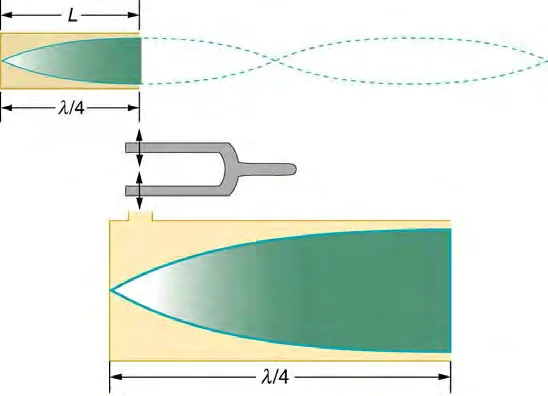
A fixed end of a string must be a node, while an open end of a pipe is an antinode of the displacement of the air, (and a node of the pressure), and a closed end is a node of the displacement.
1
The second-longest wavelength is the second harmonic, the third-longest is the third harmonic, and so on.
2
For a string of length L fixed at both ends, the wavelengths are λn = 2L/n and the frequencies are fn = nv/(2L), for n = 1, 2, 3, and so on.
3
The same relationships hold for a pipe that is open at both ends.
4
For a standing wave with a node at one end and an antinode at the other, only odd harmonics can be established.
5
Such a region is a pipe that is closed at one end and open at the other, or a string that is fixed at one end and free at the other.
6
Its frequencies are fn = nv/(4L) for n = 1, 3, 5, and so on, where v is the wave speed in metres per second (m/s) and L is the length of the region in metres (m).
7
The wavelength and the frequency of each harmonic are linked by v = fλ.
Example 1
Harmonics of a string
1
f1 = v/(2L) = (60 m/s)/(2 × 0.90 m) = 33.3 Hz.
2
The third harmonic has n = 3, so f3 = 3f1 = 100 Hz.
Answer
The fundamental is 33 Hz and the third harmonic is 100 Hz.
Example 2
Beat frequency of two tuning forks
1
fbeat = |f1 − f2| = 4 Hz, so f2 = 440 Hz ± 4 Hz.
2
The second fork can be 436 Hz or 444 Hz.
Answer
436 Hz or 444 Hz. The beat frequency alone does not show which, so a further test, such as loading the second fork with a small mass, is needed to decide.
Example 3
Closed pipe and open pipe of the same length
1
For the pipe closed at one end, f1 = v/(4L) = 340/(4 × 0.50) = 170 Hz.
2
Only odd harmonics exist, so the third harmonic is f3 = 3 × 170 Hz = 510 Hz.
3
For the pipe open at both ends, the fundamental is f1 = v/(2L) = 340/(2 × 0.50) = 340 Hz.
Answer
The closed pipe has a fundamental of 170 Hz and a third harmonic of 510 Hz. The open pipe has a fundamental of 340 Hz, which is twice that of the closed pipe.
Thinking that two waves bounce off each other when they meet
They pass through each other and the displacements add.
Using nv/(2L) for a pipe closed at one end, or including even harmonics in that case
A closed-open region has only odd harmonics and uses L/4 in the formula.
Taking the length of a string as the wavelength of its fundamental
For a string fixed at both ends, the fundamental wavelength is twice the length.
Avoid
Using the sum of the frequencies, rather than the difference, as the beat frequency
Avoid
Confusing a node, where the amplitude is always zero, with an antinode, where the amplitude is always a maximum