Curriculum
AP PHYSICS 2
9. Thermodynamics
0/13
10. Electric Force, Field, and Potential
0/15
11. Electric Circuits
0/17
12. Magnetism and Electromagnetism
0/9
13. Geometric Optics
0/9
14. Waves, Sound, and Physical Optics
0/19
-
14. Waves, Sound, and Physical Optics
 Preview
-
14.1 Properties of Wave Pulses and Waves
Preview
-
14.1 Properties of Wave Pulses and Waves - Check yourself
 Preview
-
14.2 Periodic Waves
Preview
-
14.2 Periodic Waves - Check yourself
Preview
-
14.3 Boundary Behavior of Waves and Polarization
Preview
-
14.3 Boundary Behavior of Waves and Polarization - Check yourself
Preview
-
14.4 Electromagnetic Waves
Preview
-
14.4 Electromagnetic Waves - Check yourself
Preview
-
14.5 The Doppler Effect
Preview
-
14.5 The Doppler Effect - Check yourself
Preview
-
14.6 Wave Interference and Standing Waves
Preview
-
14.6 Wave Interference and Standing Waves - Check yourself
Preview
-
14.7 Diffraction
Preview
-
14.7 Diffraction - Check yourself
Preview
-
14.8 Double-Slit Interference and Diffraction Gratings
Preview
-
14.8 Double-Slit Interference and Diffraction Gratings - Check yourself
Preview
-
14.9 Thin-Film Interference
Preview
-
14.9 Thin-Film Interference - Check yourself
Preview
15. Modern Physics
0/17
Text lesson
14. Waves, Sound, and Physical Optics
Unit 14 Waves, Sound, and Physical Optics — AP PHYSICS 2: ALGEBRA-BASED notes: You will be able to connect the nine topics of Unit 14 by explaining how every wave is described by its speed, frequency, wavelength and amplitude, how waves change at boundaries and overlap, how the Doppler effect and standing waves depend on motion and confinement, and how the diffraction and interference of light show that light behaves as a wave.
1Describing any wave2Describing any wave3Describing any wave4Describing any wave5Describing any wave
Transverse and longitudinal waves, and electromagnetic waves · Transverse and longitudinal waves, and electromagnetic waves
Transverse and longitudinal waves, and electromagnetic waves
The disturbance of a transverse wave is perpendicular to its direction of propagation, and the disturbance of a longitudinal wave is parallel to it (topic 14.1).
Transverse and longitudinal waves, and electromagnetic waves
Only transverse waves can be polarized
which restricts their oscillation to one plane and reduces the intensity of the wave (topic 14.3).
Electromagnetic waves are transverse waves of oscillating electric and magnetic fields,
and their wavelengths place them in the order of the spectrum from radio waves to gamma rays, with visible light between infrared and ultraviolet (topic 14.4).
1Boundaries, intensity and motion of sources2Boundaries, intensity and motion of sources3Boundaries, intensity and motion of sources
1Superposition, beats and standing waves2Superposition, beats and standing waves3Superposition, beats and standing waves
1Diffraction and interference of light2Diffraction and interference of light3Diffraction and interference of light4Diffraction and interference of light
Diffraction and interference of light
Diffraction and interference of light
Diffraction is the spreading of a wave through an opening, and it is most pronounced when the opening is comparable to the wavelength (topic 14.7).
1
A single slit of width
a
has dark bands where
sin
1 / 4Next ▶
Diffraction and interference of light
1
θ
2
=
3
mλ
4
.
5
2
6
Two slits separated by
◀ Previous2 / 4Next ▶
Diffraction and interference of light
Diffraction and interference of light
d
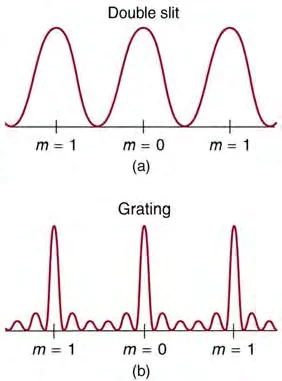
produce bright maxima where
, superimposed on the single-slit envelope,
and a diffraction grating gives the same maxima with much sharper peaks (topic 14.8).
3
Young’s double-slit experiment showed that light is a wave.
◀ Previous3 / 4Next ▶
Double-slit interference: Double-slit fringes compared with the much sharper maxima from a grating.
Diffraction and interference of light
 ⤢ Enlarge
Diffraction and interference of light
4
Thin films reflect light from two surfaces,
and the phase change of each reflection, together with the film thickness and wavelength, decides whether the reflected light is brighter or darker (topic 14.9).
◀ Previous4 / 4
1How the topics connect2How the topics connect
Key equations of Unit 14
| Equation | Symbols and SI units | Topic |
|---|---|---|
| v = fλ = λ/T; T = 1/f | v wave speed (m/s); f frequency (Hz); λ wavelength (m); T period (s) | 14.2 |
| y(x, t) = A sin[2π(x/λ − t/T)] | y displacement (m); A amplitude (m); x position (m); t time (s) | 14.2 |
| v = √(FT/μ), with μ = m/ℓ | FT tension (N); μ mass per unit length (kg/m) | 14.1 |
| I = P/A | I intensity (W/m2); P average power (W); A area perpendicular to propagation (m2) | 14.3 |
| c = fλ, with c = 3.00 × 10⁸ m/s | c speed of light in a vacuum (m/s); f (Hz); λ (m) | 14.4 |
| fbeat = |f1 − f2| | fbeat, f1, f2 frequencies (Hz) | 14.6 |
| λn = 2L/n; fn = nv/(2L) (both ends fixed or open) | L length of region (m); n = 1, 2, 3 (harmonic number) | 14.6 |
| fn = nv/(4L), for n = 1, 3, 5 (node at one end, antinode at the other) | n odd harmonic number; L (m); v (m/s) | 14.6 |
| a sin θ = mλ (single-slit minima); Δ = a sin θ | a slit width (m); θ angle (degrees or radians); m = ±1, ±2, … (no zero) | 14.7 |
| ym = mλL/a (single slit, small angles) | ym distance from centre (m); L screen distance (m) | 14.7 |
| d sin θ = mλ (double-slit and grating maxima) | d slit separation (m); m = 0, ±1, ±2, … | 14.8 |
| ym = mλL/d; Δy = λL/d (small angles) | Δy fringe spacing (m); d (m); L (m) | 14.8 |
| 2nt = mλ and 2nt = (m + ½)λ (thin film, normal incidence; the first applies when both or neither reflection is inverted) | n index of refraction (no unit); t film thickness (m); λ vacuum wavelength (m) | 14.9 |
| t = λ/(4n) (simplest antireflection coating) | t coating thickness (m); λ vacuum wavelength (m) | 14.9 |
Key terms
| Term | Meaning |
|---|---|
| Superposition | The principle that the displacement of overlapping waves is the sum of their individual displacements. |
| Standing wave | A pattern produced by two waves travelling in opposite directions in a confined region, with fixed nodes and antinodes. |
| Diffraction | The spreading of a wave around the edges of an obstacle or through an opening. |
| Doppler effect | The change in observed frequency caused by the relative motion of a source and an observer. |
| Polarization | The restriction of the oscillation of a transverse wave to a single plane. |
| Thin film | A layer whose thickness is comparable to the wavelength of light, so that its two surfaces reflect light that interferes. |
1Avoid these mistakes2Avoid these mistakes3Avoid these mistakes