Curriculum
College Physics for AP Courses 2e
Unit 1
0/5
Unit 2
0/91.1Unit 2 overview: Kinematics2.1Displacement2.2Vectors, Scalars, and Coordinate Systems2.3Time, Velocity, and Speed2.4Acceleration2.5Motion Equations for Constant Acceleration in One Dimension2.6Problem-Solving Basics for One-Dimensional Kinematics2.7Falling Objects2.8Graphical Analysis of One-Dimensional Motion
Unit 3
0/6Unit 4
0/91.1Unit 4 overview: Dynamics: Force and Newton's Laws of Motion4.1Development of Force Concept4.2Newton’s First Law of Motion: Inertia4.3Newton’s Second Law of Motion: Concept of a System4.4Newton’s Third Law of Motion: Symmetry in Forces4.5Normal, Tension, and Other Examples of Forces4.6Problem-Solving Strategies4.7Further Applications of Newton’s Laws of Motion4.8Extended Topic: The Four Basic Forces—An Introduction
Unit 5
0/4Unit 6
0/71.1Unit 6 overview: Uniform Circular Motion and Gravitation6.1Rotation Angle and Angular Velocity6.2Centripetal Acceleration6.3Centripetal Force6.4Fictitious Forces and Non-inertial Frames: The Coriolis Force6.5Newton’s Universal Law of Gravitation6.6Satellites and Kepler’s Laws: An Argument for Simplicity
Unit 7
0/101.1Unit 7 overview: Work, Energy, and Energy Resources7.1Work: The Scientific Definition7.2Kinetic Energy and the Work-Energy Theorem7.3Gravitational Potential Energy7.4Conservative Forces and Potential Energy7.5Nonconservative Forces7.6Conservation of Energy7.7Power7.8Work, Energy, and Power in Humans7.9World Energy Use
Unit 8
0/161.1Unit 8 overview: Linear Momentum and Collisions8.1Linear Momentum and Force8.1Linear Momentum and Force8.2Impulse8.2Impulse8.3Conservation of Momentum8.3Conservation of Momentum8.4Elastic Collisions in One Dimension1.9Unit 8 overview: Linear Momentum and Collisions8.4Elastic Collisions in One Dimension8.5Inelastic Collisions in One Dimension8.5Inelastic Collisions in One Dimension8.6Collisions of Point Masses in Two Dimensions8.6Collisions of Point Masses in Two Dimensions8.7Introduction to Rocket Propulsion8.7Introduction to Rocket Propulsion
Unit 9
0/141.1Unit 9 overview: Statics and Torque9.1The First Condition for Equilibrium9.1The First Condition for Equilibrium9.2The Second Condition for Equilibrium9.2The Second Condition for Equilibrium9.3Stability9.3Stability1.8Unit 9 overview: Statics and Torque9.4Applications of Statics, Including Problem-Solving Strategies9.4Applications of Statics, Including Problem-Solving Strategies9.5Simple Machines9.5Simple Machines9.6Forces and Torques in Muscles and Joints9.6Forces and Torques in Muscles and Joints
Unit 10
0/161.1Unit 10 overview: Rotational Motion and Angular Momentum10.1Angular Acceleration10.1Angular Acceleration10.2Kinematics of Rotational Motion10.2Kinematics of Rotational Motion10.3Dynamics of Rotational Motion: Rotational Inertia10.3Dynamics of Rotational Motion: Rotational Inertia10.4Rotational Kinetic Energy: Work and Energy Revisited1.9Unit 10 overview: Rotational Motion and Angular Momentum10.4Rotational Kinetic Energy: Work and Energy Revisited10.5Angular Momentum and Its Conservation10.5Angular Momentum and Its Conservation10.6Collisions of Extended Bodies in Two Dimensions10.6Collisions of Extended Bodies in Two Dimensions10.7Gyroscopic Effects: Vector Aspects of Angular Momentum10.7Gyroscopic Effects: Vector Aspects of Angular Momentum
Unit 11
0/201.1Unit 11 overview: Fluid Statics11.1What Is a Fluid?11.1What Is a Fluid?11.2Density11.2Density11.3Pressure11.3Pressure11.4Variation of Pressure with Depth in a Fluid11.4Variation of Pressure with Depth in a Fluid11.5Pascal’s Principle1.11Unit 11 overview: Fluid Statics11.5Pascal’s Principle11.6Gauge Pressure, Absolute Pressure, and Pressure Measurement11.6Gauge Pressure, Absolute Pressure, and Pressure Measurement11.7Archimedes’ Principle11.7Archimedes’ Principle11.8Cohesion and Adhesion in Liquids: Surface Tension and Capillary Action11.8Cohesion and Adhesion in Liquids: Surface Tension and Capillary Action11.9Pressures in the Body11.9Pressures in the Body
Unit 12
0/161.1Unit 12 overview: Fluid Dynamics and Its Biological and Medical Applications12.1Flow Rate and Its Relation to Velocity12.1Flow Rate and Its Relation to Velocity12.2Bernoulli’s Equation12.2Bernoulli’s Equation12.3The Most General Applications of Bernoulli’s Equation12.3The Most General Applications of Bernoulli’s Equation12.4Viscosity and Laminar Flow; Poiseuille’s Law1.9Unit 12 overview: Fluid Dynamics and Its Biological and Medical Applications12.4Viscosity and Laminar Flow; Poiseuille’s Law12.5The Onset of Turbulence12.5The Onset of Turbulence12.6Motion of an Object in a Viscous Fluid12.6Motion of an Object in a Viscous Fluid12.7Molecular Transport Phenomena: Diffusion, Osmosis, and Related Processes12.7Molecular Transport Phenomena: Diffusion, Osmosis, and Related Processes
Unit 13
0/141.1Unit 13 overview: Temperature, Kinetic Theory, and the Gas Laws13.1Temperature13.1Temperature13.2Thermal Expansion of Solids and Liquids13.2Thermal Expansion of Solids and Liquids13.3The Ideal Gas Law13.3The Ideal Gas Law1.8Unit 13 overview: Temperature, Kinetic Theory, and the Gas Laws13.4Kinetic Theory: Atomic and Molecular Explanation of Pressure and Temperature13.4Kinetic Theory: Atomic and Molecular Explanation of Pressure and Temperature13.5Phase Changes13.5Phase Changes13.6Humidity, Evaporation, and Boiling13.6Humidity, Evaporation, and Boiling
Unit 14
0/161.1Unit 14 overview: Heat and Heat Transfer Methods14.1Heat14.1Heat14.2Temperature Change and Heat Capacity14.2Temperature Change and Heat Capacity14.3Phase Change and Latent Heat14.3Phase Change and Latent Heat14.4Heat Transfer Methods1.9Unit 14 overview: Heat and Heat Transfer Methods14.4Heat Transfer Methods14.5Conduction14.5Conduction14.6Convection14.6Convection14.7Radiation14.7Radiation
Unit 15
0/161.1Unit 15 overview: Thermodynamics15.1The First Law of Thermodynamics15.1The First Law of Thermodynamics15.2The First Law of Thermodynamics and Some Simple Processes15.2The First Law of Thermodynamics and Some Simple Processes15.3Introduction to the Second Law of Thermodynamics: Heat Engines and Their Efficiency15.3Introduction to the Second Law of Thermodynamics: Heat Engines and Their Efficiency15.4Carnot’s Perfect Heat Engine: The Second Law of Thermodynamics Restated1.9Unit 15 overview: Thermodynamics15.4Carnot’s Perfect Heat Engine: The Second Law of Thermodynamics Restated15.5Applications of Thermodynamics: Heat Pumps and Refrigerators15.5Applications of Thermodynamics: Heat Pumps and Refrigerators15.6Entropy and the Second Law of Thermodynamics: Disorder and the Unavailability of Energy15.6Entropy and the Second Law of Thermodynamics: Disorder and the Unavailability of Energy15.7Statistical Interpretation of Entropy and the Second Law of Thermodynamics: The Underlying Explanation15.7Statistical Interpretation of Entropy and the Second Law of Thermodynamics: The Underlying Explanation
Unit 16
0/241.1Unit 16 overview: Oscillatory Motion and Waves16.1Hooke’s Law: Stress and Strain Revisited16.1Hooke’s Law: Stress and Strain Revisited16.2Period and Frequency in Oscillations16.2Period and Frequency in Oscillations16.3Simple Harmonic Motion: A Special Periodic Motion16.3Simple Harmonic Motion: A Special Periodic Motion16.4The Simple Pendulum16.4The Simple Pendulum16.5Energy and the Simple Harmonic Oscillator16.5Energy and the Simple Harmonic Oscillator16.6Uniform Circular Motion and Simple Harmonic Motion1.13Unit 16 overview: Oscillatory Motion and Waves16.6Uniform Circular Motion and Simple Harmonic Motion16.7Damped Harmonic Motion16.7Damped Harmonic Motion16.8Forced Oscillations and Resonance16.8Forced Oscillations and Resonance16.9Waves16.9Waves16.10Superposition and Interference16.10Superposition and Interference16.11Energy in Waves: Intensity16.11Energy in Waves: Intensity
Unit 17
0/161.1Unit 17 overview: Physics of Hearing17.1Sound17.1Sound17.2Speed of Sound, Frequency, and Wavelength17.2Speed of Sound, Frequency, and Wavelength17.3Sound Intensity and Sound Level17.3Sound Intensity and Sound Level17.4Doppler Effect and Sonic Booms1.9Unit 17 overview: Physics of Hearing17.4Doppler Effect and Sonic Booms17.5Sound Interference and Resonance: Standing Waves in Air Columns17.5Sound Interference and Resonance: Standing Waves in Air Columns17.6Hearing17.6Hearing17.7Ultrasound17.7Ultrasound
Unit 18
0/181.1Unit 18 overview: Electric Charge and Electric Field18.1Static Electricity and Charge: Conservation of Charge18.1Static Electricity and Charge: Conservation of Charge18.2Conductors and Insulators18.2Conductors and Insulators18.3Conductors and Electric Fields in Static Equilibrium18.3Conductors and Electric Fields in Static Equilibrium18.4Coulomb’s Law18.4Coulomb’s Law1.10Unit 18 overview: Electric Charge and Electric Field18.5Electric Field: Concept of a Field Revisited18.5Electric Field: Concept of a Field Revisited18.6Electric Field Lines: Multiple Charges18.6Electric Field Lines: Multiple Charges18.7Electric Forces in Biology18.7Electric Forces in Biology18.8Applications of Electrostatics18.8Applications of Electrostatics
Unit 19
0/161.1Unit 19 overview: Electric Potential and Electric Field19.1Electric Potential Energy: Potential Difference19.1Electric Potential Energy: Potential Difference19.2Electric Potential in a Uniform Electric Field19.2Electric Potential in a Uniform Electric Field19.3Electrical Potential Due to a Point Charge19.3Electrical Potential Due to a Point Charge19.4Equipotential Lines1.9Unit 19 overview: Electric Potential and Electric Field19.4Equipotential Lines19.5Capacitors and Dielectrics19.5Capacitors and Dielectrics19.6Capacitors in Series and Parallel19.6Capacitors in Series and Parallel19.7Energy Stored in Capacitors19.7Energy Stored in Capacitors
Unit 20
0/161.1Unit 20 overview: Electric Current, Resistance, and Ohm's Law20.1Current20.1Current20.2Ohm’s Law: Resistance and Simple Circuits20.2Ohm’s Law: Resistance and Simple Circuits20.3Resistance and Resistivity20.3Resistance and Resistivity20.4Electric Power and Energy1.9Unit 20 overview: Electric Current, Resistance, and Ohm's Law20.4Electric Power and Energy20.5Alternating Current versus Direct Current20.5Alternating Current versus Direct Current20.6Electric Hazards and the Human Body20.6Electric Hazards and the Human Body20.7Nerve Conduction–Electrocardiograms20.7Nerve Conduction–Electrocardiograms
Unit 21
0/141.1Unit 21 overview: Circuits and DC Instruments21.1Resistors in Series and Parallel21.1Resistors in Series and Parallel21.2Electromotive Force: Terminal Voltage21.2Electromotive Force: Terminal Voltage21.3Kirchhoff’s Rules21.3Kirchhoff’s Rules1.8Unit 21 overview: Circuits and DC Instruments21.4DC Voltmeters and Ammeters21.4DC Voltmeters and Ammeters21.5Null Measurements21.5Null Measurements21.6DC Circuits Containing Resistors and Capacitors21.6DC Circuits Containing Resistors and Capacitors
Unit 22
0/241.1Unit 22 overview: Magnetism22.1Magnets22.1Magnets22.2Ferromagnets and Electromagnets22.2Ferromagnets and Electromagnets22.3Magnetic Fields and Magnetic Field Lines22.3Magnetic Fields and Magnetic Field Lines22.4Magnetic Field Strength: Force on a Moving Charge in a Magnetic Field22.4Magnetic Field Strength: Force on a Moving Charge in a Magnetic Field22.5Force on a Moving Charge in a Magnetic Field: Examples and Applications22.5Force on a Moving Charge in a Magnetic Field: Examples and Applications22.6The Hall Effect1.13Unit 22 overview: Magnetism22.6The Hall Effect22.7Magnetic Force on a Current-Carrying Conductor22.7Magnetic Force on a Current-Carrying Conductor22.8Torque on a Current Loop: Motors and Meters22.8Torque on a Current Loop: Motors and Meters22.9Magnetic Fields Produced by Currents: Ampere’s Law22.9Magnetic Fields Produced by Currents: Ampere’s Law22.10Magnetic Force between Two Parallel Conductors22.10Magnetic Force between Two Parallel Conductors22.11More Applications of Magnetism22.11More Applications of Magnetism
Unit 23
0/261.1Unit 23 overview: Electromagnetic Induction, AC Circuits, and Electrical Technologies23.1Induced Emf and Magnetic Flux23.1Induced Emf and Magnetic Flux23.2Faraday’s Law of Induction: Lenz’s Law23.2Faraday’s Law of Induction: Lenz’s Law23.3Motional Emf23.3Motional Emf23.4Eddy Currents and Magnetic Damping23.4Eddy Currents and Magnetic Damping23.5Electric Generators23.5Electric Generators23.6Back Emf23.6Back Emf1.14Unit 23 overview: Electromagnetic Induction, AC Circuits, and Electrical Technologies23.7Transformers23.7Transformers23.8Electrical Safety: Systems and Devices23.8Electrical Safety: Systems and Devices23.9Inductance23.9Inductance23.10RL Circuits23.10RL Circuits23.11Reactance, Inductive and Capacitive23.11Reactance, Inductive and Capacitive23.12RLC Series AC Circuits23.12RLC Series AC Circuits
Unit 24
0/101.1Unit 24 overview: Electromagnetic Waves24.1Maxwell’s Equations: Electromagnetic Waves Predicted and Observed24.1Maxwell’s Equations: Electromagnetic Waves Predicted and Observed24.2Production of Electromagnetic Waves24.2Production of Electromagnetic Waves1.6Unit 24 overview: Electromagnetic Waves24.3The Electromagnetic Spectrum24.3The Electromagnetic Spectrum24.4Energy in Electromagnetic Waves24.4Energy in Electromagnetic Waves
Unit 25
0/161.1Unit 25 overview: Geometric Optics25.1The Ray Aspect of Light25.1The Ray Aspect of Light25.2The Law of Reflection25.2The Law of Reflection25.3The Law of Refraction25.3The Law of Refraction25.4Total Internal Reflection1.9Unit 25 overview: Geometric Optics25.4Total Internal Reflection25.5Dispersion: The Rainbow and Prisms25.5Dispersion: The Rainbow and Prisms25.6Image Formation by Lenses25.6Image Formation by Lenses25.7Image Formation by Mirrors25.7Image Formation by Mirrors
Unit 26
0/141.1Unit 26 overview: Vision and Optical Instruments26.1Physics of the Eye26.1Physics of the Eye26.2Vision Correction26.2Vision Correction26.3Color and Color Vision26.3Color and Color Vision1.8Unit 26 overview: Vision and Optical Instruments26.4Microscopes26.4Microscopes26.5Telescopes26.5Telescopes26.6Aberrations26.6Aberrations
Unit 27
0/201.1Unit 27 overview: Wave Optics27.1The Wave Aspect of Light: Interference27.1The Wave Aspect of Light: Interference27.2Huygens's Principle: Diffraction27.2Huygens's Principle: Diffraction27.3Young’s Double Slit Experiment27.3Young’s Double Slit Experiment27.4Multiple Slit Diffraction27.4Multiple Slit Diffraction27.5Single Slit Diffraction1.11Unit 27 overview: Wave Optics27.5Single Slit Diffraction27.6Limits of Resolution: The Rayleigh Criterion27.6Limits of Resolution: The Rayleigh Criterion27.7Thin Film Interference27.7Thin Film Interference27.8Polarization27.8Polarization27.9*Extended Topic* Microscopy Enhanced by the Wave Characteristics of Light27.9*Extended Topic* Microscopy Enhanced by the Wave Characteristics of Light
Unit 28
0/141.1Unit 28 overview: Special Relativity28.1Einstein’s Postulates28.1Einstein’s Postulates28.2Simultaneity And Time Dilation28.2Simultaneity And Time Dilation28.3Length Contraction28.3Length Contraction1.8Unit 28 overview: Special Relativity28.4Relativistic Addition of Velocities28.4Relativistic Addition of Velocities28.5Relativistic Momentum28.5Relativistic Momentum28.6Relativistic Energy28.6Relativistic Energy
Unit 29
0/181.1Unit 29 overview: Quantum Physics29.1Quantization of Energy29.1Quantization of Energy29.2The Photoelectric Effect29.2The Photoelectric Effect29.3Photon Energies and the Electromagnetic Spectrum29.3Photon Energies and the Electromagnetic Spectrum29.4Photon Momentum29.4Photon Momentum1.10Unit 29 overview: Quantum Physics29.5The Particle-Wave Duality29.5The Particle-Wave Duality29.6The Wave Nature of Matter29.6The Wave Nature of Matter29.7Probability: The Heisenberg Uncertainty Principle29.7Probability: The Heisenberg Uncertainty Principle29.8The Particle-Wave Duality Reviewed29.8The Particle-Wave Duality Reviewed
Unit 30
0/101.1Unit 30 overview: Atomic Physics30.1Discovery of the Atom30.2Discovery of the Parts of the Atom: Electrons and Nuclei30.3Bohr’s Theory of the Hydrogen Atom30.4X Rays: Atomic Origins and Applications30.5Applications of Atomic Excitations and De-Excitations30.6The Wave Nature of Matter Causes Quantization30.7Patterns in Spectra Reveal More Quantization30.8Quantum Numbers and Rules30.9The Pauli Exclusion Principle
Unit 31
0/8Unit 32
0/8Unit 33
0/7Unit 34
0/8
Text lesson
26.6 Aberrations
Aberrations
26.6 Why real lenses differ from the model
Why real lenses differ from the model

- An artist’s impression of the Australian Square Kilometre Array Pathfinder, a large telescope array in Western Australia that collects faint signals from distant sources.
- Image: OpenStax, College Physics for AP Courses 2e, CC BY 4.0.
Why real lenses differ from the model
⤢ Enlarge
Why real lenses differ from the model
- The thin lens equations describe an idealized lens.
- Real lenses behave somewhat differently, and this produces aberrations.
- An aberration is a distortion in an image.
- The size of a lens, the material it is made from, its thickness and the position of the object all affect which aberrations appear,
- and some of them can be large enough to blur or deform the image.
26.6 Aberrations · 1 / 9
26.6 Chromatic aberration
Chromatic aberration
- Chromatic aberration
- Chromatic aberration
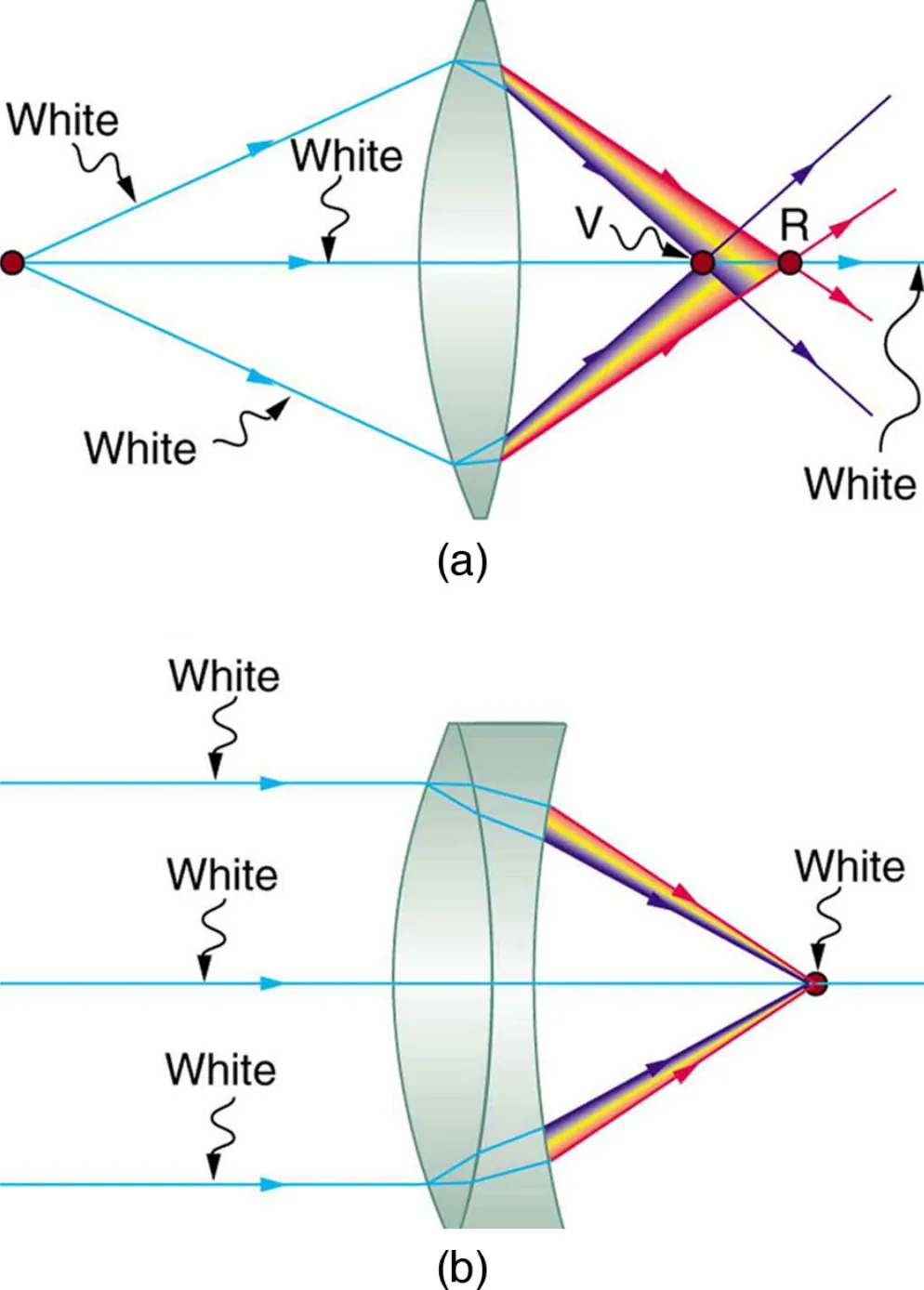
- Chromatic aberration is an aberration related to color.
- The index of refraction of a lens material depends on the wavelength of the light passing through it
- so light of different colors is bent by different amounts.
- As a result, a single lens forms images of different colors at different places and with different magnifications.
- 2Violet light has a higher index of refraction than red light
- so a convex lens bends violet rays more strongly and brings them to a focus closer to the lens than red rays.
- The image of white light therefore becomes a set of colored images at slightly different positions.
- 4A mirror does not suffer from this problem
- because the law of reflection does not depend on wavelength.
- This is one reason mirrors are used in telescopes.
- 1 / 2Next ▶
- Part (a) shows white light focusing at different points for violet and red, and part (b) shows a two-lens system that brings the colors much closer together.
- Image: OpenStax, College Physics for AP Courses 2e, CC BY 4.0.
- Chromatic aberration
- ⤢ Enlarge
- Chromatic aberration
- A diverging lens placed next to a converging lens can partly correct chromatic aberration
- but in most cases it cannot remove it completely.
- A better approach is to use two lenses made of different glasses with different dispersions.
- An achromatic doublet combines a converging lens made of crown glass with a diverging lens made of flint glass,
- and the two are cemented together in contact.
- This combination greatly reduces chromatic aberration.
- ◀ Previous, 2 / 2
26.6 Aberrations · 2 / 9
26.6 Coma
Coma
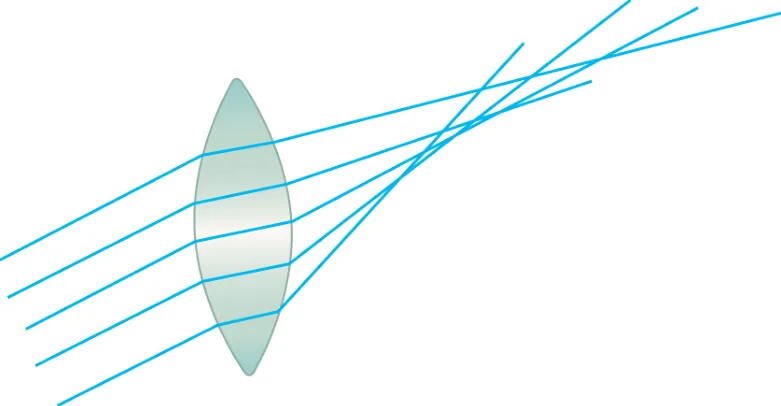
- Parallel rays arriving at an angle to a lens cross at several different points instead of meeting at one focus, which smears the image into a pear shape.
- Image: OpenStax, College Physics for AP Courses 2e, CC BY 4.0.
- Coma
26.6 Aberrations · 3 / 9
26.6 Spherical aberration
Spherical aberration
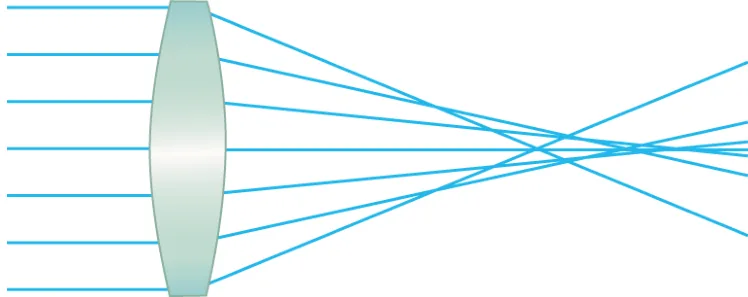
- Parallel rays hitting a lens at different distances from the axis focus at different distances, so no single point of focus exists.
- Image: OpenStax, College Physics for AP Courses 2e, CC BY 4.0.
Spherical aberration
⤢ Enlarge
Spherical aberration
- Spherical aberration occurs because rays that pass through the outer edges of a lens are bent more strongly than rays that pass close to the axis.
- Rays from the edge converge to a focus closer to the lens
- while rays near the axis focus farther away. The image of a point is therefore spread out rather than sharp.
26.6 Aberrations · 4 / 9
26.6 Astigmatism and manufacturing errors
Astigmatism and manufacturing errors
- Astigmatism and manufacturing errors
- Astigmatism in the lenses of the eye is another aberration, and it is discussed in the section on vision correction.
- A chart of lines of different orientations, like the one used to detect astigmatism, shows whether some directions appear sharper than others.
- Aberrations of this kind can also appear in manufactured lenses when their surfaces are not shaped exactly as intended.
26.6 Aberrations · 5 / 9
26.6 Brightness and pupils
Brightness and pupils
- Brightness and pupils
- Brightness and pupils
- Brightness and pupils
- An optical system must form an image that is bright enough to see.
- The brightness depends on the amount of light that passes through the system.
- The two main components that control this are the diameter of the lens and the diameter of the pupil, diaphragm or aperture stop placed in front of the lens.
- The light gathered by a circular opening is proportional to its area
- so the light increases with the square of the diameter.
- Entrance and exit pupils are often added to optical systems to reduce aberrations.
- However, limiting the light that passes through also reduces brightness.
- 1 / 2Next ▶
- Brightness and pupils
- A designer must balance these effects.
- The iris of the eye acts as an entrance pupil that dilates in dim light and constricts in bright light.
- 3Looking through a small hole made by making a fist,
- or squinting, produces a sharper view of an object because fewer rays from the outer parts of the eye’s optics reach the retina.
- ◀ Previous, 2 / 2
26.6 Aberrations · 6 / 9
26.6 Correcting aberrations
Correcting aberrations
Correcting aberrations
Correcting aberrations
- Aberrations are reduced in several ways. A lens may have a specially shaped surface instead of a simple spherical one
- which is easier to manufacture.
- Expensive camera lenses are made with large diameters to gather more light, and they use several elements to correct different aberrations together.
- Advances in materials science have produced graded index (GRIN) lenses, whose refractive index changes gradually across the lens.
- Spectacles can also use similar techniques to provide a range of focusing power.
- GRIN lenses are especially important at the tip of optical fibers in endoscopes.
- Finally, computer processing can correct many aberrations after the image has been recorded,
- as long as the characteristics of the optical system are known.
- Some of these methods are sophisticated versions of the corrections available in common image editing software.
26.6 Aberrations · 7 / 9
26.6 Key terms
Key terms
- Key terms
| Term | Meaning |
|---|---|
| Aberration | A distortion in an image caused by the imperfect behavior of a real lens or mirror. |
| Chromatic aberration |
|
| Index of refraction |
|
| Achromatic doublet | A two-lens combination of crown glass (converging) and flint glass (diverging) that greatly reduces chromatic aberration. |
| Coma |
|
| Spherical aberration |
|
| Astigmatism |
|
| Graded index (GRIN) lens |
|
| Entrance pupil |
|
| Exit pupil |
|
| Diaphragm (aperture stop) | A device placed in front of a lens to limit the diameter of the light beam passing through it. |
| Dispersion | The variation of a material’s index of refraction with wavelength. |
26.6 Aberrations · 8 / 9
26.6 Avoid these mistakes
Avoid these mistakes
Avoid these mistakes2→Avoid these mistakes3Avoid these mistakes
Avoid these mistakes
Avoid this
- Saying that mirrors suffer from chromatic aberration
- the law of reflection does not depend on wavelength
- so mirrors avoid it.Avoid this
Avoid this
- Claiming a diverging lens removes chromatic aberration completely
- it only partly corrects it.Avoid this
Avoid this
Confusing coma with spherical aberration→coma comes from an off-center object,Avoid this
1 / 3Next ▶
Avoid these mistakes
- while spherical aberration comes from rays at different distances from the axis.Avoid this
Avoid this
- Stating that violet light focuses farther from a lens than red light
- violet is bent more and focuses closer to the lens.Avoid this
Avoid this
- Thinking that a smaller aperture only makes an image dimmer
- it also reduces aberrations
- so the trade-off must be balanced.Avoid this
Avoid this
◀ Previous, 2 / 3Next ▶
Avoid these mistakes
- Assuming that a larger lens diameter always gives a better image; a larger lens gathers more light but can increase aberrations unless it is corrected.Avoid this
◀ Previous, 3 / 3
26.6 Aberrations · 9 / 9
Well done! You finished this lesson
What would you like to do next?