Curriculum
College Physics for AP Courses 2e
Unit 1
0/5
Unit 2
0/91.1Unit 2 overview: Kinematics2.1Displacement2.2Vectors, Scalars, and Coordinate Systems2.3Time, Velocity, and Speed2.4Acceleration2.5Motion Equations for Constant Acceleration in One Dimension2.6Problem-Solving Basics for One-Dimensional Kinematics2.7Falling Objects2.8Graphical Analysis of One-Dimensional Motion
Unit 3
0/6Unit 4
0/91.1Unit 4 overview: Dynamics: Force and Newton's Laws of Motion4.1Development of Force Concept4.2Newton’s First Law of Motion: Inertia4.3Newton’s Second Law of Motion: Concept of a System4.4Newton’s Third Law of Motion: Symmetry in Forces4.5Normal, Tension, and Other Examples of Forces4.6Problem-Solving Strategies4.7Further Applications of Newton’s Laws of Motion4.8Extended Topic: The Four Basic Forces—An Introduction
Unit 5
0/4Unit 6
0/71.1Unit 6 overview: Uniform Circular Motion and Gravitation6.1Rotation Angle and Angular Velocity6.2Centripetal Acceleration6.3Centripetal Force6.4Fictitious Forces and Non-inertial Frames: The Coriolis Force6.5Newton’s Universal Law of Gravitation6.6Satellites and Kepler’s Laws: An Argument for Simplicity
Unit 7
0/101.1Unit 7 overview: Work, Energy, and Energy Resources7.1Work: The Scientific Definition7.2Kinetic Energy and the Work-Energy Theorem7.3Gravitational Potential Energy7.4Conservative Forces and Potential Energy7.5Nonconservative Forces7.6Conservation of Energy7.7Power7.8Work, Energy, and Power in Humans7.9World Energy Use
Unit 8
0/161.1Unit 8 overview: Linear Momentum and Collisions8.1Linear Momentum and Force8.1Linear Momentum and Force8.2Impulse8.2Impulse8.3Conservation of Momentum8.3Conservation of Momentum8.4Elastic Collisions in One Dimension1.9Unit 8 overview: Linear Momentum and Collisions8.4Elastic Collisions in One Dimension8.5Inelastic Collisions in One Dimension8.5Inelastic Collisions in One Dimension8.6Collisions of Point Masses in Two Dimensions8.6Collisions of Point Masses in Two Dimensions8.7Introduction to Rocket Propulsion8.7Introduction to Rocket Propulsion
Unit 9
0/141.1Unit 9 overview: Statics and Torque9.1The First Condition for Equilibrium9.1The First Condition for Equilibrium9.2The Second Condition for Equilibrium9.2The Second Condition for Equilibrium9.3Stability9.3Stability1.8Unit 9 overview: Statics and Torque9.4Applications of Statics, Including Problem-Solving Strategies9.4Applications of Statics, Including Problem-Solving Strategies9.5Simple Machines9.5Simple Machines9.6Forces and Torques in Muscles and Joints9.6Forces and Torques in Muscles and Joints
Unit 10
0/161.1Unit 10 overview: Rotational Motion and Angular Momentum10.1Angular Acceleration10.1Angular Acceleration10.2Kinematics of Rotational Motion10.2Kinematics of Rotational Motion10.3Dynamics of Rotational Motion: Rotational Inertia10.3Dynamics of Rotational Motion: Rotational Inertia10.4Rotational Kinetic Energy: Work and Energy Revisited1.9Unit 10 overview: Rotational Motion and Angular Momentum10.4Rotational Kinetic Energy: Work and Energy Revisited10.5Angular Momentum and Its Conservation10.5Angular Momentum and Its Conservation10.6Collisions of Extended Bodies in Two Dimensions10.6Collisions of Extended Bodies in Two Dimensions10.7Gyroscopic Effects: Vector Aspects of Angular Momentum10.7Gyroscopic Effects: Vector Aspects of Angular Momentum
Unit 11
0/201.1Unit 11 overview: Fluid Statics11.1What Is a Fluid?11.1What Is a Fluid?11.2Density11.2Density11.3Pressure11.3Pressure11.4Variation of Pressure with Depth in a Fluid11.4Variation of Pressure with Depth in a Fluid11.5Pascal’s Principle1.11Unit 11 overview: Fluid Statics11.5Pascal’s Principle11.6Gauge Pressure, Absolute Pressure, and Pressure Measurement11.6Gauge Pressure, Absolute Pressure, and Pressure Measurement11.7Archimedes’ Principle11.7Archimedes’ Principle11.8Cohesion and Adhesion in Liquids: Surface Tension and Capillary Action11.8Cohesion and Adhesion in Liquids: Surface Tension and Capillary Action11.9Pressures in the Body11.9Pressures in the Body
Unit 12
0/161.1Unit 12 overview: Fluid Dynamics and Its Biological and Medical Applications12.1Flow Rate and Its Relation to Velocity12.1Flow Rate and Its Relation to Velocity12.2Bernoulli’s Equation- Pressure drops in fast-moving fluids
- Bernoulli’s equation
- Making connections: take-home investigation with a sheet of paper
- Making connections: conservation of energy
- Bernoulli’s equation for static fluids
- Bernoulli’s principle at constant depth
- Applications: entrainment
- Applications: wings and sails
- Velocity measurement
- Making connections: take-home investigation with two strips of paper
- Worked examples
- Key terms
- Avoid these mistakes
- Quiz
12.2Bernoulli’s Equation12.3The Most General Applications of Bernoulli’s Equation12.3The Most General Applications of Bernoulli’s Equation12.4Viscosity and Laminar Flow; Poiseuille’s Law1.9Unit 12 overview: Fluid Dynamics and Its Biological and Medical Applications12.4Viscosity and Laminar Flow; Poiseuille’s Law12.5The Onset of Turbulence12.5The Onset of Turbulence12.6Motion of an Object in a Viscous Fluid12.6Motion of an Object in a Viscous Fluid12.7Molecular Transport Phenomena: Diffusion, Osmosis, and Related Processes12.7Molecular Transport Phenomena: Diffusion, Osmosis, and Related Processes
Unit 13
0/141.1Unit 13 overview: Temperature, Kinetic Theory, and the Gas Laws13.1Temperature13.1Temperature13.2Thermal Expansion of Solids and Liquids13.2Thermal Expansion of Solids and Liquids13.3The Ideal Gas Law13.3The Ideal Gas Law1.8Unit 13 overview: Temperature, Kinetic Theory, and the Gas Laws13.4Kinetic Theory: Atomic and Molecular Explanation of Pressure and Temperature13.4Kinetic Theory: Atomic and Molecular Explanation of Pressure and Temperature13.5Phase Changes13.5Phase Changes13.6Humidity, Evaporation, and Boiling13.6Humidity, Evaporation, and Boiling
Unit 14
0/161.1Unit 14 overview: Heat and Heat Transfer Methods14.1Heat14.1Heat14.2Temperature Change and Heat Capacity14.2Temperature Change and Heat Capacity14.3Phase Change and Latent Heat14.3Phase Change and Latent Heat14.4Heat Transfer Methods1.9Unit 14 overview: Heat and Heat Transfer Methods14.4Heat Transfer Methods14.5Conduction14.5Conduction14.6Convection14.6Convection14.7Radiation14.7Radiation
Unit 15
0/161.1Unit 15 overview: Thermodynamics15.1The First Law of Thermodynamics15.1The First Law of Thermodynamics15.2The First Law of Thermodynamics and Some Simple Processes15.2The First Law of Thermodynamics and Some Simple Processes15.3Introduction to the Second Law of Thermodynamics: Heat Engines and Their Efficiency15.3Introduction to the Second Law of Thermodynamics: Heat Engines and Their Efficiency15.4Carnot’s Perfect Heat Engine: The Second Law of Thermodynamics Restated1.9Unit 15 overview: Thermodynamics15.4Carnot’s Perfect Heat Engine: The Second Law of Thermodynamics Restated15.5Applications of Thermodynamics: Heat Pumps and Refrigerators15.5Applications of Thermodynamics: Heat Pumps and Refrigerators15.6Entropy and the Second Law of Thermodynamics: Disorder and the Unavailability of Energy15.6Entropy and the Second Law of Thermodynamics: Disorder and the Unavailability of Energy15.7Statistical Interpretation of Entropy and the Second Law of Thermodynamics: The Underlying Explanation15.7Statistical Interpretation of Entropy and the Second Law of Thermodynamics: The Underlying Explanation
Unit 16
0/241.1Unit 16 overview: Oscillatory Motion and Waves16.1Hooke’s Law: Stress and Strain Revisited16.1Hooke’s Law: Stress and Strain Revisited16.2Period and Frequency in Oscillations16.2Period and Frequency in Oscillations16.3Simple Harmonic Motion: A Special Periodic Motion16.3Simple Harmonic Motion: A Special Periodic Motion16.4The Simple Pendulum16.4The Simple Pendulum16.5Energy and the Simple Harmonic Oscillator16.5Energy and the Simple Harmonic Oscillator16.6Uniform Circular Motion and Simple Harmonic Motion1.13Unit 16 overview: Oscillatory Motion and Waves16.6Uniform Circular Motion and Simple Harmonic Motion16.7Damped Harmonic Motion16.7Damped Harmonic Motion16.8Forced Oscillations and Resonance16.8Forced Oscillations and Resonance16.9Waves16.9Waves16.10Superposition and Interference16.10Superposition and Interference16.11Energy in Waves: Intensity16.11Energy in Waves: Intensity
Unit 17
0/161.1Unit 17 overview: Physics of Hearing17.1Sound17.1Sound17.2Speed of Sound, Frequency, and Wavelength17.2Speed of Sound, Frequency, and Wavelength17.3Sound Intensity and Sound Level17.3Sound Intensity and Sound Level17.4Doppler Effect and Sonic Booms1.9Unit 17 overview: Physics of Hearing17.4Doppler Effect and Sonic Booms17.5Sound Interference and Resonance: Standing Waves in Air Columns17.5Sound Interference and Resonance: Standing Waves in Air Columns17.6Hearing17.6Hearing17.7Ultrasound17.7Ultrasound
Unit 18
0/181.1Unit 18 overview: Electric Charge and Electric Field18.1Static Electricity and Charge: Conservation of Charge18.1Static Electricity and Charge: Conservation of Charge18.2Conductors and Insulators18.2Conductors and Insulators18.3Conductors and Electric Fields in Static Equilibrium18.3Conductors and Electric Fields in Static Equilibrium18.4Coulomb’s Law18.4Coulomb’s Law1.10Unit 18 overview: Electric Charge and Electric Field18.5Electric Field: Concept of a Field Revisited18.5Electric Field: Concept of a Field Revisited18.6Electric Field Lines: Multiple Charges18.6Electric Field Lines: Multiple Charges18.7Electric Forces in Biology18.7Electric Forces in Biology18.8Applications of Electrostatics18.8Applications of Electrostatics
Unit 19
0/161.1Unit 19 overview: Electric Potential and Electric Field19.1Electric Potential Energy: Potential Difference19.1Electric Potential Energy: Potential Difference19.2Electric Potential in a Uniform Electric Field19.2Electric Potential in a Uniform Electric Field19.3Electrical Potential Due to a Point Charge19.3Electrical Potential Due to a Point Charge19.4Equipotential Lines1.9Unit 19 overview: Electric Potential and Electric Field19.4Equipotential Lines19.5Capacitors and Dielectrics19.5Capacitors and Dielectrics19.6Capacitors in Series and Parallel19.6Capacitors in Series and Parallel19.7Energy Stored in Capacitors19.7Energy Stored in Capacitors
Unit 20
0/161.1Unit 20 overview: Electric Current, Resistance, and Ohm's Law20.1Current20.1Current20.2Ohm’s Law: Resistance and Simple Circuits20.2Ohm’s Law: Resistance and Simple Circuits20.3Resistance and Resistivity20.3Resistance and Resistivity20.4Electric Power and Energy1.9Unit 20 overview: Electric Current, Resistance, and Ohm's Law20.4Electric Power and Energy20.5Alternating Current versus Direct Current20.5Alternating Current versus Direct Current20.6Electric Hazards and the Human Body20.6Electric Hazards and the Human Body20.7Nerve Conduction–Electrocardiograms20.7Nerve Conduction–Electrocardiograms
Unit 21
0/141.1Unit 21 overview: Circuits and DC Instruments21.1Resistors in Series and Parallel21.1Resistors in Series and Parallel21.2Electromotive Force: Terminal Voltage21.2Electromotive Force: Terminal Voltage21.3Kirchhoff’s Rules21.3Kirchhoff’s Rules1.8Unit 21 overview: Circuits and DC Instruments21.4DC Voltmeters and Ammeters21.4DC Voltmeters and Ammeters21.5Null Measurements21.5Null Measurements21.6DC Circuits Containing Resistors and Capacitors21.6DC Circuits Containing Resistors and Capacitors
Unit 22
0/241.1Unit 22 overview: Magnetism22.1Magnets22.1Magnets22.2Ferromagnets and Electromagnets22.2Ferromagnets and Electromagnets22.3Magnetic Fields and Magnetic Field Lines22.3Magnetic Fields and Magnetic Field Lines22.4Magnetic Field Strength: Force on a Moving Charge in a Magnetic Field22.4Magnetic Field Strength: Force on a Moving Charge in a Magnetic Field22.5Force on a Moving Charge in a Magnetic Field: Examples and Applications22.5Force on a Moving Charge in a Magnetic Field: Examples and Applications22.6The Hall Effect1.13Unit 22 overview: Magnetism22.6The Hall Effect22.7Magnetic Force on a Current-Carrying Conductor22.7Magnetic Force on a Current-Carrying Conductor22.8Torque on a Current Loop: Motors and Meters22.8Torque on a Current Loop: Motors and Meters22.9Magnetic Fields Produced by Currents: Ampere’s Law22.9Magnetic Fields Produced by Currents: Ampere’s Law22.10Magnetic Force between Two Parallel Conductors22.10Magnetic Force between Two Parallel Conductors22.11More Applications of Magnetism22.11More Applications of Magnetism
Unit 23
0/261.1Unit 23 overview: Electromagnetic Induction, AC Circuits, and Electrical Technologies23.1Induced Emf and Magnetic Flux23.1Induced Emf and Magnetic Flux23.2Faraday’s Law of Induction: Lenz’s Law23.2Faraday’s Law of Induction: Lenz’s Law23.3Motional Emf23.3Motional Emf23.4Eddy Currents and Magnetic Damping23.4Eddy Currents and Magnetic Damping23.5Electric Generators23.5Electric Generators23.6Back Emf23.6Back Emf1.14Unit 23 overview: Electromagnetic Induction, AC Circuits, and Electrical Technologies23.7Transformers23.7Transformers23.8Electrical Safety: Systems and Devices23.8Electrical Safety: Systems and Devices23.9Inductance23.9Inductance23.10RL Circuits23.10RL Circuits23.11Reactance, Inductive and Capacitive23.11Reactance, Inductive and Capacitive23.12RLC Series AC Circuits23.12RLC Series AC Circuits
Unit 24
0/101.1Unit 24 overview: Electromagnetic Waves24.1Maxwell’s Equations: Electromagnetic Waves Predicted and Observed24.1Maxwell’s Equations: Electromagnetic Waves Predicted and Observed24.2Production of Electromagnetic Waves24.2Production of Electromagnetic Waves1.6Unit 24 overview: Electromagnetic Waves24.3The Electromagnetic Spectrum24.3The Electromagnetic Spectrum24.4Energy in Electromagnetic Waves24.4Energy in Electromagnetic Waves
Unit 25
0/161.1Unit 25 overview: Geometric Optics25.1The Ray Aspect of Light25.1The Ray Aspect of Light25.2The Law of Reflection25.2The Law of Reflection25.3The Law of Refraction25.3The Law of Refraction25.4Total Internal Reflection1.9Unit 25 overview: Geometric Optics25.4Total Internal Reflection25.5Dispersion: The Rainbow and Prisms25.5Dispersion: The Rainbow and Prisms25.6Image Formation by Lenses25.6Image Formation by Lenses25.7Image Formation by Mirrors25.7Image Formation by Mirrors
Unit 26
0/141.1Unit 26 overview: Vision and Optical Instruments26.1Physics of the Eye26.1Physics of the Eye26.2Vision Correction26.2Vision Correction26.3Color and Color Vision26.3Color and Color Vision1.8Unit 26 overview: Vision and Optical Instruments26.4Microscopes26.4Microscopes26.5Telescopes26.5Telescopes26.6Aberrations26.6Aberrations
Unit 27
0/201.1Unit 27 overview: Wave Optics27.1The Wave Aspect of Light: Interference27.1The Wave Aspect of Light: Interference27.2Huygens's Principle: Diffraction27.2Huygens's Principle: Diffraction27.3Young’s Double Slit Experiment27.3Young’s Double Slit Experiment27.4Multiple Slit Diffraction27.4Multiple Slit Diffraction27.5Single Slit Diffraction1.11Unit 27 overview: Wave Optics27.5Single Slit Diffraction27.6Limits of Resolution: The Rayleigh Criterion27.6Limits of Resolution: The Rayleigh Criterion27.7Thin Film Interference27.7Thin Film Interference27.8Polarization27.8Polarization27.9*Extended Topic* Microscopy Enhanced by the Wave Characteristics of Light27.9*Extended Topic* Microscopy Enhanced by the Wave Characteristics of Light
Unit 28
0/141.1Unit 28 overview: Special Relativity28.1Einstein’s Postulates28.1Einstein’s Postulates28.2Simultaneity And Time Dilation28.2Simultaneity And Time Dilation28.3Length Contraction28.3Length Contraction1.8Unit 28 overview: Special Relativity28.4Relativistic Addition of Velocities28.4Relativistic Addition of Velocities28.5Relativistic Momentum28.5Relativistic Momentum28.6Relativistic Energy28.6Relativistic Energy
Unit 29
0/181.1Unit 29 overview: Quantum Physics29.1Quantization of Energy29.1Quantization of Energy29.2The Photoelectric Effect29.2The Photoelectric Effect29.3Photon Energies and the Electromagnetic Spectrum29.3Photon Energies and the Electromagnetic Spectrum29.4Photon Momentum29.4Photon Momentum1.10Unit 29 overview: Quantum Physics29.5The Particle-Wave Duality29.5The Particle-Wave Duality29.6The Wave Nature of Matter29.6The Wave Nature of Matter29.7Probability: The Heisenberg Uncertainty Principle29.7Probability: The Heisenberg Uncertainty Principle29.8The Particle-Wave Duality Reviewed29.8The Particle-Wave Duality Reviewed
Unit 30
0/101.1Unit 30 overview: Atomic Physics30.1Discovery of the Atom30.2Discovery of the Parts of the Atom: Electrons and Nuclei30.3Bohr’s Theory of the Hydrogen Atom30.4X Rays: Atomic Origins and Applications30.5Applications of Atomic Excitations and De-Excitations30.6The Wave Nature of Matter Causes Quantization30.7Patterns in Spectra Reveal More Quantization30.8Quantum Numbers and Rules30.9The Pauli Exclusion Principle
Unit 31
0/8Unit 32
0/8Unit 33
0/7Unit 34
0/8
Text lesson
12.2 Bernoulli’s Equation
Bernoulli’s Equation
12.2 Pressure drops in fast-moving fluids
Pressure drops in fast-moving fluids
- Pressure drops in fast-moving fluids3Pressure drops in fast-moving fluids4Pressure drops in fast-moving fluids
- Pressure drops in fast-moving fluids
- Pressure drops in fast-moving fluids
- When a fluid flows into a narrower channel, its speed increases
- so its kinetic energy increases.
- That extra kinetic energy must come from work done on the fluid.
- The work is done by the pressure pushing the fluid into the channel, and by gravity if the fluid changes height.
- When the channel narrows, the pressure differs between the wide and narrow sections.
- That pressure difference produces a net force on the fluid, and the net work done by this force increases the fluid’s kinetic energy.
- The result is that pressure drops in a rapidly moving fluid, whether or not the fluid is confined to a tube.
- 1 / 4Next ▶
- Pressure drops in fast-moving fluids
- Everyday examples show this effect.
- A shower curtain bulges inward when the shower runs,
- because the fast stream of water and air lowers the pressure inside the stall,
- while atmospheric pressure acts from outside.
- ◀ Previous, 2 / 4Next ▶
- Pressure drops in fast-moving fluids
- Pressure drops in fast-moving fluids
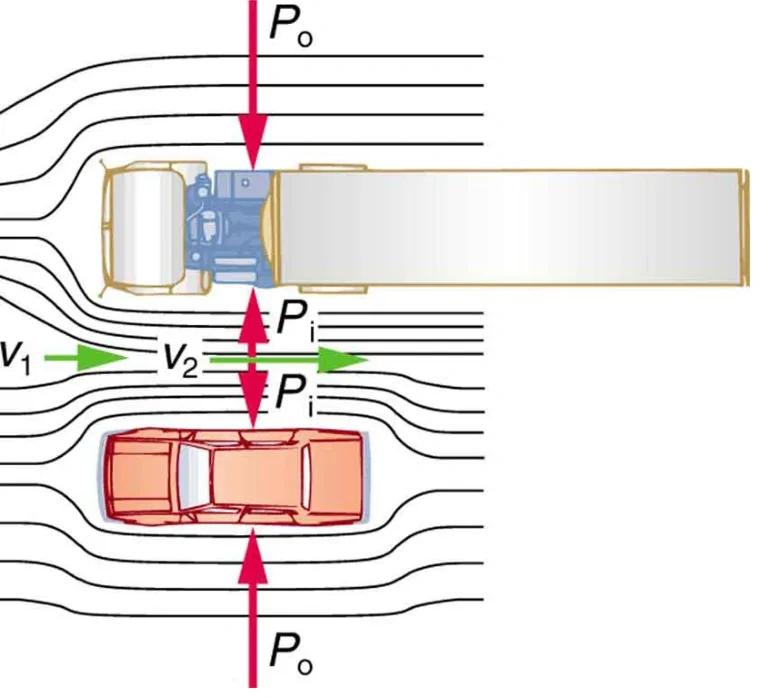
- The diagram below shows a car passing a truck.
- Air between the two vehicles moves through a narrow channel and speeds up
- so its pressure falls.
- Greater pressure on the outside pushes the vehicles together
- which is why the car tends to veer toward the truck.
- ◀ Previous, 3 / 4Next ▶
- An overhead view of a car passing a truck.
- Air between the vehicles speeds up in the narrow gap, so the pressure there is lower than on the outside, and the vehicles are pushed together.
- Image: OpenStax, College Physics for AP Courses 2e, CC BY 4.0.
- Pressure drops in fast-moving fluids
- ⤢ Enlarge
- Pressure drops in fast-moving fluids
- The same effect was noticed in the mid-1800s, when trains passing in opposite directions were seen to tip toward one another.
- ◀ Previous, 4 / 4
12.2 Bernoulli’s Equation · 1 / 13
12.2 Bernoulli’s equation
Bernoulli’s equation
- Bernoulli’s equation
- The relationship between pressure and speed in a fluid is described quantitatively by Bernoulli’s equation, named after the Swiss scientist Daniel Bernoulli (1700–1782).
- It applies to an incompressible, frictionless fluid.
- The equation states that the following sum stays constant along the path of a small volume of fluid:
- 2 + ρgh = constant
- is the absolute pressure in pascals (Pa
- which equals N/m2)ρ is the fluid density in kilograms per cubic metre (kg/m3)v is the fluid speed in metres per second (m/s)h is the height above a chosen reference point in metres (m)and g is the acceleration due to gravity, 9.80 m/s2.
- 4If we follow a small volume of fluid, the individual terms may change
- but their sum does not. Writing the equation for two points 1 and 2 on the path of the fluid gives:
- 12 + ρgh1 = P2 + ½ρv22 + ρgh2
- 6Each term has units of energy per unit volume (J/m3)
- because a pascal is also a joule per cubic metre.
- The second term, ½ρv2, is the kinetic energy per unit volume of the fluid.
- The third term, ρgh, is the gravitational potential energy per unit volume.
12.2 Bernoulli’s Equation · 2 / 13
12.2 Making connections: take-home investigation with a sheet of paper
Making connections: take-home investigation with a sheet of paper
- Making connections: take-home investigation with a sheet of
- take-home investigation with a sheet of paper
- 1Hold the short edge of a sheet of paper near your mouth, with one hand on each side of your mouth
- so that the page slopes downward over your hands.
- Blow across the top of the page.
- The sheet rises instead of sagging.
- 1 / 2Next ▶
- take-home investigation with a sheet of paper
- take-home investigation with a sheet of paper
- Air moving quickly over the top surface has lower pressure than the still air underneath
- so the greater pressure below pushes the paper upward.
- This is Bernoulli’s principle at work.
- ◀ Previous, 2 / 2
12.2 Bernoulli’s Equation · 3 / 13
12.2 Making connections: conservation of energy
Making connections: conservation of energy
- Making connections conservation of energy · Making connections: conservation of energy
- Making connections conservation of energy
- Bernoulli’s equation is a statement of conservation of energy for a fluid.
- Making connections conservation of energy
- The net work done by the fluid’s pressure changes the fluid’s kinetic energy and potential energy per unit volume.
- The equation is exact only for an incompressible fluid with no friction.
- If other forms of energy are involved, such as thermal energy dissipated by viscosity, the equation must be modified to include them.
12.2 Bernoulli’s Equation · 4 / 13
12.2 Bernoulli’s equation for static fluids
Bernoulli’s equation for static fluids
- Bernoulli’s equation for static fluids · Bernoulli’s equation for static fluids
Bernoulli’s equation for static fluids
Consider first a fluid that is not moving
- so v₁ = v₂ = 0 in the equation.
- Taking the height of the top of the fluid to be zero, the equation reduces to the familiar result that the pressure at depth h below the surface is P = P0 + ρghwhere P0 is the pressure at the surface.
- This shows that pressure increases with depth in a static fluid.
Bernoulli’s equation for static fluids
- Moving from point 1 to point 2, the depth increases by an amount Δh, and the pressure increases by ρgΔh.
- Although Bernoulli’s equation is introduced for flowing fluids, it includes the results for static fluids from the previous chapter,
- because the pressure due to the weight of a fluid is ρgh.
12.2 Bernoulli’s Equation · 5 / 13
12.2 Bernoulli’s principle at constant depth
Bernoulli’s principle at constant depth
Bernoulli’s principle at constant depth
Bernoulli’s principle at constant depth
- When a fluid moves at a constant depth, the height terms are equal and cancel. Bernoulli’s equation then becomes:
- P1 + ½ρv 12 = P2 + ½ρv22
- This special case is so important that it is called Bernoulli’s principle.
- It applies to a small volume of fluid as it follows its path at constant height.
- It shows directly that pressure drops as speed increases.
For example, if v₂ is greater than v₁
- then P₂ must be less than P₁ for the equality to hold.
12.2 Bernoulli’s Equation · 6 / 13
12.2 Applications: entrainment
Applications: entrainment
- Applications: entrainment3Applications: entrainment
- entrainment
- Devices can use the Bernoulli principle when fluid flows at a constant height.
- People have long used reduced pressure in a high-velocity fluid to move other fluids.
- Higher pressure on the outside pushes a second fluid into the fast stream, a process called entrainment.
- 1 / 3Next ▶
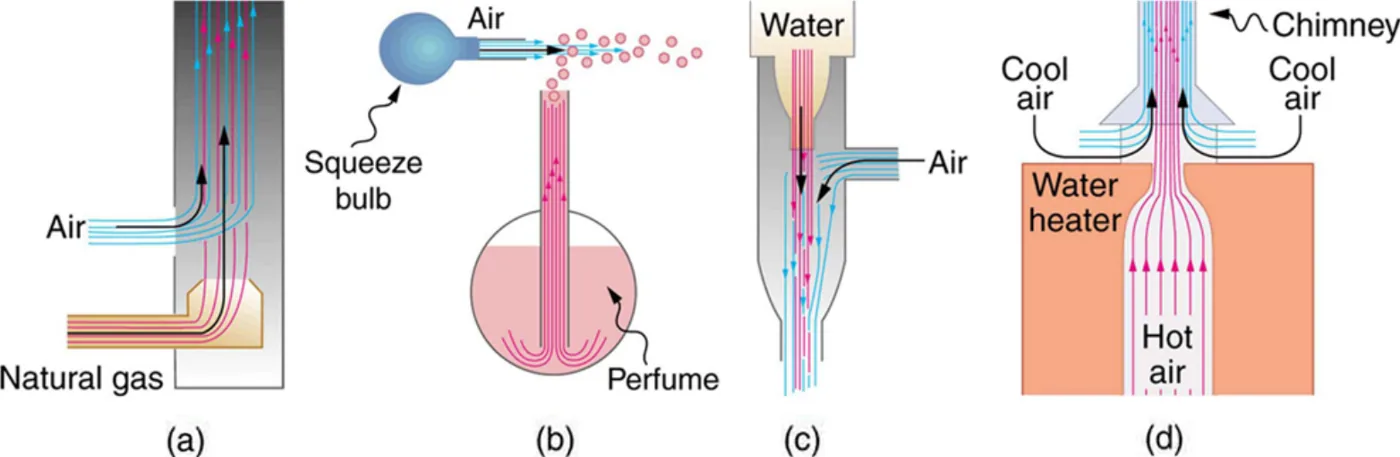
- a gas burner that draws in air, a squeeze-bulb atomizer that lifts perfume drops, a water aspirator used as a suction pump, and a water heater chimney that draws in cool air. Image: OpenStax, College Physics for AP Courses 2e, CC BY 4.0.
- entrainment
- ⤢ Enlarge
- Entrainment devices have been used since ancient times, particularly as pumps to raise water small heights, for example when draining swamps, fields or other low-lying areas.
- The diagram below shows several entrainment devices.
- In a Bunsen burner, the fast gas jet lowers the pressure and draws in air for proper combustion.
- In an atomizer, a squeeze bulb produces a jet of air that draws drops of liquid up a tube.
- Paint sprayers and carburetors use similar techniques.
- ◀ Previous, 2 / 3Next ▶
- entrainment
- entrainment
- An aspirator uses a fast stream of water to make a region of low pressure,
- and it can drain a flooded basement or act as a suction pump in dental and surgical work.
- The chimney of a water heater is designed so that the hot rising air entrains cool air into the flue.
- ◀ Previous, 3 / 3
12.2 Bernoulli’s Equation · 7 / 13
12.2 Applications: wings and sails
Applications: wings and sails
- Applications: wings and sails3Applications: wings and sails
- wings and sails
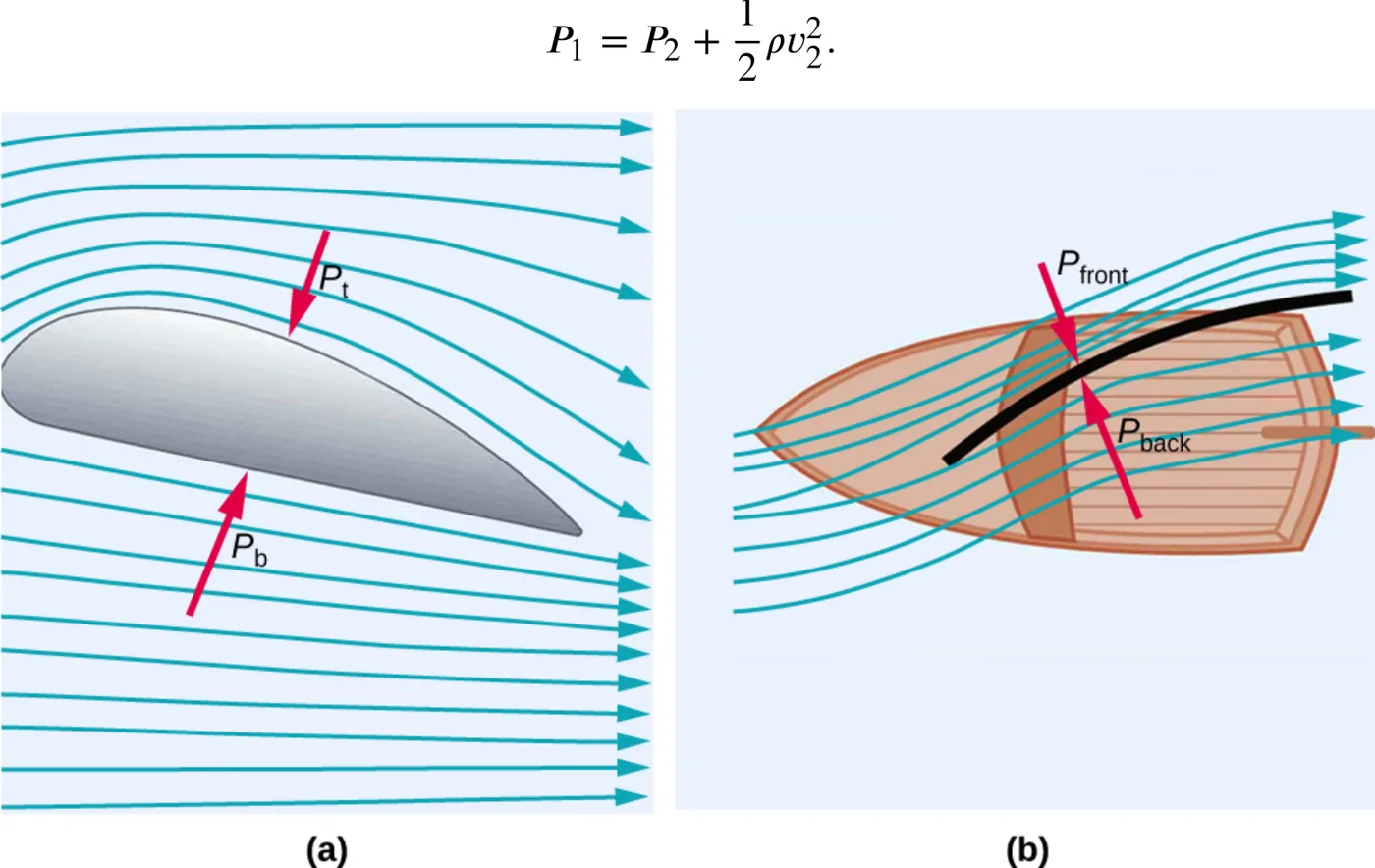
- The airplane wing is a clear example of Bernoulli’s principle.
- A wing has a characteristic shape, tilted slightly upward at a small angle, with a longer upper surface.
- 5Air flows faster over the top
- so the pressure there is reduced.
- 1 / 3Next ▶
- wings and sails
- wings and sails
- The resulting net upward force is called lift.
- Wings can also gain lift by pushing air downward
- which by Newton’s third law produces an upward force on the wing.
- Sails have the same wing-like shape.
- The pressure on the front of a sail is lower than the pressure on its back.
- This produces a forward force
- which allows a sailboat to travel even partly into the wind. The diagram below shows the flow lines around a wing and a sail.
- ◀ Previous, 2 / 3Next ▶
- Flow lines around an airplane wing, with lower pressure on the upper surface giving lift, and around a sail, with lower pressure on the front giving a forward force.
- Image: OpenStax, College Physics for AP Courses 2e, CC BY 4.0.
- wings and sails
- ⤢ Enlarge
- ◀ Previous, 3 / 3
12.2 Bernoulli’s Equation · 8 / 13
12.2 Velocity measurement
Velocity measurement
- Velocity measurement3Velocity measurement
- Velocity measurement
- Bernoulli’s principle can measure fluid velocity.
- A manometer has two tubes, small enough not to disturb the flow.
- One tube faces the oncoming fluid and creates a dead spot where the fluid speed is zero.
- 1 / 3Next ▶
- Velocity measurement
- 1The other tube sits beside the flow
- where the fluid has speed v.
- Bernoulli’s principle then says that the pressure at the second opening is lower than at the dead spot by an amount equal to ½ρv2.
- The fluid in the manometer rises on the side connected to the second opening by a height proportional to this pressure difference.
- ◀ Previous, 2 / 3Next ▶
- Velocity measurement
- Velocity measurement
- Solving for v gives the speed in terms of the height difference.
- A version of this device, the pitot tube, is in common use as an air speed indicator in aircraft.
- ◀ Previous, 3 / 3
12.2 Bernoulli’s Equation · 9 / 13
12.2 Making connections: take-home investigation with two strips of paper
Making connections: take-home investigation with two strips of paper
- Making connections: take-home investigation with two strips
- take-home investigation with two strips of paper
- Make two strips of paper, each about 15 cm long and 4 cm wide.
- 3Hold the small end of one strip to your lips so that it drapes over your finger
- then blow across the paper.
- It lifts as air moves quickly over it.
- 1 / 2Next ▶
- take-home investigation with two strips of paper
- take-home investigation with two strips of paper
- Now hold two strips apart with your fingers and blow between them.
- The strips move toward each other
- because the fast air between them has lower pressure than the still air outside.
- This is the same principle that pushes the car and truck together.
- ◀ Previous, 2 / 2
12.2 Bernoulli’s Equation · 10 / 13
12.2 Worked examples
Worked examples
- Worked examples3Example 12.4: Pressure in a hose when the water speeds up4Check Your Learning: pressure from a speed change
- Example 12.3: Flow speed in the aorta and the number of capillaries
- Example 12.3: Flow speed in the aorta and the number of capillaries
- The aorta carries blood out of the heart.
- Part (a): the flow rate is 5.0 L/min and the aorta radius is 10 mm.
- Find the average blood speed in the aorta.
- Part (b): the average blood speed in the capillaries is 0.33 mm/s and the average capillary diameter is 2.0 μm.
- Find the number of capillaries.
- Use the flow rate Q = Av
- where for a cylinder A = πr2, to find the aortic speed.
- Then use the continuity equation A₁v₁ = nA₂v₂where n is the number of capillaries, to find n.
- Convert the flow rate to SI units: Q = 5.0 × 10⁻³ m3 ÷ 60 s = 8.33 × 10⁻⁵ m3/s. The area is A = π(0.010 m)2 = 3.14 × 10⁻⁴ m2. So v = Q/A = (8.33 × 10⁻⁵ m3/s) ÷ (3.14 × 10⁻⁴ m2) ≈ 0.27 m/s.
- The total capillary area is n times the area of one capillary
- so n = A₁v₁ ÷ (A₂v₂).
- 1 / 4Next ▶
- Worked examples
- Here A₁v₁ = Q = 8.33 × 10⁻⁵ m3/s.
- The area of one capillary is A₂ = π(1.0 × 10⁻⁶ m)2 = 3.14 × 10⁻¹² m2, and v₂ = 0.33 × 10⁻³ m/s.
- Therefore n = (8.33 × 10⁻⁵ m3/s) ÷ [(3.14 × 10⁻¹² m2)(0.33 × 10⁻³ m/s)] ≈ 8.0 × 10¹⁰ capillaries.
- The speed in the capillaries is much lower than in the aorta
- because their total cross-sectional area is so much larger.
- The slow speed allows time for exchange with the tissues.
- The flow must not stop, however, or clotting becomes possible.
- A count this large is consistent with the dense capillary network that supplies the body’s tissues.
- ◀ Previous, 2 / 4Next ▶
- Example 12.4: Pressure in a hose when the water speeds up
- In Example 12.2, the speed of water in a hose rose from 1.96 m/s to 25.5 m/s at the nozzle.
- The absolute pressure at the nozzle is 1.01 × 10⁵ Pa
- which is atmospheric pressure. Assuming level, frictionless flow, find the absolute pressure P₁ in the hose.
- Level flow means constant depth
- so Bernoulli’s principle applies. Subscript 1 refers to the hose and 2 to the nozzle.
- Rearranging gives P₁ = P₂ + ½ρ(v₂2 − v₁2). With ρ = 1000 kg/m3 for water, v₂2 = 650.25 m2/s2 and v₁2 = 3.84 m2/s2. So P₁ = 1.01 × 10⁵ Pa + ½(1000 kg/m3)(646.4 m2/s2) = 1.01 × 10⁵ Pa + 3.23 × 10⁵ Pa ≈ 4.24 × 10⁵ Pa.
- The pressure in the hose is greater than at the nozzle
- because the speed in the hose is much lower.
- The nozzle pressure equals atmospheric pressure, because the water leaves into the air without any other change in conditions.
- ◀ Previous, 3 / 4Next ▶
- pressure from a speed change
- pressure from a speed change
- Water at 2.0 m/s in a pipe has absolute pressure 2.0 × 10⁵ Pa.
- If it speeds up to 10 m/s at the same height, what is the new pressure?
- Answer: P₂ = P₁ + ½ρ(v₁2 − v₂2) = 2.0 × 10⁵ Pa + 500(4 − 100) Pa ≈ 1.52 × 10⁵ Pa.
- ◀ Previous, 4 / 4
12.2 Bernoulli’s Equation · 11 / 13
12.2 Key terms
Key terms
- Key terms
| Term | Meaning |
|---|---|
| Bernoulli’s equation |
|
| Bernoulli’s principle |
|
| Absolute pressure |
|
| Incompressible fluid | A fluid whose density does not change significantly when the pressure changes. |
| Frictionless fluid |
|
| Static fluid |
|
| Kinetic energy per unit volume |
|
| Gravitational potential energy per unit volume |
|
| Entrainment |
|
| Lift |
|
| Dead spot | A point in front of a manometer tube where the fluid has zero velocity. |
12.2 Bernoulli’s Equation · 12 / 13
12.2 Avoid these mistakes
Avoid these mistakes
Avoid these mistakes2→Avoid these mistakes
Avoid these mistakes
Avoid this
- Thinking that a faster fluid has higher pressure.
- In Bernoulli’s principle, higher speed at constant depth means lower pressure.Avoid this
Avoid this
- Using the diameter instead of the radius when finding the area πr2 of a pipe or vessel.Avoid this
Avoid this
- Forgetting to convert units. Flow rate in L/min must become m3/s
- and mm/s must become m/s
- before the calculation.Avoid this
1 / 2Next ▶
Avoid these mistakes
Avoid this
- Applying Bernoulli’s principle to flow at different heights without including the ρgh term.Avoid this
Avoid this
- Treating gauge pressure as absolute pressure. Bernoulli’s equation uses absolute pressure.Avoid this
Avoid this
- Assuming the equation holds for real fluids with friction or viscosity. Those cases need an extra energy term.Avoid this
◀ Previous, 2 / 2
12.2 Bernoulli’s Equation · 13 / 13
Well done! You finished this lesson
What would you like to do next?