- Two equal and opposite charges3Two equal and opposite charges
- Two equal and opposite charges
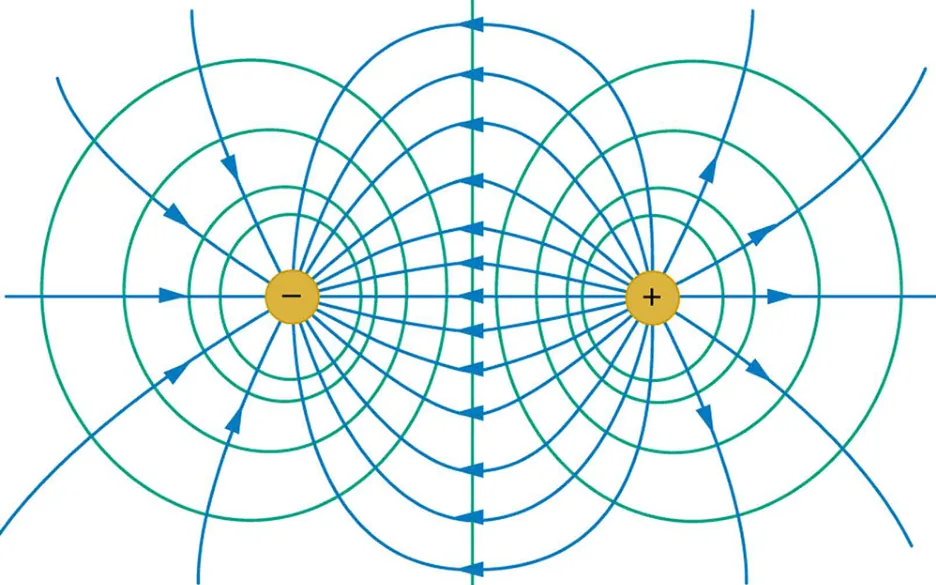
- Consider two equal and opposite charges.
- The electric field lines and the equipotential lines for this pair are shown below.
- Once the electric field lines are known, the equipotential lines can be drawn by making them perpendicular to the field lines at every point.
- In the figure, the potential is greatest, meaning most positive, near the positive charge and least, meaning most negative, near the negative charge.
- 1 / 3Next ▶
- Electric field lines and equipotential lines for two equal but opposite charges, with the equipotential lines drawn perpendicular to the field lines.
- Image: OpenStax, College Physics for AP Courses 2e, CC BY 4.0.
- Two equal and opposite charges
- ⤢ Enlarge
- Two equal and opposite charges
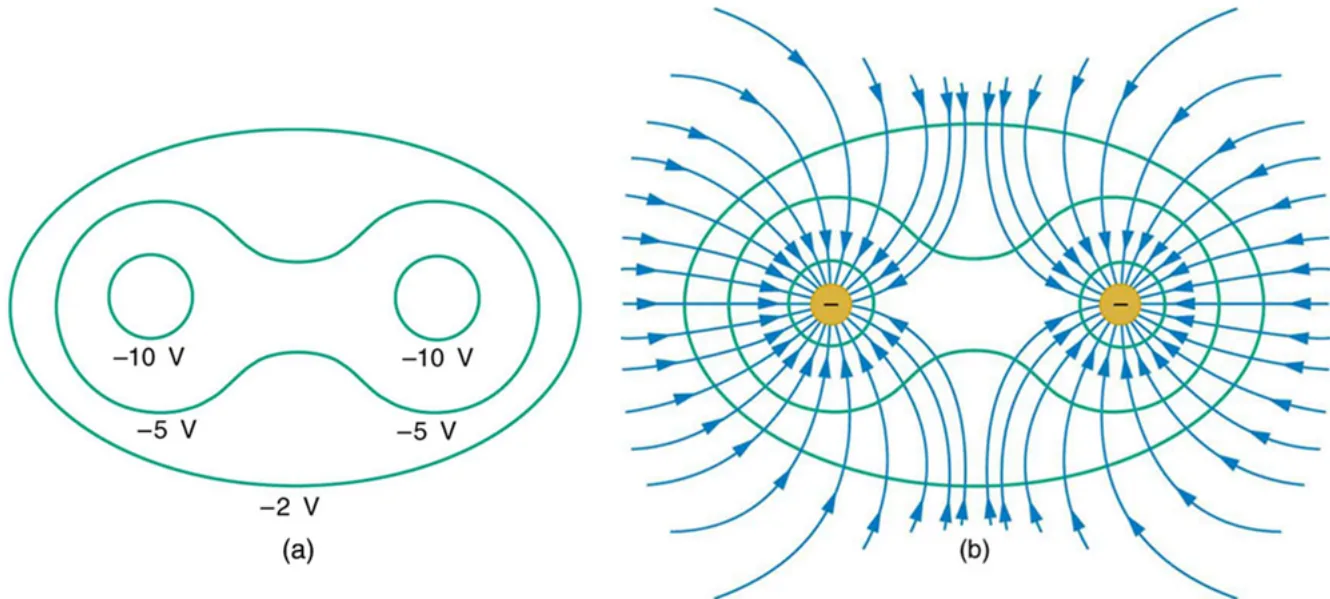
- The process also works in reverse.
- If the equipotential lines are measured, for example with a voltmeter in a laboratory experiment, the electric field lines can be drawn by making them perpendicular to the equipotential lines.
- The left picture shows measured equipotential lines around two equal negative charges, with values of −10 V, −5 V and −2 V.
- The right picture shows the field lines drawn from them.
- The field lines point into both negative charges
- which is consistent with the two charges being negative.
- ◀ Previous, 2 / 3Next ▶
- measured equipotential lines around two equal negative charges. Right: the electric field lines drawn perpendicular to those equipotentials. Image: OpenStax, College Physics for AP Courses 2e, CC BY 4.0.
- Two equal and opposite charges
- ⤢ Enlarge
- ◀ Previous, 3 / 3