Curriculum
OCR A Level Physics A H556
1. Development of Practical Skills in Physics
0/56
2. Foundations in Physics
0/29
3. Forces and Motion
0/108
-
3. Forces and Motion
 Preview
-
1.6.3 Force-Extension Graphs
Preview
-
1.6.3 Force-Extension Graphs - Check yourself
 Preview
-
1.6.4 Stress-Strain Graphs
Preview
-
1.6.4 Stress-Strain Graphs - Check yourself
Preview
-
2.1.1 Displacement, Velocity and Acceleration
Preview
-
2.1.1 Displacement, Velocity and Acceleration - Check yourself
Preview
-
2.1.2 Motion Graphs
Preview
-
2.1.9 Projectile Motion
Preview
-
2.1.9 Projectile Motion - Check yourself
Preview
-
3.1.2 Force and Acceleration
Preview
-
3.1.2 Force and Acceleration - Check yourself
Preview
-
3.1.3 Displacement and Velocity-Time Graphs
Preview
-
3.1.3 Displacement and Velocity-Time Graphs - Check yourself
Preview
-
3.1.3 Linear Momentum
Preview
-
3.1.3 Linear Momentum - Check yourself
Preview
-
3.2.2 Investigating Motion and Collisions
Preview
-
3.2.2 Investigating Motion and Collisions - Check yourself
Preview
-
3.2.2 Terminal Velocity
Preview
-
3.2.2 Terminal Velocity - Check yourself
Preview
-
3.2.3 Acceleration and Free Fall
Preview
-
3.2.3 Acceleration and Free Fall - Check yourself
Preview
-
3.2.4 Braking and Reaction Times
Preview
-
3.2.4 Braking and Reaction Times - Check yourself
Preview
-
3.3.1 Conservation of Momentum
Preview
-
3.3.1 Conservation of Momentum - Check yourself
Preview
-
3.3.2 Weight
Preview
-
3.3.2 Weight - Check yourself
Preview
-
3.3.3 Tension, Normal force, Upthrust and Friction
Preview
-
3.3.3 Tension, Normal force, Upthrust and Friction - Check yourself
Preview
-
3.3.4 Motion in One and Two Dimensions
Preview
-
3.3.4 Motion in One and Two Dimensions - Check yourself
Preview
-
3.3.7 Investigating Terminal Velocity
Preview
-
3.3.7 Investigating Terminal Velocity - Check yourself
Preview
-
3.4.2 Couples and Torque
Preview
-
3.4.2 Couples and Torque - Check yourself
Preview
-
3.4.4 Equilibrium
Preview
-
3.4.4 Equilibrium - Check yourself
Preview
-
3.6.1 Work Done
Preview
-
3.6.1 Work Done - Check yourself
Preview
-
3.6.3 Energy and Work
Preview
-
3.6.3 Energy and Work - Check yourself
Preview
-
3.7.1 Deformation and Compression
Preview
-
3.7.1 Deformation and Compression - Check yourself
Preview
-
3.7.5 Stress, Strain and Tensile Strength
Preview
-
3.7.5 Stress, Strain and Tensile Strength - Check yourself
Preview
-
3.7.6 Young's Modulus
Preview
-
3.7.6 Young's Modulus - Check yourself
Preview
-
3.7.8 Elastic and Plastic Deformation
Preview
-
3.7.8 Elastic and Plastic Deformation - Check yourself
Preview
-
3.8.1 Newton's Three Laws of Motion
Preview
-
3.8.1 Newton's Three Laws of Motion - Check yourself
Preview
-
4.1.1 Impulse
Preview
-
4.1.1 Impulse - Check yourself
Preview
-
4.1.2 Moments
Preview
-
4.1.2 Moments - Check yourself
Preview
-
4.2.3 Centre of Mass
Preview
-
4.2.3 Centre of Mass - Check yourself
Preview
-
4.3.1 Density
Preview
-
4.3.1 Density - Check yourself
Preview
-
4.3.2 Pressure
Preview
-
4.3.2 Pressure - Check yourself
Preview
-
4.3.3 SUVAT Equations
Preview
-
4.3.3 SUVAT Equations - Check yourself
Preview
-
4.3.5 Drag Forces
Preview
-
4.3.5 Drag Forces - Check yourself
Preview
-
4.3.5 Archimedes' Principle
Preview
-
4.3.5 Archimedes' Principle - Check yourself
Preview
-
4.5.4 Impulse on a Force-Time Graph
Preview
-
4.5.4 Impulse on a Force-Time Graph - Check yourself
Preview
-
4.5.5 Collisions
Preview
-
4.5.5 Collisions - Check yourself
Preview
-
4.6.4 Conservation of Energy
Preview
-
4.6.4 Conservation of Energy - Check yourself
Preview
-
5.1.3 Efficiency
Preview
-
5.1.3 Efficiency - Check yourself
Preview
-
5.1.4 Power
Preview
-
5.1.4 Power - Check yourself
Preview
-
5.2.1 Gravitational Potential Energy
Preview
-
5.2.1 Gravitational Potential Energy - Check yourself
Preview
-
5.2.2 Kinetic Energy
Preview
-
5.2.2 Kinetic Energy - Check yourself
Preview
-
6.1.2 Hooke's Law
Preview
-
6.1.2 Hooke's Law - Check yourself
Preview
-
6.2.2 Elastic Potential Energy
Preview
-
6.2.2 Elastic Potential Energy - Check yourself
Preview
-
3.1.1 Displacement, Velocity and Acceleration
Preview
-
3.2.1 SUVAT Equations
Preview
-
3.2.5 Projectile Motion
Preview
-
3.3.5 Drag Forces
Preview
-
3.4.1 Moments
Preview
-
3.4.3 Centre of Mass
Preview
-
3.5.1 Density
Preview
-
3.5.2 Pressure
Preview
-
3.5.3 Archimedes' Principle
Preview
-
3.6.2 Conservation of Energy
Preview
-
3.6.4 Kinetic Energy
Preview
-
3.6.5 Gravitational Potential Energy
Preview
-
3.6.6 Power
Preview
-
3.6.7 Efficiency
Preview
-
3.7.2 Hooke's Law
Preview
-
3.7.3 Force-Extension Graphs
Preview
-
3.7.4 Elastic Potential Energy
Preview
-
3.7.7 Stress-Strain Graphs
Preview
-
3.8.2 Linear Momentum
Preview
-
3.8.3 Impulse
Preview
-
3.8.4 Impulse on a Force-Time Graph
Preview
-
3.8.5 Conservation of Momentum
Preview
4. Electrons, Waves and Photons
0/71
OCR H556 chapter questions and answers
0/2
Text lesson
3.5.1 Density
3.5.1 Density: Define density, use ρ = m/V with consistent units, and apply it to regular solids, liquids and gases including unit conversions.
1Defining Density2Definition · Equation · Rearranging3Particle link4Intensive property
Defining Density
 ⤢ Enlarge
Defining Density
Density links the mass of a sample to the space it takes up.
1 / 4Next ▶
Definition · Equation · Rearranging
Definition
Density is the mass contained in each unit volume of a material
so it describes how tightly matter is packed together.
Equation
ρ = m/V
where ρ is density in kg m−3, m is mass in kg and V is volume in m3.
Rearranging
The same relationship gives m = ρV for the mass of a known volume and V = m/ρ for the volume of a known mass.
◀ Previous2 / 4Next ▶
Particle link
Particle link
A solid or liquid has particles almost touching
while a gas has the same particles spread over a far larger volume.
◀ Previous3 / 4Next ▶
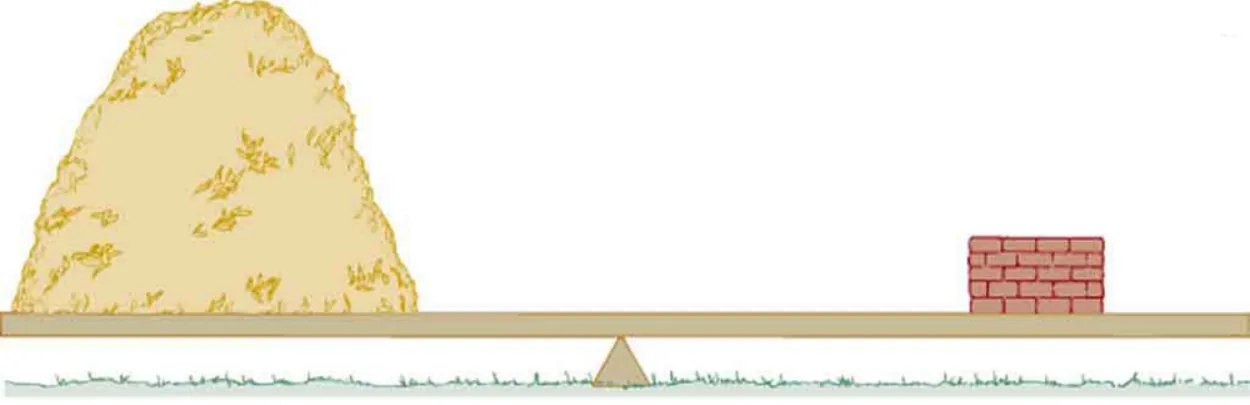
Why density matters: Equal masses of feathers and bricks: the feathers fill a far larger pile because they are much less dense.
Intensive property
 ⤢ Enlarge
Intensive property
Density depends on the material, not on the size of the sample
so a small and a large piece of iron have equal density.
| Material | Typical density / kg m−3 |
|---|---|
| Air (room conditions) | 1.2 |
| Water | 1.0 × 10³ |
| Aluminium | 2.7 × 10³ |
| Iron | 7.9 × 10³ |
| Lead | 1.1 × 10⁴ |
◀ Previous4 / 4
1Finding Volume and Mass2Finding Volume and Mass
Units and Conversions
Units and Conversions
Converting a length unit to a volume unit needs the conversion factor cubed
so 1 cm3 = (10−2 m)3 = 10−6 m3.
Multiply by 1000
because 1 g cm−3 equals 10−3 kg divided by 10−6 m3giving 1000 kg m−3.
Divide by 1000 for each length
so a 40 mm side is 0.040 m before multiplying the three sides.
Metals should come out in thousands of kg m−3, liquids near 103 and gases near 1
which quickly exposes a slip.
1Sinking · Floating · Gas density2Alloys and mixtures
Worked Example
Worked Example
Question: A metal block measures 5.0 cm × 4.0 cm × 2.5 cm and has a mass of 395 g. Calculate its density in kg m−3.
Volume = 5.0 × 4.0 × 2.5 = 50 cm3 = 50 × 10−6 m3 = 5.0 × 10⁻⁵ m3.
Mass = 395 g = 0.395 kg.
ρ = m/V = 0.395 / (5.0 × 10⁻⁵) = 7.9 × 10³ kg m−3.What the symbols mean: ρ = density (kg m−3 or g cm−3) · m = mass (kg) · V = volume (m3)
Answer: ρ = 7.9 × 10³ kg m−3
which is consistent with iron or steel.
13.5.1 – Main ideas for the Exam2Common Mistakes