Curriculum
OCR A Level Physics A H556
1. Development of Practical Skills in Physics
0/56
2. Foundations in Physics
0/29
3. Forces and Motion
0/108
-
3. Forces and Motion
 Preview
-
1.6.3 Force-Extension Graphs
Preview
-
1.6.3 Force-Extension Graphs - Check yourself
 Preview
-
1.6.4 Stress-Strain Graphs
Preview
-
1.6.4 Stress-Strain Graphs - Check yourself
Preview
-
2.1.1 Displacement, Velocity and Acceleration
Preview
-
2.1.1 Displacement, Velocity and Acceleration - Check yourself
Preview
-
2.1.2 Motion Graphs
Preview
-
2.1.9 Projectile Motion
Preview
-
2.1.9 Projectile Motion - Check yourself
Preview
-
3.1.2 Force and Acceleration
Preview
-
3.1.2 Force and Acceleration - Check yourself
Preview
-
3.1.3 Displacement and Velocity-Time Graphs
Preview
-
3.1.3 Displacement and Velocity-Time Graphs - Check yourself
Preview
-
3.1.3 Linear Momentum
Preview
-
3.1.3 Linear Momentum - Check yourself
Preview
-
3.2.2 Investigating Motion and Collisions
Preview
-
3.2.2 Investigating Motion and Collisions - Check yourself
Preview
-
3.2.2 Terminal Velocity
Preview
-
3.2.2 Terminal Velocity - Check yourself
Preview
-
3.2.3 Acceleration and Free Fall
Preview
-
3.2.3 Acceleration and Free Fall - Check yourself
Preview
-
3.2.4 Braking and Reaction Times
Preview
-
3.2.4 Braking and Reaction Times - Check yourself
Preview
-
3.3.1 Conservation of Momentum
Preview
-
3.3.1 Conservation of Momentum - Check yourself
Preview
-
3.3.2 Weight
Preview
-
3.3.2 Weight - Check yourself
Preview
-
3.3.3 Tension, Normal force, Upthrust and Friction
Preview
-
3.3.3 Tension, Normal force, Upthrust and Friction - Check yourself
Preview
-
3.3.4 Motion in One and Two Dimensions
Preview
-
3.3.4 Motion in One and Two Dimensions - Check yourself
Preview
-
3.3.7 Investigating Terminal Velocity
Preview
-
3.3.7 Investigating Terminal Velocity - Check yourself
Preview
-
3.4.2 Couples and Torque
Preview
-
3.4.2 Couples and Torque - Check yourself
Preview
-
3.4.4 Equilibrium
Preview
-
3.4.4 Equilibrium - Check yourself
Preview
-
3.6.1 Work Done
Preview
-
3.6.1 Work Done - Check yourself
Preview
-
3.6.3 Energy and Work
Preview
-
3.6.3 Energy and Work - Check yourself
Preview
-
3.7.1 Deformation and Compression
Preview
-
3.7.1 Deformation and Compression - Check yourself
Preview
-
3.7.5 Stress, Strain and Tensile Strength
Preview
-
3.7.5 Stress, Strain and Tensile Strength - Check yourself
Preview
-
3.7.6 Young's Modulus
Preview
-
3.7.6 Young's Modulus - Check yourself
Preview
-
3.7.8 Elastic and Plastic Deformation
Preview
-
3.7.8 Elastic and Plastic Deformation - Check yourself
Preview
-
3.8.1 Newton's Three Laws of Motion
Preview
-
3.8.1 Newton's Three Laws of Motion - Check yourself
Preview
-
4.1.1 Impulse
Preview
-
4.1.1 Impulse - Check yourself
Preview
-
4.1.2 Moments
Preview
-
4.1.2 Moments - Check yourself
Preview
-
4.2.3 Centre of Mass
Preview
-
4.2.3 Centre of Mass - Check yourself
Preview
-
4.3.1 Density
Preview
-
4.3.1 Density - Check yourself
Preview
-
4.3.2 Pressure
Preview
-
4.3.2 Pressure - Check yourself
Preview
-
4.3.3 SUVAT Equations
Preview
-
4.3.3 SUVAT Equations - Check yourself
Preview
-
4.3.5 Drag Forces
Preview
-
4.3.5 Drag Forces - Check yourself
Preview
-
4.3.5 Archimedes' Principle
Preview
-
4.3.5 Archimedes' Principle - Check yourself
Preview
-
4.5.4 Impulse on a Force-Time Graph
Preview
-
4.5.4 Impulse on a Force-Time Graph - Check yourself
Preview
-
4.5.5 Collisions
Preview
-
4.5.5 Collisions - Check yourself
Preview
-
4.6.4 Conservation of Energy
Preview
-
4.6.4 Conservation of Energy - Check yourself
Preview
-
5.1.3 Efficiency
Preview
-
5.1.3 Efficiency - Check yourself
Preview
-
5.1.4 Power
Preview
-
5.1.4 Power - Check yourself
Preview
-
5.2.1 Gravitational Potential Energy
Preview
-
5.2.1 Gravitational Potential Energy - Check yourself
Preview
-
5.2.2 Kinetic Energy
Preview
-
5.2.2 Kinetic Energy - Check yourself
Preview
-
6.1.2 Hooke's Law
Preview
-
6.1.2 Hooke's Law - Check yourself
Preview
-
6.2.2 Elastic Potential Energy
Preview
-
6.2.2 Elastic Potential Energy - Check yourself
Preview
-
3.1.1 Displacement, Velocity and Acceleration
Preview
-
3.2.1 SUVAT Equations
Preview
-
3.2.5 Projectile Motion
Preview
-
3.3.5 Drag Forces
Preview
-
3.4.1 Moments
Preview
-
3.4.3 Centre of Mass
Preview
-
3.5.1 Density
Preview
-
3.5.2 Pressure
Preview
-
3.5.3 Archimedes' Principle
Preview
-
3.6.2 Conservation of Energy
Preview
-
3.6.4 Kinetic Energy
Preview
-
3.6.5 Gravitational Potential Energy
Preview
-
3.6.6 Power
Preview
-
3.6.7 Efficiency
Preview
-
3.7.2 Hooke's Law
Preview
-
3.7.3 Force-Extension Graphs
Preview
-
3.7.4 Elastic Potential Energy
Preview
-
3.7.7 Stress-Strain Graphs
Preview
-
3.8.2 Linear Momentum
Preview
-
3.8.3 Impulse
Preview
-
3.8.4 Impulse on a Force-Time Graph
Preview
-
3.8.5 Conservation of Momentum
Preview
4. Electrons, Waves and Photons
0/71
OCR H556 chapter questions and answers
0/2
Text lesson
4.3.1 Density
4.3.1 Density — AS PHYSICS 9702 notes: Define density and measure it for regular solids, irregular solids and liquids.
1Definition2Definition
1Why materials differ2Why materials differ
Why materials differ
Why materials differ
Density depends on the mass of the particles and how closely they are packed.
Gases are less dense than liquids, which are less dense than solids gas particles are far apart
so there is less mass per unit volume.
Most substances expand when heated the volume increases and the density decreases slightly
water is unusual near 4 °C.
Cork (about 250 kg m−3) and wood float on water aluminium (2700) and steel (7800) sink unless shaped to enclose air.
1 / 2Next ▶
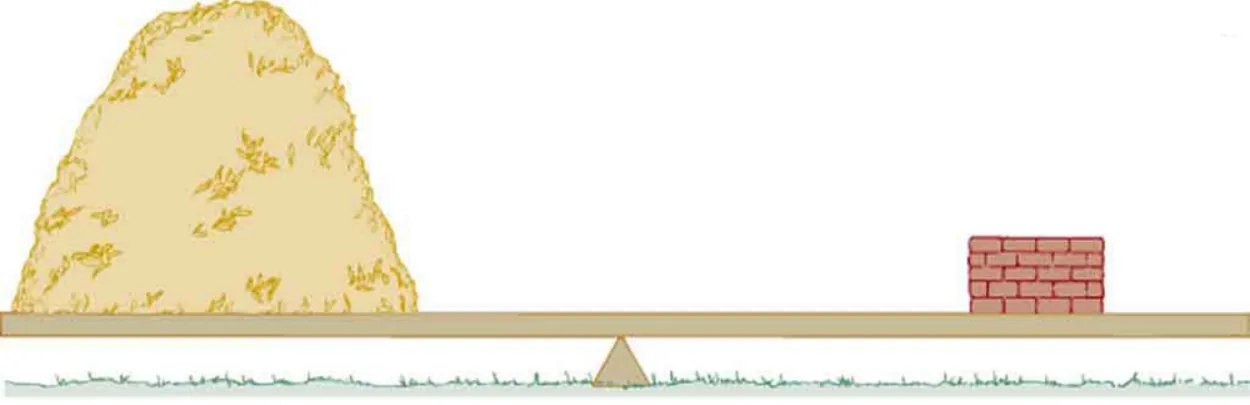
Why density matters: Equal masses of feathers and bricks: the feathers fill a far larger pile because they are much less dense.
Why materials differ
◀ Previous2 / 2
1Volumes and unit conversions2Volumes and unit conversions3Volumes and unit conversions
1Measuring the density of a regular solid2Measuring the density of a regular solid
1Measuring the density of an irregular solid2Measuring the density of an irregular solid
1Measuring the density of a liquid2Measuring the density of a liquid
Uncertainty in density · For a cube of side l · For mixtures
Uncertainty in density
Percentage uncertainties add.
For a cube of side l
the percentage uncertainty in V is three times that in l.
For mixtures
find the total mass and divide by the total volume
the result is not the simple average of the two densities.
1Applications and links2Applications and links3Applications and links
Newton
- Unit of force, kg m s-2.
Manometer
- Device measuring pressure differences with a liquid column.
Hydrostatic pressure
- P = P0 + ρgh.
Atmospheric pressure
- Pressure of the air, about 1.01 × 10⁵ Pa at sea level.
Gravitational field
- Region where mass experiences gravitational force.
Field strength
- G = Fg/m.
Weight of a volume
- Weight of a volume use m = ρV then W = mg, which combine to give W = ρVg.
- Equation
- ΔE = m × c × Δθ
What the symbols mean: E, Q or q = energy transferred (J) · m = mass (kg; g in chemistry calorimetry) · c = specific heat capacity (J kg−1 °C−1; water 4.18 J g−1 °C−1) · ΔT or Δθ = temperature change (°C or K)
- ΔE = m × c × Δθ
Key terms
| Term | Meaning |
|---|---|
| Density | Mass per unit volume, ρ = m ÷ V. |
| Volume | The space an object occupies, in m3. |
| Displacement method | Finding the volume of an irregular solid from the rise in water level. |
| Meniscus | The curved surface of a liquid in a narrow tube. |
| Average density | Total mass divided by total volume of a composite object. |
| Micrometer | An instrument measuring small lengths to 0.01 mm. |
| Eureka can | A can with a spout used to collect displaced liquid. |
| kg m-3 | The SI unit of density. |
1Avoid these mistakes2Avoid these mistakes