Curriculum
OCR A Level Physics A H556
1. Development of Practical Skills in Physics
0/56
2. Foundations in Physics
0/29
3. Forces and Motion
0/108
4. Electrons, Waves and Photons
0/71
-
4. Electrons, Waves and Photons
 Preview
-
4.1.1 Electric Current and Charge
Preview
-
4.1.1 Electric Current and Charge - Check yourself
 Preview
-
4.1.2 Electric Current and Electron Flow
Preview
-
4.1.2 Electric Current and Electron Flow - Check yourself
Preview
-
4.1.4 Current in a Current Carrying Conductor
Preview
-
4.1.4 Current in a Current Carrying Conductor - Check yourself
Preview
-
4.1.5 Conductors, Semiconductors and Insulators
Preview
-
4.1.5 Conductors, Semiconductors and Insulators - Check yourself
Preview
-
4.1.6 Circuit Symbols and Diagrams
Preview
-
4.1.6 Circuit Symbols and Diagrams - Check yourself
Preview
-
4.2.2 Ohm's Law and I-V Characteristics
Preview
-
4.2.2 Ohm's Law and I-V Characteristics - Check yourself
Preview
-
4.2.3 Investigating Electrical Characteristics of Components
Preview
-
4.2.3 Investigating Electrical Characteristics of Components - Check yourself
Preview
-
9.3.1 Resistance
Preview
-
9.3.1 Resistance - Check yourself
Preview
-
10.2.1 Kirchhoff's First Law
Preview
-
10.2.1 Kirchhoff's First Law - Check yourself
Preview
-
4.1.3 Kirchhoff's First Law
Preview
-
4.2.1 Resistance
Preview
-
4.10.1 The Photoelectric Effect
Preview
-
4.10.2 Demonstrating the Photoelectric Effect
Preview
-
4.10.3 The Photoelectric Equation
Preview
-
4.10.4 Work Function and Threshold Frequency
Preview
-
4.10.5 Maximum Kinetic Energy and Intensity
Preview
-
4.11.1 The Photon
Preview
-
4.11.2 The Electronvolt
Preview
-
4.11.3 Determining the Planck Constant
Preview
-
4.11.4 Electron Diffraction
Preview
-
4.11.5 The de Broglie Equation
Preview
-
4.2.4 The Light-Dependent Resistor (LDR)
Preview
-
4.2.5 Resistivity
Preview
-
4.2.6 Determining the Resistivity of a Metal
Preview
-
4.2.7 Thermistors
Preview
-
4.3.1 Power
Preview
-
4.3.2 Electrical Energy
Preview
-
4.3.3 Kirchhoff's Second Law
Preview
-
4.3.4 Kirchhoff's Laws in Circuits
Preview
-
4.3.5 Resistors in Series and Parallel Circuits
Preview
-
4.3.6 Series and Parallel Circuits
Preview
-
4.3.7 Circuits with Multiple Sources of e.m.f
Preview
-
4.4.1 E.m.f and Internal Resistance
Preview
-
4.4.2 Calculating E.m.f
Preview
-
4.4.3 Determining Internal Resistance
Preview
-
4.4.4 E.m.f and Potential Difference
Preview
-
4.4.5 Energy Transfer
Preview
-
4.5.1 Potential Divider Circuits
Preview
-
4.5.2 Variable Resistance Components
Preview
-
4.5.3 Investigating Potential Divider Circuits
Preview
-
4.6.1 Progressive Waves: Longitudinal and Transverse
Preview
-
4.6.2 Calculating Frequency
Preview
-
4.6.3 The Wave Equation
Preview
-
4.6.4 Graphical Representations of Transverse and Longitudinal Waves
Preview
-
4.6.5 Intensity of a Wave
Preview
-
4.7.1 The Electromagnetic Spectrum
Preview
-
4.7.2 Polarisation
Preview
-
4.8.1 Refraction
Preview
-
4.8.2 Total Internal Reflection
Preview
-
4.8.3 Wave Phenomena
Preview
-
4.9.1 Superposition
Preview
-
4.9.10 Determining the Speed of Sound in Air in a Resonance Tube
Preview
-
4.9.11 Harmonics
Preview
-
4.9.2 Graphical Representation of Superposition
Preview
-
4.9.3 Interference
Preview
-
4.9.4 Two-Source Interference
Preview
-
4.9.5 Young's Double-Slit Experiment
Preview
-
4.9.6 Determining the Wavelength of Light
Preview
-
4.9.7 Stationary Waves
Preview
-
4.9.8 Stationary vs Progressive Waves
Preview
-
4.9.9 Nodes and Antinodes
Preview
OCR H556 chapter questions and answers
0/2
Text lesson
4.11.4 Electron Diffraction
4.11.4 Electron Diffraction: Describe how electron diffraction by a thin crystalline target shows that electrons have wave properties.
1Electron gun2Thin target · Screen · Pattern
Electron gun
 ⤢ Enlarge
Electron gun
Electrons are released from a heated filament and accelerated by a high voltage in an evacuated tube.
1 / 2Next ▶
Thin target · Screen · Pattern
Thin target
The electron beam passes through a thin film of graphite whose atoms are arranged regularly.
Screen
The electrons land on a fluorescent screen
which glows where they arrive.
Pattern
The screen shows a bright central spot surrounded by rings
which is a diffraction pattern.
◀ Previous2 / 2
1Why This Shows Wave Behaviour2Why This Shows Wave Behaviour
Why This Shows Wave Behaviour
Why This Shows Wave Behaviour
Diffraction is a wave effect
so seeing it with electrons shows that electrons can behave as waves.
Diffraction is clear when the wavelength is similar to the gap, and atom spacing in graphite is about 10−10 m.
Individual electrons still arrive at single points
so electrons show both wave and particle properties.
This is evidence for wave-particle duality
which applies to matter as well as to radiation.
1 / 2Next ▶
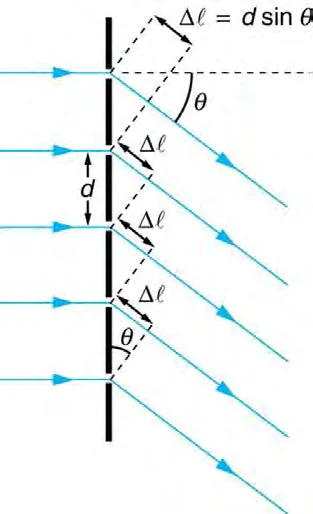
Diagram of a row of atoms spaced d apart scattering waves at angle θ, with the path difference d sin θ marked
Why This Shows Wave Behaviour

◀ Previous2 / 2
1Changing the Accelerating Voltage2Changing the Accelerating Voltage3Changing the Accelerating Voltage
Changing the Accelerating Voltage
1
1
2
Increase the accelerating voltage so that each electron gains more kinetic energy.
3
2
4
The electrons move faster and have greater momentum.
5
3
6
The de Broglie wavelength λ = h/p becomes shorter.
1 / 3Next ▶
Changing the Accelerating Voltage
1
4
2
A shorter wavelength produces less diffraction
so the rings shrink towards the centre.
3
5
4
Lowering the voltage does the opposite and the rings spread outwards.
◀ Previous2 / 3Next ▶
Graph of electron de Broglie wavelength against accelerating voltage, falling curve with points at 100 V, 200 V and 400 V
Changing the Accelerating Voltage

◀ Previous3 / 3
1Same behaviour · Different cause · Ring shape2Conclusion3Conclusion
Same behaviour · Different cause · Ring shape
Same behaviour
Light shone through a narrow slit or grating also gives a diffraction pattern with maxima and minima.
Different cause
Electrons need a crystal target because their wavelength is much smaller than for visible light.
Ring shape
The target contains crystals in many orientations
which spreads the pattern into circular rings.
1 / 3Next ▶
Conclusion
Conclusion
Both radiation and matter can behave like waves or particles depending on the experiment.
The kinetic energy gained by each electron is proportional to the accelerating voltage between anode and cathode.
Louis de Broglie suggested that particles of matter can have wave properties.
If electrons behaved only as particles, the screen would show a uniform spread instead of a diffraction pattern.
The gaps between neighbouring planes of atoms in the graphite crystal act as slits that spread the electron waves.
◀ Previous2 / 3Next ▶
Diffraction gratings: Path difference d sin theta between rays from neighbouring slits of a grating.
Conclusion
◀ Previous3 / 3
14.11.4 – Main ideas for the Exam2Common Mistakes