Curriculum
OCR A Level Physics A H556
1. Development of Practical Skills in Physics
0/56
2. Foundations in Physics
0/29
3. Forces and Motion
0/108
-
3. Forces and Motion
 Preview
-
1.6.3 Force-Extension Graphs
Preview
-
1.6.3 Force-Extension Graphs - Check yourself
 Preview
-
1.6.4 Stress-Strain Graphs
Preview
-
1.6.4 Stress-Strain Graphs - Check yourself
Preview
-
2.1.1 Displacement, Velocity and Acceleration
Preview
-
2.1.1 Displacement, Velocity and Acceleration - Check yourself
Preview
-
2.1.2 Motion Graphs
Preview
-
2.1.9 Projectile Motion
Preview
-
2.1.9 Projectile Motion - Check yourself
Preview
-
3.1.2 Force and Acceleration
Preview
-
3.1.2 Force and Acceleration - Check yourself
Preview
-
3.1.3 Displacement and Velocity-Time Graphs
Preview
-
3.1.3 Displacement and Velocity-Time Graphs - Check yourself
Preview
-
3.1.3 Linear Momentum
Preview
-
3.1.3 Linear Momentum - Check yourself
Preview
-
3.2.2 Investigating Motion and Collisions
Preview
-
3.2.2 Investigating Motion and Collisions - Check yourself
Preview
-
3.2.2 Terminal Velocity
Preview
-
3.2.2 Terminal Velocity - Check yourself
Preview
-
3.2.3 Acceleration and Free Fall
Preview
-
3.2.3 Acceleration and Free Fall - Check yourself
Preview
-
3.2.4 Braking and Reaction Times
Preview
-
3.2.4 Braking and Reaction Times - Check yourself
Preview
-
3.3.1 Conservation of Momentum
Preview
-
3.3.1 Conservation of Momentum - Check yourself
Preview
-
3.3.2 Weight
Preview
-
3.3.2 Weight - Check yourself
Preview
-
3.3.3 Tension, Normal force, Upthrust and Friction
Preview
-
3.3.3 Tension, Normal force, Upthrust and Friction - Check yourself
Preview
-
3.3.4 Motion in One and Two Dimensions
Preview
-
3.3.4 Motion in One and Two Dimensions - Check yourself
Preview
-
3.3.7 Investigating Terminal Velocity
Preview
-
3.3.7 Investigating Terminal Velocity - Check yourself
Preview
-
3.4.2 Couples and Torque
Preview
-
3.4.2 Couples and Torque - Check yourself
Preview
-
3.4.4 Equilibrium
Preview
-
3.4.4 Equilibrium - Check yourself
Preview
-
3.6.1 Work Done
Preview
-
3.6.1 Work Done - Check yourself
Preview
-
3.6.3 Energy and Work
Preview
-
3.6.3 Energy and Work - Check yourself
Preview
-
3.7.1 Deformation and Compression
Preview
-
3.7.1 Deformation and Compression - Check yourself
Preview
-
3.7.5 Stress, Strain and Tensile Strength
Preview
-
3.7.5 Stress, Strain and Tensile Strength - Check yourself
Preview
-
3.7.6 Young's Modulus
Preview
-
3.7.6 Young's Modulus - Check yourself
Preview
-
3.7.8 Elastic and Plastic Deformation
Preview
-
3.7.8 Elastic and Plastic Deformation - Check yourself
Preview
-
3.8.1 Newton's Three Laws of Motion
Preview
-
3.8.1 Newton's Three Laws of Motion - Check yourself
Preview
-
4.1.1 Impulse
Preview
-
4.1.1 Impulse - Check yourself
Preview
-
4.1.2 Moments
Preview
-
4.1.2 Moments - Check yourself
Preview
-
4.2.3 Centre of Mass
Preview
-
4.2.3 Centre of Mass - Check yourself
Preview
-
4.3.1 Density
Preview
-
4.3.1 Density - Check yourself
Preview
-
4.3.2 Pressure
Preview
-
4.3.2 Pressure - Check yourself
Preview
-
4.3.3 SUVAT Equations
Preview
-
4.3.3 SUVAT Equations - Check yourself
Preview
-
4.3.5 Drag Forces
Preview
-
4.3.5 Drag Forces - Check yourself
Preview
-
4.3.5 Archimedes' Principle
Preview
-
4.3.5 Archimedes' Principle - Check yourself
Preview
-
4.5.4 Impulse on a Force-Time Graph
Preview
-
4.5.4 Impulse on a Force-Time Graph - Check yourself
Preview
-
4.5.5 Collisions
Preview
-
4.5.5 Collisions - Check yourself
Preview
-
4.6.4 Conservation of Energy
Preview
-
4.6.4 Conservation of Energy - Check yourself
Preview
-
5.1.3 Efficiency
Preview
-
5.1.3 Efficiency - Check yourself
Preview
-
5.1.4 Power
Preview
-
5.1.4 Power - Check yourself
Preview
-
5.2.1 Gravitational Potential Energy
Preview
-
5.2.1 Gravitational Potential Energy - Check yourself
Preview
-
5.2.2 Kinetic Energy
Preview
-
5.2.2 Kinetic Energy - Check yourself
Preview
-
6.1.2 Hooke's Law
Preview
-
6.1.2 Hooke's Law - Check yourself
Preview
-
6.2.2 Elastic Potential Energy
Preview
-
6.2.2 Elastic Potential Energy - Check yourself
Preview
-
3.1.1 Displacement, Velocity and Acceleration
Preview
-
3.2.1 SUVAT Equations
Preview
-
3.2.5 Projectile Motion
Preview
-
3.3.5 Drag Forces
Preview
-
3.4.1 Moments
Preview
-
3.4.3 Centre of Mass
Preview
-
3.5.1 Density
Preview
-
3.5.2 Pressure
Preview
-
3.5.3 Archimedes' Principle
Preview
-
3.6.2 Conservation of Energy
Preview
-
3.6.4 Kinetic Energy
Preview
-
3.6.5 Gravitational Potential Energy
Preview
-
3.6.6 Power
Preview
-
3.6.7 Efficiency
Preview
-
3.7.2 Hooke's Law
Preview
-
3.7.3 Force-Extension Graphs
Preview
-
3.7.4 Elastic Potential Energy
Preview
-
3.7.7 Stress-Strain Graphs
Preview
-
3.8.2 Linear Momentum
Preview
-
3.8.3 Impulse
Preview
-
3.8.4 Impulse on a Force-Time Graph
Preview
-
3.8.5 Conservation of Momentum
Preview
4. Electrons, Waves and Photons
0/71
OCR H556 chapter questions and answers
0/2
Text lesson
3.8.3 Impulse
3.8.3 Impulse: Define impulse as force multiplied by contact time, link it to the change in momentum, and use it to explain safety features.
1Impulse and Momentum Change2Definition · Equation · Impulse theorem3Origin4Average force
Impulse and Momentum Change
 ⤢ Enlarge
Impulse and Momentum Change
A large impulse is needed to change the motion of a heavy or fast-moving object.
1 / 4Next ▶
Definition · Equation · Impulse theorem
Definition
Impulse is the product of the force acting on an object and the time for which the force acts.
Equation
Impulse = FΔt, measured in newton seconds (N s).
Impulse theorem
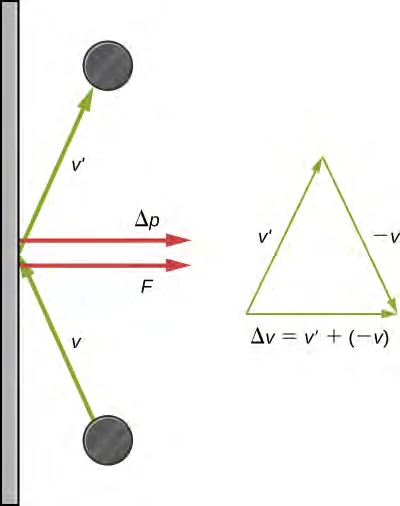
The impulse of the resultant force equals the change in momentum of the object, FΔt = Δp.
◀ Previous2 / 4Next ▶
Origin
Origin
The relationship comes from rearranging Newton’s second law in the form F = Δp/Δt.
◀ Previous3 / 4Next ▶
The impulse–momentum theorem: A ball rebounding from a wall, showing that the force and the change in momentum point the same way.
Average force
 ⤢ Enlarge
Average force
For a short collision the force varies, and the equation gives the average force over the contact time.
◀ Previous4 / 4
1Calculating an Impulse2Calculating an Impulse
1Controlling the Force2Controlling the Force
Controlling the Force
Controlling the Force
If the change in momentum is fixed, a longer contact time gives a smaller average force.
An air bag lengthens the time over which a passenger is stopped
which lowers the force on their body.
A car front deforms during a crash, extending the stopping time and lowering the peak force.
A ball that bounces back has a larger momentum change than one that stops
so the impulse and force are larger.
1 / 2Next ▶
Force against time graphs of a short and a long collision with equal areas representing the same impulse
Controlling the Force

◀ Previous2 / 2
1Cricket catch · Landing2Hitting a ball
Cricket catch · Landing
Cricket catch
Drawing the hands back on catching extends the contact time, reducing the force on the fingers.
Landing
Bending the knees when landing increases the time to stop
so the force on the legs is smaller.
1 / 2Next ▶
Force against time graphs of a hard impact and a cushioned catch with equal shaded areas
Hitting a ball
 ⤢ Enlarge
Hitting a ball
A bat and ball are in contact for only a few milliseconds
so the forces involved reach hundreds of newtons.
◀ Previous2 / 2
Worked Example
1
Question: A tennis ball of mass 0.057 kg, initially at rest, is struck and leaves the racket at 45 m s−1. The contact lasts 5.0 ms. Find the impulse and the average force.
2
Change in momentum = 0.057 × 45 − 0 = 2.57 N s
so the impulse is 2.57 N s.
3
Contact time = 5.0 ms = 5.0 × 10⁻³ s.
4
F = impulse / time = 2.565 / (5.0 × 10⁻³) = 513 N.
5
Answer: Impulse = 2.6 N s
average force = 5.1 × 10² N.
13.8.3 – Main ideas for the Exam2Common Mistakes