Curriculum
OCR A Level Physics A H556
1. Development of Practical Skills in Physics
0/56
2. Foundations in Physics
0/29
3. Forces and Motion
0/108
-
3. Forces and Motion
 Preview
-
1.6.3 Force-Extension Graphs
Preview
-
1.6.3 Force-Extension Graphs - Check yourself
 Preview
-
1.6.4 Stress-Strain Graphs
Preview
-
1.6.4 Stress-Strain Graphs - Check yourself
Preview
-
2.1.1 Displacement, Velocity and Acceleration
Preview
-
2.1.1 Displacement, Velocity and Acceleration - Check yourself
Preview
-
2.1.2 Motion Graphs
Preview
-
2.1.9 Projectile Motion
Preview
-
2.1.9 Projectile Motion - Check yourself
Preview
-
3.1.2 Force and Acceleration
Preview
-
3.1.2 Force and Acceleration - Check yourself
Preview
-
3.1.3 Displacement and Velocity-Time Graphs
Preview
-
3.1.3 Displacement and Velocity-Time Graphs - Check yourself
Preview
-
3.1.3 Linear Momentum
Preview
-
3.1.3 Linear Momentum - Check yourself
Preview
-
3.2.2 Investigating Motion and Collisions
Preview
-
3.2.2 Investigating Motion and Collisions - Check yourself
Preview
-
3.2.2 Terminal Velocity
Preview
-
3.2.2 Terminal Velocity - Check yourself
Preview
-
3.2.3 Acceleration and Free Fall
Preview
-
3.2.3 Acceleration and Free Fall - Check yourself
Preview
-
3.2.4 Braking and Reaction Times
Preview
-
3.2.4 Braking and Reaction Times - Check yourself
Preview
-
3.3.1 Conservation of Momentum
Preview
-
3.3.1 Conservation of Momentum - Check yourself
Preview
-
3.3.2 Weight
Preview
-
3.3.2 Weight - Check yourself
Preview
-
3.3.3 Tension, Normal force, Upthrust and Friction
Preview
-
3.3.3 Tension, Normal force, Upthrust and Friction - Check yourself
Preview
-
3.3.4 Motion in One and Two Dimensions
Preview
-
3.3.4 Motion in One and Two Dimensions - Check yourself
Preview
-
3.3.7 Investigating Terminal Velocity
Preview
-
3.3.7 Investigating Terminal Velocity - Check yourself
Preview
-
3.4.2 Couples and Torque
Preview
-
3.4.2 Couples and Torque - Check yourself
Preview
-
3.4.4 Equilibrium
Preview
-
3.4.4 Equilibrium - Check yourself
Preview
-
3.6.1 Work Done
Preview
-
3.6.1 Work Done - Check yourself
Preview
-
3.6.3 Energy and Work
Preview
-
3.6.3 Energy and Work - Check yourself
Preview
-
3.7.1 Deformation and Compression
Preview
-
3.7.1 Deformation and Compression - Check yourself
Preview
-
3.7.5 Stress, Strain and Tensile Strength
Preview
-
3.7.5 Stress, Strain and Tensile Strength - Check yourself
Preview
-
3.7.6 Young's Modulus
Preview
-
3.7.6 Young's Modulus - Check yourself
Preview
-
3.7.8 Elastic and Plastic Deformation
Preview
-
3.7.8 Elastic and Plastic Deformation - Check yourself
Preview
-
3.8.1 Newton's Three Laws of Motion
Preview
-
3.8.1 Newton's Three Laws of Motion - Check yourself
Preview
-
4.1.1 Impulse
Preview
-
4.1.1 Impulse - Check yourself
Preview
-
4.1.2 Moments
Preview
-
4.1.2 Moments - Check yourself
Preview
-
4.2.3 Centre of Mass
Preview
-
4.2.3 Centre of Mass - Check yourself
Preview
-
4.3.1 Density
Preview
-
4.3.1 Density - Check yourself
Preview
-
4.3.2 Pressure
Preview
-
4.3.2 Pressure - Check yourself
Preview
-
4.3.3 SUVAT Equations
Preview
-
4.3.3 SUVAT Equations - Check yourself
Preview
-
4.3.5 Drag Forces
Preview
-
4.3.5 Drag Forces - Check yourself
Preview
-
4.3.5 Archimedes' Principle
Preview
-
4.3.5 Archimedes' Principle - Check yourself
Preview
-
4.5.4 Impulse on a Force-Time Graph
Preview
-
4.5.4 Impulse on a Force-Time Graph - Check yourself
Preview
-
4.5.5 Collisions
Preview
-
4.5.5 Collisions - Check yourself
Preview
-
4.6.4 Conservation of Energy
Preview
-
4.6.4 Conservation of Energy - Check yourself
Preview
-
5.1.3 Efficiency
Preview
-
5.1.3 Efficiency - Check yourself
Preview
-
5.1.4 Power
Preview
-
5.1.4 Power - Check yourself
Preview
-
5.2.1 Gravitational Potential Energy
Preview
-
5.2.1 Gravitational Potential Energy - Check yourself
Preview
-
5.2.2 Kinetic Energy
Preview
-
5.2.2 Kinetic Energy - Check yourself
Preview
-
6.1.2 Hooke's Law
Preview
-
6.1.2 Hooke's Law - Check yourself
Preview
-
6.2.2 Elastic Potential Energy
Preview
-
6.2.2 Elastic Potential Energy - Check yourself
Preview
-
3.1.1 Displacement, Velocity and Acceleration
Preview
-
3.2.1 SUVAT Equations
Preview
-
3.2.5 Projectile Motion
Preview
-
3.3.5 Drag Forces
Preview
-
3.4.1 Moments
Preview
-
3.4.3 Centre of Mass
Preview
-
3.5.1 Density
Preview
-
3.5.2 Pressure
Preview
-
3.5.3 Archimedes' Principle
Preview
-
3.6.2 Conservation of Energy
Preview
-
3.6.4 Kinetic Energy
Preview
-
3.6.5 Gravitational Potential Energy
Preview
-
3.6.6 Power
Preview
-
3.6.7 Efficiency
Preview
-
3.7.2 Hooke's Law
Preview
-
3.7.3 Force-Extension Graphs
Preview
-
3.7.4 Elastic Potential Energy
Preview
-
3.7.7 Stress-Strain Graphs
Preview
-
3.8.2 Linear Momentum
Preview
-
3.8.3 Impulse
Preview
-
3.8.4 Impulse on a Force-Time Graph
Preview
-
3.8.5 Conservation of Momentum
Preview
4. Electrons, Waves and Photons
0/71
OCR H556 chapter questions and answers
0/2
Text lesson
3.6.6 Power
3.6.6 Power: Define power as the rate of energy transfer, use P = W/t and P = Fv, and relate the watt and kilowatt-hour to the joule.
1What Power Means2Definition · Equation · The watt3Larger units4Comparing machines
What Power Means
 ⤢ Enlarge
What Power Means
Power tells us how quickly something converts energy, not how much energy it converts in total.
1 / 4Next ▶
Definition · Equation · The watt
Definition
Power is the rate at which energy is transferred, or the rate at which work is done.
Equation
P = ΔE/t = W/t
where P is power in watts, W is work in joules and t is time in seconds.
The watt
One watt is the transfer of one joule of energy each second
so 1 W = 1 J s−1.
◀ Previous2 / 4Next ▶
Larger units
Larger units
Power stations use kilowatts, megawatts and gigawatts
which are 103 W, 106 W and 109 W.
◀ Previous3 / 4Next ▶
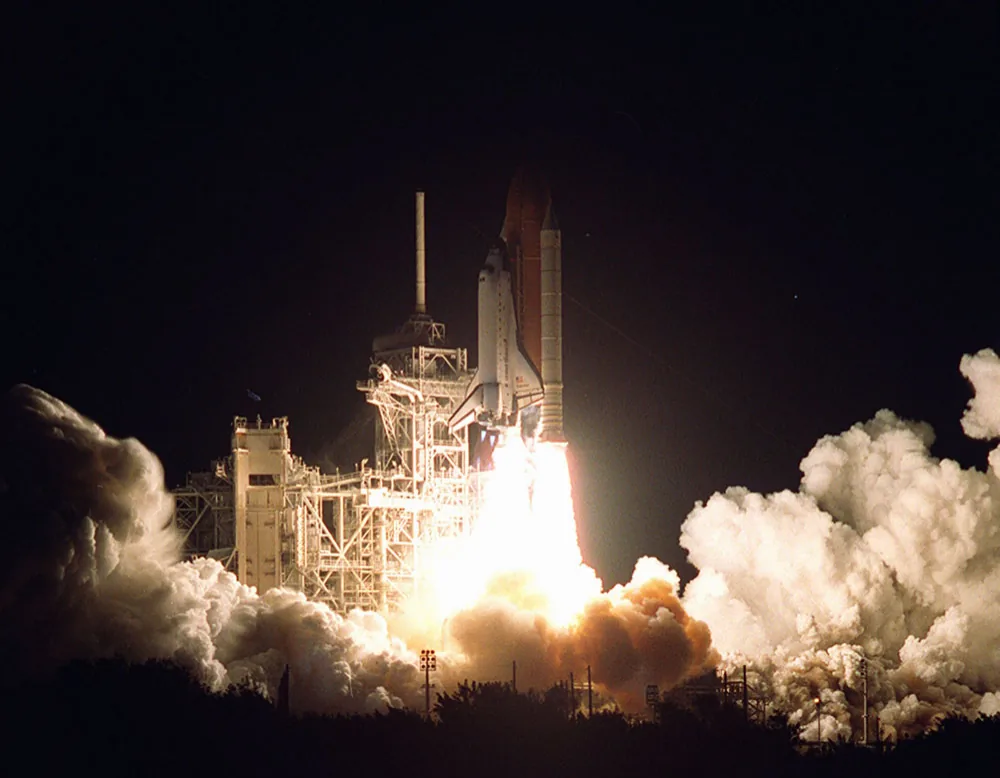
What is power?: A rocket on the Space Shuttle lifting off, doing work and using energy at a very high rate.
Comparing machines
 ⤢ Enlarge
Comparing machines
Two machines doing the same work are distinguished by power
because the more powerful one finishes sooner.
◀ Previous4 / 4
1Power, Force and Velocity2Power, Force and Velocity
Energy Bills and Units
Energy Bills and Units
A kilowatt-hour is the energy used by a 1 kW device running for one hour.
1 kW h = 1000 W × 3600 s = 3.6 × 10⁶ J
which is why it is used for large domestic quantities.
Cost equals energy in kW h multiplied by the price per kW h
so power in kW and time in hours are used.
The power rating on an appliance gives the energy it transfers every second at its normal operating voltage.
1Lifting · Vehicle motion2Human power3Human power
Lifting · Vehicle motion
Lifting
A crane lifting a load steadily must supply power equal to the load’s weight multiplied by its speed.
Vehicle motion
At top speed the engine’s useful power is the product of drag force and speed.
1 / 3Next ▶
Human power
Human power
Short bursts of exercise transfer energy faster than steady activity
so a sprinter’s power is far above an average walker’s.
Power ratings printed on electrical items, such as light bulbs, show how much energy an electric current transfers each second.
P = Fv is valid only when the force stays constant and the body moves at a steady velocity.
Power is also needed to produce an acceleration
which the constant-velocity form of P = Fv does not describe.
◀ Previous2 / 3Next ▶
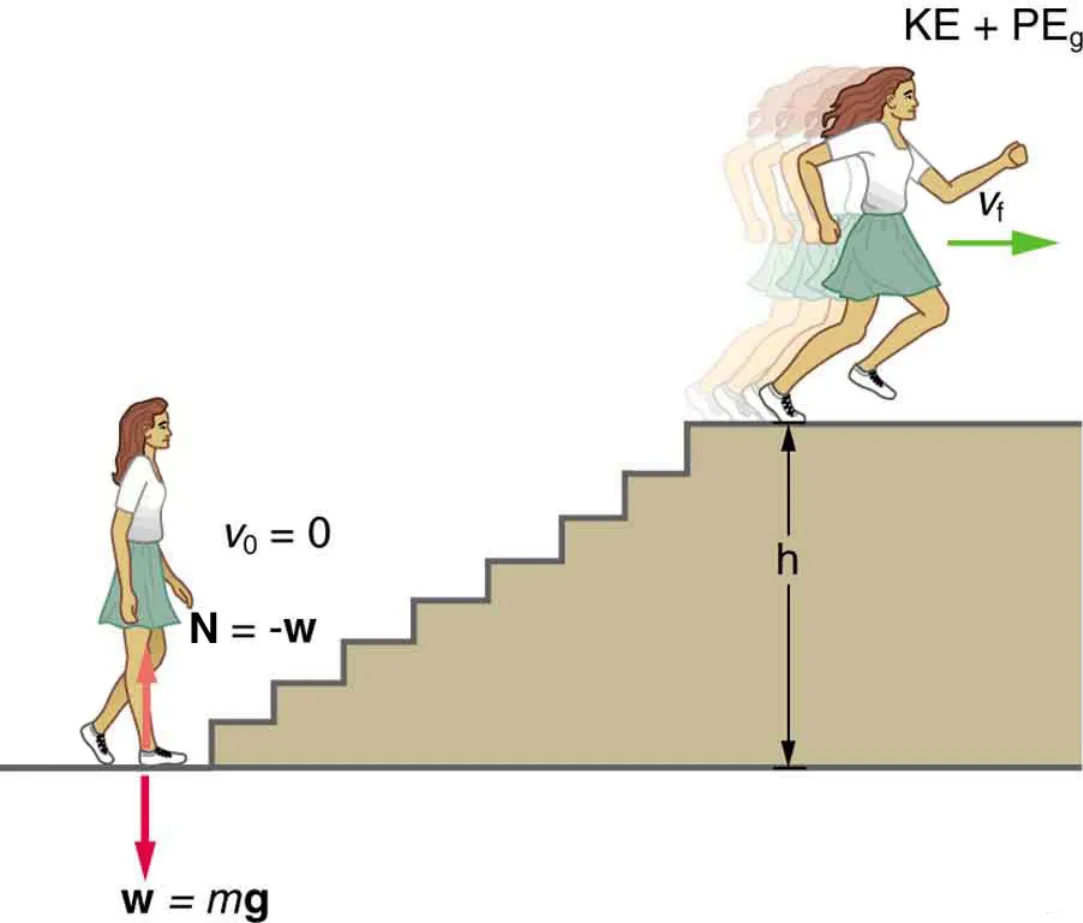
Worked examples: A woman running up a flight of stairs from rest, converting chemical energy from food into kinetic and gravitational potential energy.
Human power
◀ Previous3 / 3
Worked Example
1
Question: A crane lifts an 800 kg load vertically at a constant speed of 0.50 m s−1. Calculate the useful power delivered to the load. (g = 9.81 N kg−1)
2
At constant speed the lifting force equals the weight: F = mg = 800 × 9.81 = 7848 N.
3
P = Fv = 7848 × 0.50 = 3924 W.What the symbols mean: P = power (W = J s−1) · W or E = work done / energy transferred (J) · t = time (s) · F = force (N) · v = velocity (m s−1)
4
Answer: P ≈ 3.9 × 10³ W, or 3.9 kW.
13.6.6 – Main ideas for the Exam2Common Mistakes