Curriculum
OCR A Level Physics A H556
1. Development of Practical Skills in Physics
0/56
2. Foundations in Physics
0/29
3. Forces and Motion
0/108
4. Electrons, Waves and Photons
0/71
-
4. Electrons, Waves and Photons
 Preview
-
4.1.1 Electric Current and Charge
Preview
-
4.1.1 Electric Current and Charge - Check yourself
 Preview
-
4.1.2 Electric Current and Electron Flow
Preview
-
4.1.2 Electric Current and Electron Flow - Check yourself
Preview
-
4.1.4 Current in a Current Carrying Conductor
Preview
-
4.1.4 Current in a Current Carrying Conductor - Check yourself
Preview
-
4.1.5 Conductors, Semiconductors and Insulators
Preview
-
4.1.5 Conductors, Semiconductors and Insulators - Check yourself
Preview
-
4.1.6 Circuit Symbols and Diagrams
Preview
-
4.1.6 Circuit Symbols and Diagrams - Check yourself
Preview
-
4.2.2 Ohm's Law and I-V Characteristics
Preview
-
4.2.2 Ohm's Law and I-V Characteristics - Check yourself
Preview
-
4.2.3 Investigating Electrical Characteristics of Components
Preview
-
4.2.3 Investigating Electrical Characteristics of Components - Check yourself
Preview
-
9.3.1 Resistance
Preview
-
9.3.1 Resistance - Check yourself
Preview
-
10.2.1 Kirchhoff's First Law
Preview
-
10.2.1 Kirchhoff's First Law - Check yourself
Preview
-
4.1.3 Kirchhoff's First Law
Preview
-
4.2.1 Resistance
Preview
-
4.10.1 The Photoelectric Effect
Preview
-
4.10.2 Demonstrating the Photoelectric Effect
Preview
-
4.10.3 The Photoelectric Equation
Preview
-
4.10.4 Work Function and Threshold Frequency
Preview
-
4.10.5 Maximum Kinetic Energy and Intensity
Preview
-
4.11.1 The Photon
Preview
-
4.11.2 The Electronvolt
Preview
-
4.11.3 Determining the Planck Constant
Preview
-
4.11.4 Electron Diffraction
Preview
-
4.11.5 The de Broglie Equation
Preview
-
4.2.4 The Light-Dependent Resistor (LDR)
Preview
-
4.2.5 Resistivity
Preview
-
4.2.6 Determining the Resistivity of a Metal
Preview
-
4.2.7 Thermistors
Preview
-
4.3.1 Power
Preview
-
4.3.2 Electrical Energy
Preview
-
4.3.3 Kirchhoff's Second Law
Preview
-
4.3.4 Kirchhoff's Laws in Circuits
Preview
-
4.3.5 Resistors in Series and Parallel Circuits
Preview
-
4.3.6 Series and Parallel Circuits
Preview
-
4.3.7 Circuits with Multiple Sources of e.m.f
Preview
-
4.4.1 E.m.f and Internal Resistance
Preview
-
4.4.2 Calculating E.m.f
Preview
-
4.4.3 Determining Internal Resistance
Preview
-
4.4.4 E.m.f and Potential Difference
Preview
-
4.4.5 Energy Transfer
Preview
-
4.5.1 Potential Divider Circuits
Preview
-
4.5.2 Variable Resistance Components
Preview
-
4.5.3 Investigating Potential Divider Circuits
Preview
-
4.6.1 Progressive Waves: Longitudinal and Transverse
Preview
-
4.6.2 Calculating Frequency
Preview
-
4.6.3 The Wave Equation
Preview
-
4.6.4 Graphical Representations of Transverse and Longitudinal Waves
Preview
-
4.6.5 Intensity of a Wave
Preview
-
4.7.1 The Electromagnetic Spectrum
Preview
-
4.7.2 Polarisation
Preview
-
4.8.1 Refraction
Preview
-
4.8.2 Total Internal Reflection
Preview
-
4.8.3 Wave Phenomena
Preview
-
4.9.1 Superposition
Preview
-
4.9.10 Determining the Speed of Sound in Air in a Resonance Tube
Preview
-
4.9.11 Harmonics
Preview
-
4.9.2 Graphical Representation of Superposition
Preview
-
4.9.3 Interference
Preview
-
4.9.4 Two-Source Interference
Preview
-
4.9.5 Young's Double-Slit Experiment
Preview
-
4.9.6 Determining the Wavelength of Light
Preview
-
4.9.7 Stationary Waves
Preview
-
4.9.8 Stationary vs Progressive Waves
Preview
-
4.9.9 Nodes and Antinodes
Preview
OCR H556 chapter questions and answers
0/2
Text lesson
4.8.2 Total Internal Reflection
4.8.2 Total Internal Reflection: State the conditions for total internal reflection, use sin C = 1/n to find the critical angle, and explain how optical fibres use it.
1The Phenomenon2Starting point · Critical angle · Beyond C3Conditions
The Phenomenon
 ⤢ Enlarge
The Phenomenon
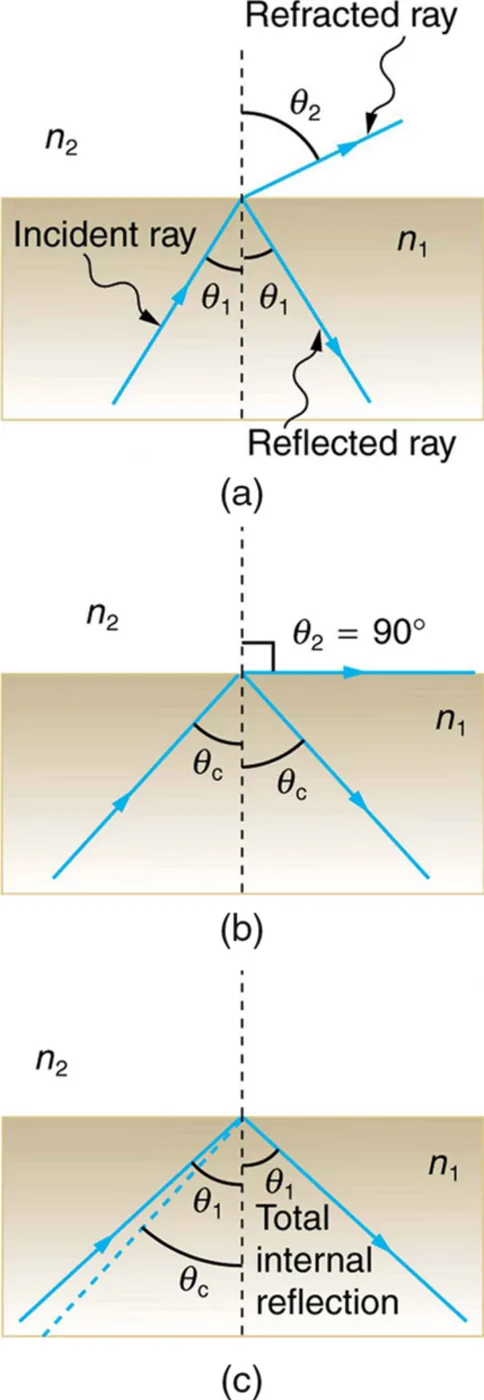
Total internal reflection reflects all of the light, with no refracted ray at all.
1 / 3Next ▶
Starting point · Critical angle · Beyond C
Starting point
A ray going from a more optically dense medium to a less dense one bends away from the normal.
Critical angle
The critical angle C is the angle of incidence in the denser medium at which the refracted ray travels along the boundary.
Beyond C
For incidence angles greater than C no light is refracted out, and all of it is reflected back inside.
◀ Previous2 / 3Next ▶
Total internal reflection and the critical angle: Three ray diagrams show a ray moving from a material with a higher index into one with a lower index: the refracted ray bends away from the normal, reaches 90 degrees at the critical angle, and is totally reflected at a larger incident angle.
Conditions
 ⤢ Enlarge
Conditions
Total internal reflection needs light travelling towards a medium of lower refractive index at an angle greater than C.
◀ Previous3 / 3
1The Critical Angle2The Critical Angle
The Critical Angle
The Critical Angle
At C, the refracted angle is 90°
so n sin C = 1 × sin 90°giving sin C = 1/n for a boundary with air.
For a boundary between two media, sin C = n₂/n₁
where n₁ is the higher index.
With n = 1.50, the critical angle is about 42°.
With n = 1.33, the critical angle is about 49°.
A material’s refractive index is always greater than 1
because light travels more slowly in it than in a vacuum.
For calculations, the refractive index of air is taken as approximately 1.
1 / 2Next ▶
Light rays in diamond meeting the boundary with air at 10, critical angle 24.4 and 40 degrees, showing refraction, grazing emergence and total internal reflection
The Critical Angle
 ⤢ Enlarge
1
Snell’s law links the angles of incidence and refraction through n₁ sin θ₁ = n₂ sin θ₂, with both angles measured from the normal.
2
If an angle is given between the ray and the boundary, subtract it from 90° to get the angle from the normal.
3
At a reflecting boundary, the angle of incidence always equals the angle of reflection.
◀ Previous2 / 2
1Optical Fibres2Optical Fibres3Optical Fibres
Optical Fibres
1
1
2
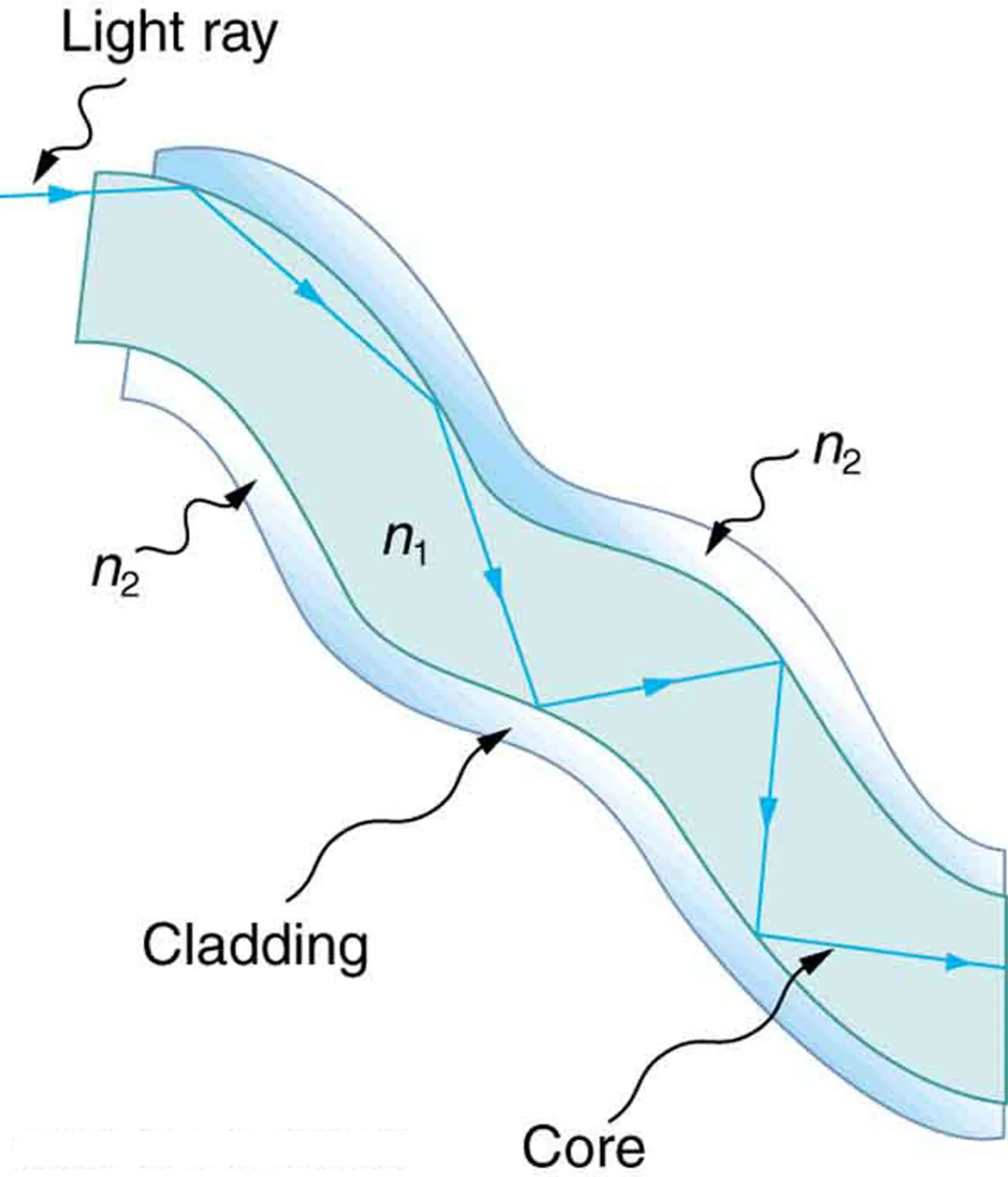
An optical fibre has a central core of glass surrounded by a cladding of lower refractive index.
3
2
4
Light enters the core and strikes the core-cladding boundary at an angle larger than the critical angle.
5
3
6
It is totally internally reflected again and again along the fibre with very little loss.
1 / 3Next ▶
Optical Fibres
Optical Fibres
4
The cladding protects the core surface, and prevents signal leaking between neighbouring fibres.
5
Fibres carry telephone, internet and cable-television signals, and are used in endoscopes to view inside the body.
◀ Previous2 / 3Next ▶
Fiber optics: endoscopes to telephones: A single fiber with its cladding: the lower-index cladding keeps light totally reflected inside the core.
Optical Fibres
◀ Previous3 / 3
Worked Example
Worked Example
Question: Calculate the critical angle for light travelling from glass of refractive index 1.50 into air.
Use sin C = 1/n = 1⁄1.50 = 0.667.
C = sin−1(0.667) = 41.8°.
Answer: Critical angle = 42° (to 2 significant figures).
14.8.2 – Main ideas for the Exam2Common Mistakes