Curriculum
OCR A Level Physics A H556
1. Development of Practical Skills in Physics
0/56
2. Foundations in Physics
0/29
3. Forces and Motion
0/108
4. Electrons, Waves and Photons
0/71
-
4. Electrons, Waves and Photons
 Preview
-
4.1.1 Electric Current and Charge
Preview
-
4.1.1 Electric Current and Charge - Check yourself
 Preview
-
4.1.2 Electric Current and Electron Flow
Preview
-
4.1.2 Electric Current and Electron Flow - Check yourself
Preview
-
4.1.4 Current in a Current Carrying Conductor
Preview
-
4.1.4 Current in a Current Carrying Conductor - Check yourself
Preview
-
4.1.5 Conductors, Semiconductors and Insulators
Preview
-
4.1.5 Conductors, Semiconductors and Insulators - Check yourself
Preview
-
4.1.6 Circuit Symbols and Diagrams
Preview
-
4.1.6 Circuit Symbols and Diagrams - Check yourself
Preview
-
4.2.2 Ohm's Law and I-V Characteristics
Preview
-
4.2.2 Ohm's Law and I-V Characteristics - Check yourself
Preview
-
4.2.3 Investigating Electrical Characteristics of Components
Preview
-
4.2.3 Investigating Electrical Characteristics of Components - Check yourself
Preview
-
9.3.1 Resistance
Preview
-
9.3.1 Resistance - Check yourself
Preview
-
10.2.1 Kirchhoff's First Law
Preview
-
10.2.1 Kirchhoff's First Law - Check yourself
Preview
-
4.1.3 Kirchhoff's First Law
Preview
-
4.2.1 Resistance
Preview
-
4.10.1 The Photoelectric Effect
Preview
-
4.10.2 Demonstrating the Photoelectric Effect
Preview
-
4.10.3 The Photoelectric Equation
Preview
-
4.10.4 Work Function and Threshold Frequency
Preview
-
4.10.5 Maximum Kinetic Energy and Intensity
Preview
-
4.11.1 The Photon
Preview
-
4.11.2 The Electronvolt
Preview
-
4.11.3 Determining the Planck Constant
Preview
-
4.11.4 Electron Diffraction
Preview
-
4.11.5 The de Broglie Equation
Preview
-
4.2.4 The Light-Dependent Resistor (LDR)
Preview
-
4.2.5 Resistivity
Preview
-
4.2.6 Determining the Resistivity of a Metal
Preview
-
4.2.7 Thermistors
Preview
-
4.3.1 Power
Preview
-
4.3.2 Electrical Energy
Preview
-
4.3.3 Kirchhoff's Second Law
Preview
-
4.3.4 Kirchhoff's Laws in Circuits
Preview
-
4.3.5 Resistors in Series and Parallel Circuits
Preview
-
4.3.6 Series and Parallel Circuits
Preview
-
4.3.7 Circuits with Multiple Sources of e.m.f
Preview
-
4.4.1 E.m.f and Internal Resistance
Preview
-
4.4.2 Calculating E.m.f
Preview
-
4.4.3 Determining Internal Resistance
Preview
-
4.4.4 E.m.f and Potential Difference
Preview
-
4.4.5 Energy Transfer
Preview
-
4.5.1 Potential Divider Circuits
Preview
-
4.5.2 Variable Resistance Components
Preview
-
4.5.3 Investigating Potential Divider Circuits
Preview
-
4.6.1 Progressive Waves: Longitudinal and Transverse
Preview
-
4.6.2 Calculating Frequency
Preview
-
4.6.3 The Wave Equation
Preview
-
4.6.4 Graphical Representations of Transverse and Longitudinal Waves
Preview
-
4.6.5 Intensity of a Wave
Preview
-
4.7.1 The Electromagnetic Spectrum
Preview
-
4.7.2 Polarisation
Preview
-
4.8.1 Refraction
Preview
-
4.8.2 Total Internal Reflection
Preview
-
4.8.3 Wave Phenomena
Preview
-
4.9.1 Superposition
Preview
-
4.9.10 Determining the Speed of Sound in Air in a Resonance Tube
Preview
-
4.9.11 Harmonics
Preview
-
4.9.2 Graphical Representation of Superposition
Preview
-
4.9.3 Interference
Preview
-
4.9.4 Two-Source Interference
Preview
-
4.9.5 Young's Double-Slit Experiment
Preview
-
4.9.6 Determining the Wavelength of Light
Preview
-
4.9.7 Stationary Waves
Preview
-
4.9.8 Stationary vs Progressive Waves
Preview
-
4.9.9 Nodes and Antinodes
Preview
OCR H556 chapter questions and answers
0/2
Text lesson
4.10.4 Work Function and Threshold Frequency
4.10.4 Work Function and Threshold Frequency: Define work function and threshold frequency and wavelength, and use them to decide whether a metal emits photoelectrons.
1Work function2Threshold frequency · Threshold wavelength · Metal dependent
Work function
 ⤢ Enlarge
Work function
The work function Φ is the minimum energy needed to remove an electron from the surface of a metal.
1 / 2Next ▶
Threshold frequency · Threshold wavelength · Metal dependent
Threshold frequency
The threshold frequency f₀ is the lowest frequency of radiation that can release a photoelectron from the metal.
Threshold wavelength
The threshold wavelength λ₀ is the longest wavelength that can release a photoelectron,
because wavelength is inversely related to frequency.
Metal dependent
Each metal has its own work function
so its threshold frequency differs from that of other metals.
◀ Previous2 / 2
1Relationships2Relationships
Relationships
Relationships
At the threshold the photon energy only just equals the work function
so hf₀ = Φ.
Rearranging gives f₀ = Φ / h
which is the minimum frequency needed.
Since f = c/λ, the threshold wavelength is λ₀ = hc / Φ.
A larger Φ means a higher threshold frequency and a shorter threshold wavelength.
| Condition | Result |
|---|---|
| f < f₀ (λ > λ₀) | No photoelectrons |
| f = f₀ (λ = λ₀) | Electrons just escape with no kinetic energy |
| f > f₀ (λ < λ₀) | Electrons escape with kinetic energy |
1 / 2Next ▶
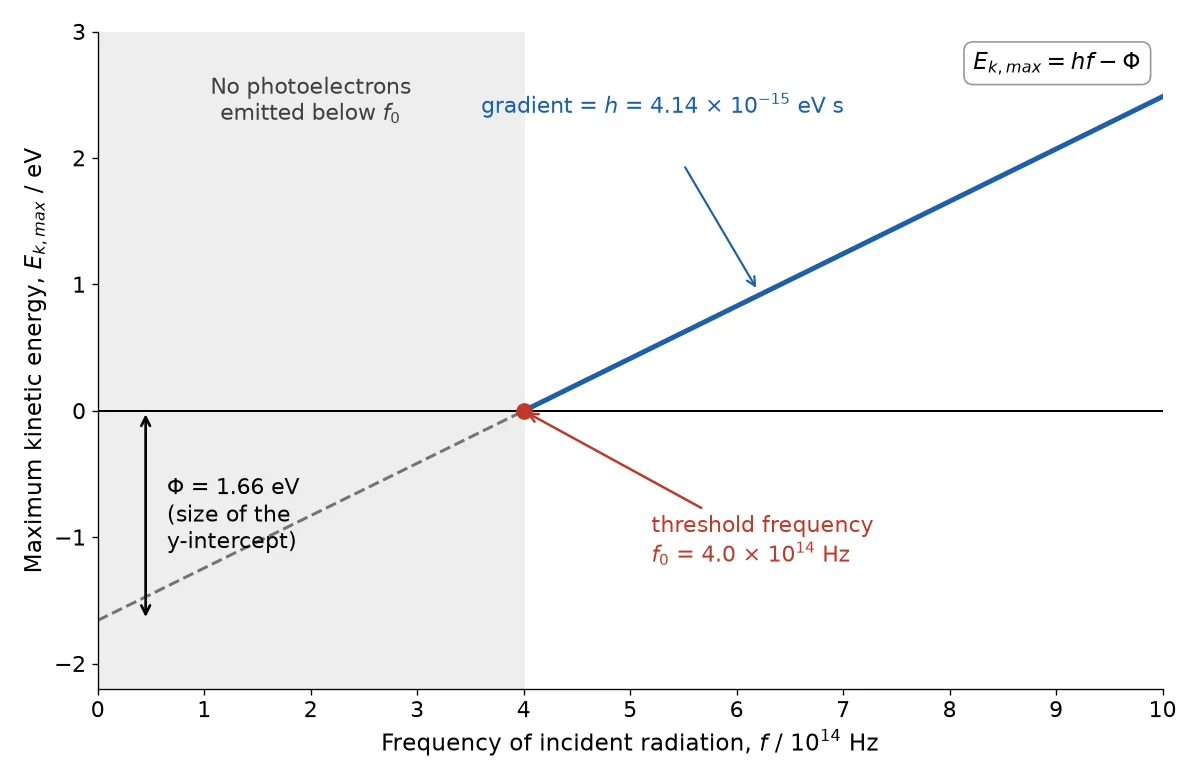
Graph of maximum kinetic energy against photon frequency for a metal, with threshold frequency, y-intercept at minus the work function, and gradient h
Relationships

◀ Previous2 / 2
1Deciding Whether Emission Occurs2Deciding Whether Emission Occurs
1Same gradient · Different intercepts · Using the intercept2Using the y-intercept3Using the y-intercept
Same gradient · Different intercepts · Using the intercept
Same gradient
Graphs of KEmax against f for different metals are parallel lines, since each has the gradient h.
Different intercepts
A metal with a larger work function has an x-intercept at a higher frequency.
Using the intercept
Reading f₀ from the graph lets you calculate Φ using Φ = hf₀.
1 / 3Next ▶
Using the y-intercept
1
The vertical intercept gives −Φ directly, in joules or electronvolts depending on the axis.
2
The photoelectric effect provides evidence that light is carried in discrete packets called photons.
3
Each surface electron absorbs only one photon
so a single photon’s energy must be enough to overcome the work function.
4
The photoelectric equation states that hf equals the work function plus the maximum kinetic energy of an emitted electron.
5
The maximum kinetic energy of an electron is set by the frequency of the incident radiation rather than its intensity.
6
Brighter radiation releases more photoelectrons each second but does not change their maximum energy.
◀ Previous2 / 3Next ▶
Graph of maximum photoelectron kinetic energy against frequency for sodium, with threshold frequency and work function marked
Using the y-intercept
 ⤢ Enlarge
Using the y-intercept
Photoelectrons are emitted as soon as radiation of sufficient frequency strikes the metal surface, with no time delay.
◀ Previous3 / 3
Worked Example
Worked Example
Question: The work function of a metal is 4.2 eV. Calculate its threshold frequency and threshold wavelength. (h = 6.63 × 10⁻³⁴ J s, c = 3.00 × 10⁸ m/s, e = 1.60 × 10⁻¹⁹ C)
Convert Φ to joules: 4.2 × 1.60 × 10−19 = 6.72 × 10⁻¹⁹ J.
Threshold frequency f₀ = Φ / h = 6.72 × 10⁻¹⁹ / 6.63 × 10−34 = 1.01 × 10¹⁵ Hz.
Threshold wavelength λ₀ = c / f₀ = 3.00 × 10⁸ / 1.01 × 1015 = 2.96 × 10⁻⁷ m.
Answer: f₀ = 1.0 × 10¹⁵ Hz and λ₀ = 296 nm
so only ultraviolet of shorter wavelength causes emission.
14.10.4 – Main ideas for the Exam2Common Mistakes