Curriculum
OCR A Level Physics A H556
1. Development of Practical Skills in Physics
0/56
2. Foundations in Physics
0/29
3. Forces and Motion
0/108
4. Electrons, Waves and Photons
0/71
-
4. Electrons, Waves and Photons
 Preview
-
4.1.1 Electric Current and Charge
Preview
-
4.1.1 Electric Current and Charge - Check yourself
 Preview
-
4.1.2 Electric Current and Electron Flow
Preview
-
4.1.2 Electric Current and Electron Flow - Check yourself
Preview
-
4.1.4 Current in a Current Carrying Conductor
Preview
-
4.1.4 Current in a Current Carrying Conductor - Check yourself
Preview
-
4.1.5 Conductors, Semiconductors and Insulators
Preview
-
4.1.5 Conductors, Semiconductors and Insulators - Check yourself
Preview
-
4.1.6 Circuit Symbols and Diagrams
Preview
-
4.1.6 Circuit Symbols and Diagrams - Check yourself
Preview
-
4.2.2 Ohm's Law and I-V Characteristics
Preview
-
4.2.2 Ohm's Law and I-V Characteristics - Check yourself
Preview
-
4.2.3 Investigating Electrical Characteristics of Components
Preview
-
4.2.3 Investigating Electrical Characteristics of Components - Check yourself
Preview
-
9.3.1 Resistance
Preview
-
9.3.1 Resistance - Check yourself
Preview
-
10.2.1 Kirchhoff's First Law
Preview
-
10.2.1 Kirchhoff's First Law - Check yourself
Preview
-
4.1.3 Kirchhoff's First Law
Preview
-
4.2.1 Resistance
Preview
-
4.10.1 The Photoelectric Effect
Preview
-
4.10.2 Demonstrating the Photoelectric Effect
Preview
-
4.10.3 The Photoelectric Equation
Preview
-
4.10.4 Work Function and Threshold Frequency
Preview
-
4.10.5 Maximum Kinetic Energy and Intensity
Preview
-
4.11.1 The Photon
Preview
-
4.11.2 The Electronvolt
Preview
-
4.11.3 Determining the Planck Constant
Preview
-
4.11.4 Electron Diffraction
Preview
-
4.11.5 The de Broglie Equation
Preview
-
4.2.4 The Light-Dependent Resistor (LDR)
Preview
-
4.2.5 Resistivity
Preview
-
4.2.6 Determining the Resistivity of a Metal
Preview
-
4.2.7 Thermistors
Preview
-
4.3.1 Power
Preview
-
4.3.2 Electrical Energy
Preview
-
4.3.3 Kirchhoff's Second Law
Preview
-
4.3.4 Kirchhoff's Laws in Circuits
Preview
-
4.3.5 Resistors in Series and Parallel Circuits
Preview
-
4.3.6 Series and Parallel Circuits
Preview
-
4.3.7 Circuits with Multiple Sources of e.m.f
Preview
-
4.4.1 E.m.f and Internal Resistance
Preview
-
4.4.2 Calculating E.m.f
Preview
-
4.4.3 Determining Internal Resistance
Preview
-
4.4.4 E.m.f and Potential Difference
Preview
-
4.4.5 Energy Transfer
Preview
-
4.5.1 Potential Divider Circuits
Preview
-
4.5.2 Variable Resistance Components
Preview
-
4.5.3 Investigating Potential Divider Circuits
Preview
-
4.6.1 Progressive Waves: Longitudinal and Transverse
Preview
-
4.6.2 Calculating Frequency
Preview
-
4.6.3 The Wave Equation
Preview
-
4.6.4 Graphical Representations of Transverse and Longitudinal Waves
Preview
-
4.6.5 Intensity of a Wave
Preview
-
4.7.1 The Electromagnetic Spectrum
Preview
-
4.7.2 Polarisation
Preview
-
4.8.1 Refraction
Preview
-
4.8.2 Total Internal Reflection
Preview
-
4.8.3 Wave Phenomena
Preview
-
4.9.1 Superposition
Preview
-
4.9.10 Determining the Speed of Sound in Air in a Resonance Tube
Preview
-
4.9.11 Harmonics
Preview
-
4.9.2 Graphical Representation of Superposition
Preview
-
4.9.3 Interference
Preview
-
4.9.4 Two-Source Interference
Preview
-
4.9.5 Young's Double-Slit Experiment
Preview
-
4.9.6 Determining the Wavelength of Light
Preview
-
4.9.7 Stationary Waves
Preview
-
4.9.8 Stationary vs Progressive Waves
Preview
-
4.9.9 Nodes and Antinodes
Preview
OCR H556 chapter questions and answers
0/2
Text lesson
4.2.5 Resistivity
4.2.5 Resistivity: Define resistivity, use R = ρL/A to find the resistance of wires, and compare materials.
1Length2Cross-sectional area · Material3Temperature
Length
 ⤢ Enlarge
Length
For a given material and cross-section, resistance is proportional to the length of the conductor.
1 / 3Next ▶
Cross-sectional area · Material
Cross-sectional area
Resistance is inversely proportional to the area
because a wider wire gives more paths for charge flow.
Material
Different materials have different numbers of charge carriers
which is accounted for by resistivity.
◀ Previous2 / 3Next ▶
Graph of resistance R against length L for a test wire, a straight line through the origin with measured points and a gradient triangle.
Temperature
 ⤢ Enlarge
Temperature
For a metal, resistance rises with temperature as ions vibrate more and impede the electrons.
◀ Previous3 / 3
The Resistivity Equation
The Resistivity Equation
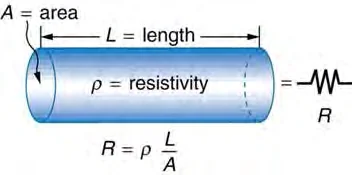
R = ρL/A
where R is resistance, L is length, A is cross-sectional area and ρ is resistivity.
The resistivity can be found from ρ = RA/L.
Resistivity is measured in ohm metres, written Ω m.
Resistivity is a property of the material, equal to the resistance of a sample of unit length and unit area.
| Material | Resistivity (Ω m) | Note |
|---|---|---|
| Copper | 1.7 × 10⁻⁸ | Very good conductor |
| Constantan | 4.9 × 10⁻⁷ | Used in resistance wire |
1Using the Equation2Using the Equation3Using the Equation
Using the Equation
1
1
2
Write down the known quantities and convert them to SI units.
3
2
4
For a round wire, find the area from A = πd2/4 or πr2, using a diameter in metres.
5
3
6
Substitute into R = ρL/A, or rearrange to find another quantity.
1 / 3Next ▶
Using the Equation
1
4
2
Check the unit, since a diameter given in mm must be converted to metres before squaring.
3
5
4
Comment on the size of the answer, such as whether the resistance is small for a short copper wire.
◀ Previous2 / 3Next ▶
Resistivity and the geometry of a resistor: A uniform resistor with length, area and resistivity, giving R = rho L/A.
Using the Equation
◀ Previous3 / 3
1Double the length · Double the diameter · Same wire, new mat2Choosing materials
Worked Example
Worked Example
Question: A copper wire of length 2.5 m has diameter 0.30 mm. The resistivity of copper is 1.7 × 10⁻⁸ Ω m. Calculate its resistance.
Diameter = 0.30 × 10⁻³ m
so area A = π d2 / 4 = π × (0.30 × 10⁻³)2 / 4 = 7.07 × 10⁻⁸ m2.
R = ρL/A = 1.7 × 10−8 × 2.5 / 7.07 × 10⁻⁸.What the symbols mean: R = resistance (Ω) · ρ = resistivity (Ω m) · L = length (m) · A = cross-sectional area (m2)
R = 4.25 × 10⁻⁸ / 7.07 × 10−8 = 0.60 Ω.
Answer: The resistance is 0.60 Ω.
14.2.5 – Main ideas for the Exam2Common Mistakes