Curriculum
OCR A Level Physics A H556
1. Development of Practical Skills in Physics
0/56
2. Foundations in Physics
0/29
3. Forces and Motion
0/108
4. Electrons, Waves and Photons
0/71
-
4. Electrons, Waves and Photons
 Preview
-
4.1.1 Electric Current and Charge
Preview
-
4.1.1 Electric Current and Charge - Check yourself
 Preview
-
4.1.2 Electric Current and Electron Flow
Preview
-
4.1.2 Electric Current and Electron Flow - Check yourself
Preview
-
4.1.4 Current in a Current Carrying Conductor
Preview
-
4.1.4 Current in a Current Carrying Conductor - Check yourself
Preview
-
4.1.5 Conductors, Semiconductors and Insulators
Preview
-
4.1.5 Conductors, Semiconductors and Insulators - Check yourself
Preview
-
4.1.6 Circuit Symbols and Diagrams
Preview
-
4.1.6 Circuit Symbols and Diagrams - Check yourself
Preview
-
4.2.2 Ohm's Law and I-V Characteristics
Preview
-
4.2.2 Ohm's Law and I-V Characteristics - Check yourself
Preview
-
4.2.3 Investigating Electrical Characteristics of Components
Preview
-
4.2.3 Investigating Electrical Characteristics of Components - Check yourself
Preview
-
9.3.1 Resistance
Preview
-
9.3.1 Resistance - Check yourself
Preview
-
10.2.1 Kirchhoff's First Law
Preview
-
10.2.1 Kirchhoff's First Law - Check yourself
Preview
-
4.1.3 Kirchhoff's First Law
Preview
-
4.2.1 Resistance
Preview
-
4.10.1 The Photoelectric Effect
Preview
-
4.10.2 Demonstrating the Photoelectric Effect
Preview
-
4.10.3 The Photoelectric Equation
Preview
-
4.10.4 Work Function and Threshold Frequency
Preview
-
4.10.5 Maximum Kinetic Energy and Intensity
Preview
-
4.11.1 The Photon
Preview
-
4.11.2 The Electronvolt
Preview
-
4.11.3 Determining the Planck Constant
Preview
-
4.11.4 Electron Diffraction
Preview
-
4.11.5 The de Broglie Equation
Preview
-
4.2.4 The Light-Dependent Resistor (LDR)
Preview
-
4.2.5 Resistivity
Preview
-
4.2.6 Determining the Resistivity of a Metal
Preview
-
4.2.7 Thermistors
Preview
-
4.3.1 Power
Preview
-
4.3.2 Electrical Energy
Preview
-
4.3.3 Kirchhoff's Second Law
Preview
-
4.3.4 Kirchhoff's Laws in Circuits
Preview
-
4.3.5 Resistors in Series and Parallel Circuits
Preview
-
4.3.6 Series and Parallel Circuits
Preview
-
4.3.7 Circuits with Multiple Sources of e.m.f
Preview
-
4.4.1 E.m.f and Internal Resistance
Preview
-
4.4.2 Calculating E.m.f
Preview
-
4.4.3 Determining Internal Resistance
Preview
-
4.4.4 E.m.f and Potential Difference
Preview
-
4.4.5 Energy Transfer
Preview
-
4.5.1 Potential Divider Circuits
Preview
-
4.5.2 Variable Resistance Components
Preview
-
4.5.3 Investigating Potential Divider Circuits
Preview
-
4.6.1 Progressive Waves: Longitudinal and Transverse
Preview
-
4.6.2 Calculating Frequency
Preview
-
4.6.3 The Wave Equation
Preview
-
4.6.4 Graphical Representations of Transverse and Longitudinal Waves
Preview
-
4.6.5 Intensity of a Wave
Preview
-
4.7.1 The Electromagnetic Spectrum
Preview
-
4.7.2 Polarisation
Preview
-
4.8.1 Refraction
Preview
-
4.8.2 Total Internal Reflection
Preview
-
4.8.3 Wave Phenomena
Preview
-
4.9.1 Superposition
Preview
-
4.9.10 Determining the Speed of Sound in Air in a Resonance Tube
Preview
-
4.9.11 Harmonics
Preview
-
4.9.2 Graphical Representation of Superposition
Preview
-
4.9.3 Interference
Preview
-
4.9.4 Two-Source Interference
Preview
-
4.9.5 Young's Double-Slit Experiment
Preview
-
4.9.6 Determining the Wavelength of Light
Preview
-
4.9.7 Stationary Waves
Preview
-
4.9.8 Stationary vs Progressive Waves
Preview
-
4.9.9 Nodes and Antinodes
Preview
OCR H556 chapter questions and answers
0/2
Text lesson
4.9.4 Two-Source Interference
4.9.4 Two-Source Interference: Explain how two coherent wave sources produce regions of reinforcement and cancellation, and use path difference to decide whether a point is a maximum or a minimum.
1Conditions and Meaning2Coherent sources · Overlap · Constructive3Destructive
Conditions and Meaning
 ⤢ Enlarge
Conditions and Meaning
A steady, stable pattern of loud and quiet regions only appears when the two sources are coherent.
1 / 3Next ▶
Coherent sources · Overlap · Constructive
Coherent sources
Two sources are coherent when they keep a constant phase difference,
which in practice means they share the same frequency and are driven from one oscillator.
Overlap
Where waves from both sources arrive at one point, the principle of superposition says the resultant displacement is the sum of the individual displacements.
Constructive
Waves arriving in phase add to give a maximum, such as loud sound or a strong microwave signal.
◀ Previous2 / 3Next ▶
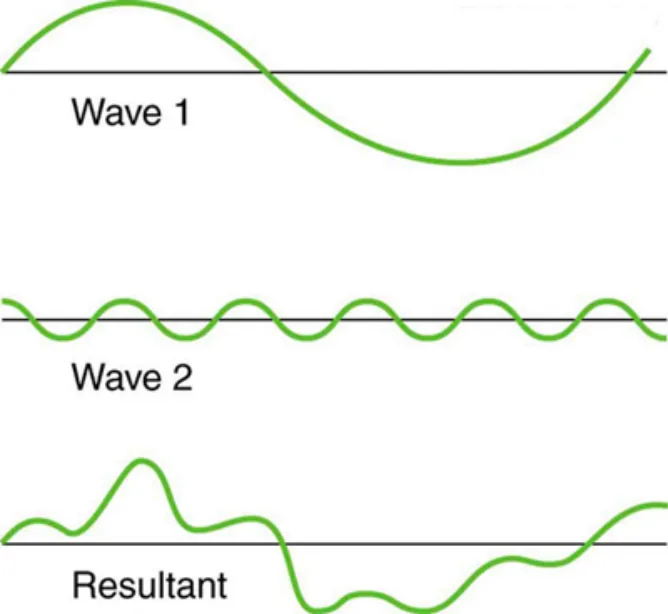
Constructive and destructive interference: Two identical waves half a cycle out of step cancel each other completely, leaving a flat line.
Destructive
 ⤢ Enlarge
Destructive
Waves arriving in antiphase cancel to give a minimum
which is a quiet point or a near-zero detector reading.
◀ Previous3 / 3
1Path Difference Rule2Path Difference Rule3Path Difference Rule
Path Difference Rule
Path Difference Rule
This is the difference between the distances from the two sources to the point being considered, measured in metres.
For two sources vibrating in phase, a maximum occurs where the path difference is a whole number of wavelengths: nλ.
For in-phase sources, a minimum occurs where the path difference is an odd number of half wavelengths: (n + ½)λ.
Points equidistant from both sources have zero path difference
so the waves always arrive in phase and the centre is a maximum.
Young’s double-slit experiment needs monochromatic light, meaning light of a single wavelength, as well as coherent sources.
Laser light is coherent
which is why it gives a clear interference pattern, whereas filament lamps are not coherent.
| Path difference | Phase relationship | Result |
|---|---|---|
| 0, λ, 2λ … | In phase | Constructive: maximum |
| ½λ, 1½λ, 2½λ … | Antiphase | Destructive: minimum |
1 / 3Next ▶
Path Difference Rule
1
For sound, two compressions or two rarefactions meeting give a louder sound
while a compression meeting a rarefaction gives a quieter sound.
2
In phase-difference terms, an even multiple of π gives constructive interference and an odd multiple of π gives destructive interference.
3
The order n counts maxima from the centre
so n = 0 is the central maximum and n = 1 lies one fringe either side of it.
4
The spacing between the maxima and minima of a light interference pattern depends on the colour of the light.
5
Interference is clearest when the two waves have the same frequency and amplitude
so that complete cancellation or reinforcement occurs.
◀ Previous2 / 3Next ▶
Two coherent sources S1 and S2 with paths to a point P, a central equal-distance line, and the path difference rule
Path Difference Rule

◀ Previous3 / 3
1Demonstrations2Demonstrations3Demonstrations
Demonstrations
Demonstrations
1
Connect two loudspeakers to one signal generator and walk along a line parallel to them, hearing loud and quiet positions alternate.
2
Place a microwave transmitter behind two slits in a metal sheet and move a detector along a line in front of the slits.
3
The detector reading rises to a maximum where the waves reinforce and falls close to zero where they cancel out.
1 / 3Next ▶
Demonstrations
1
4
2
Noise-cancelling headphones apply the same idea by producing sound that arrives in antiphase with unwanted noise.
3
5
4
In an answer always describe the effect in terms of the signal or loudness actually being measured, not just “interference”.
◀ Previous2 / 3Next ▶
Interference patterns: Two speakers produce constructive and destructive interference across a room. Points of constructive interference are marked, and the shading shows how the intensity varies from place to place.
Demonstrations

◀ Previous3 / 3
Worked Example
Worked Example
Question: Two loudspeakers S₁ and S₂ emit in-phase sound of frequency 1000 Hz. The speed of sound is 340 m/s. A point P is 4.00 m from S₁ and 4.51 m from S₂. State whether P is a loud or quiet position.
Wavelength λ = v ÷ f = 340 ÷ 1000 = 0.34 m.
Path difference = 4.51 − 4.00 = 0.51 m.
Number of wavelengths = 0.51 ÷ 0.34 = 1.5, an odd number of half wavelengths.
Answer: The waves arrive in antiphase
so P is a quiet position (destructive interference).
14.9.4 – Main ideas for the Exam2Common Mistakes