Curriculum
AQA A Level Physics 7408
1. Measurements and Their Errors
0/15
2. Particles and Radiation
0/58
3. Waves
0/39
4. Mechanics and Materials
0/77
5. Electricity
0/25
6. Further Mechanics and Thermal Physics
0/77
7. Fields and Their Consequences
0/111
-
7. Fields and Their Consequences
 Preview
-
4.3.2 Electric Field Strength
Preview
-
4.3.2 Electric Field Strength - Check yourself
 Preview
-
4.4.2 Energy Stored by a Capacitor
Preview
-
4.4.2 Energy Stored by a Capacitor - Check yourself
Preview
-
4.5.3 Magnetic Force on a Current-Carrying Conductor
Preview
-
4.5.3 Magnetic Force on a Current-Carrying Conductor - Check yourself
Preview
-
7.1.1 Force Fields
Preview
-
7.1.1 Force Fields - Check yourself
Preview
-
7.1.3 Representing Gravitational Fields
Preview
-
7.1.3 Representing Gravitational Fields - Check yourself
Preview
-
7.1.4 Newton's Law of Gravitation
Preview
-
7.1.4 Newton's Law of Gravitation - Check yourself
Preview
-
7.1.5 Gravitational Field Strength in a Radial Field
Preview
-
7.1.5 Gravitational Field Strength in a Radial Field - Check yourself
Preview
-
7.2.2 Calculating Gravitational Potential
Preview
-
7.2.2 Calculating Gravitational Potential - Check yourself
Preview
-
7.2.3 Graphical Representation of Gravitational Potential
Preview
-
7.2.3 Graphical Representation of Gravitational Potential - Check yourself
Preview
-
7.2.4 Work Done on a Mass
Preview
-
7.2.4 Work Done on a Mass - Check yourself
Preview
-
7.3.2 Energy of an Orbiting Satellite
Preview
-
7.3.2 Energy of an Orbiting Satellite - Check yourself
Preview
-
7.3.3 Escape Velocity
Preview
-
7.3.3 Escape Velocity - Check yourself
Preview
-
7.4.1 Coulomb's Law
Preview
-
7.4.1 Coulomb's Law - Check yourself
Preview
-
7.4.4 Uniform Electric Field
Preview
-
7.4.4 Uniform Electric Field - Check yourself
Preview
-
7.4.6 Radial Electric Field
Preview
-
7.4.6 Radial Electric Field - Check yourself
Preview
-
7.4.7 Comparing Gravitational and Electrostatic Forces
Preview
-
7.4.7 Comparing Gravitational and Electrostatic Forces - Check yourself
Preview
-
7.5.2 Graphical Representation of Electric Potential
Preview
-
7.5.2 Graphical Representation of Electric Potential - Check yourself
Preview
-
7.5.3 Work Done on a Charge
Preview
-
7.5.3 Work Done on a Charge - Check yourself
Preview
-
7.6.2 Parallel Plate Capacitor
Preview
-
7.6.2 Parallel Plate Capacitor - Check yourself
Preview
-
7.7.1 Charge and Discharge Graphs
Preview
-
7.7.1 Charge and Discharge Graphs - Check yourself
Preview
-
7.7.2 The Time Constant
Preview
-
7.7.2 The Time Constant - Check yourself
Preview
-
7.7.3 Charge and Discharge Equations
Preview
-
7.7.3 Charge and Discharge Equations - Check yourself
Preview
-
7.7.4 Required Practical- Charging and Discharging Capacitors
Preview
-
7.7.4 Required Practical- Charging and Discharging Capacitors - Check yourself
Preview
-
7.8.5 Circular Path of Particles
Preview
-
7.8.5 Circular Path of Particles - Check yourself
Preview
-
7.8.6 Required Practical- Investigating Magnetic Fields in Wires
Preview
-
7.8.6 Required Practical- Investigating Magnetic Fields in Wires - Check yourself
Preview
-
7.9.5 Applications of EM Induction
Preview
-
7.9.5 Applications of EM Induction - Check yourself
Preview
-
7.9.6 Required Practical- Investigating Flux Linkage on a Search Coil
Preview
-
7.9.6 Required Practical- Investigating Flux Linkage on a Search Coil - Check yourself
Preview
-
7.10.2 The Operation of an Oscilloscope
Preview
-
7.10.2 The Operation of an Oscilloscope - Check yourself
Preview
-
7.10.3 The Operation of a Transformer
Preview
-
7.10.3 The Operation of a Transformer - Check yourself
Preview
-
7.10.4 Transformer Efficiency
Preview
-
7.10.4 Transformer Efficiency - Check yourself
Preview
-
7.10.5 Transformer Inefficiencies
Preview
-
7.10.5 Transformer Inefficiencies - Check yourself
Preview
-
13.2.3 Circular Orbits in Gravitational Fields
Preview
-
13.2.3 Circular Orbits in Gravitational Fields - Check yourself
Preview
-
13.2.4 Geostationary Orbits
Preview
-
13.2.4 Geostationary Orbits - Check yourself
Preview
-
13.3.1 Gravitational Field Strength
Preview
-
13.3.1 Gravitational Field Strength - Check yourself
Preview
-
13.4.1 Gravitational Potential
Preview
-
13.4.1 Gravitational Potential - Check yourself
Preview
-
18.1.2 Electric Field Lines
Preview
-
18.1.2 Electric Field Lines - Check yourself
Preview
-
18.2.2 Motion of Charged Particles
Preview
-
18.2.2 Motion of Charged Particles - Check yourself
Preview
-
18.5.1 Electric Potential
Preview
-
18.5.1 Electric Potential - Check yourself
Preview
-
19.1.1 Capacitance
Preview
-
19.1.1 Capacitance - Check yourself
Preview
-
20.2.1 Magnetic Flux Density
Preview
-
20.2.1 Magnetic Flux Density - Check yourself
Preview
-
20.3.1 Fleming's Left-Hand Rule
Preview
-
20.3.1 Fleming's Left-Hand Rule - Check yourself
Preview
-
20.3.2 Force on a Moving Charge
Preview
-
20.3.2 Force on a Moving Charge - Check yourself
Preview
-
20.5.1 Magnetic Flux
Preview
-
20.5.1 Magnetic Flux - Check yourself
Preview
-
20.5.2 Magnetic Flux Linkage
Preview
-
20.5.2 Magnetic Flux Linkage - Check yourself
Preview
-
20.5.3 Principles of Electromagnetic Induction
Preview
-
20.5.3 Principles of Electromagnetic Induction - Check yourself
Preview
-
20.5.4 Faraday's and Lenz's Laws
Preview
-
20.5.4 Faraday's and Lenz's Laws - Check yourself
Preview
-
21.1.1 Alternating Current and Voltage
Preview
-
21.1.1 Alternating Current and Voltage - Check yourself
Preview
-
7.10.1 Alternating Current and Voltage
Preview
-
7.3.1 Circular Orbits in Gravitational Fields
Preview
-
7.3.4 Geostationary Orbits
Preview
-
7.4.2 Electric Field Lines
Preview
-
7.4.3 Electric Field Strength
Preview
-
7.4.5 Motion of Charged Particles
Preview
-
7.6.1 Capacitance
Preview
-
7.6.3 Energy Stored by a Capacitor
Preview
-
7.8.1 Magnetic Flux Density
Preview
-
7.8.2 Magnetic Force on a Current-Carrying Conductor
Preview
-
7.8.3 Fleming's Left Hand Rule
Preview
-
7.8.4 Force on a Moving Charge
Preview
-
7.9.1 Magnetic Flux
Preview
-
7.9.2 Magnetic Flux Linkage
Preview
-
7.9.3 Principles of Electromagnetic Induction
Preview
-
7.9.4 Faraday's and Lenz's Laws
Preview
8. Nuclear Physics
0/56
9. Astrophysics
0/65
10. Medical Physics
0/64
11. Engineering Physics
0/46
12. Turning Points in Physics
0/56
Text lesson
7.6.1 Capacitance
7.6.1 Capacitance: Define capacitance, use C = Q/V to relate stored charge and potential difference, and recognise typical capacitor values and units.
1What a Capacitor Does2Structure · Charging · Charge stored3Circuit symbol
What a Capacitor Does
 ⤢ Enlarge
What a Capacitor Does
A capacitor stores electrical energy by holding separated charge on two conducting plates.
1 / 3Next ▶
Structure · Charging · Charge stored
Structure
A basic capacitor has two parallel conducting plates separated by an insulator, called a dielectric.
Charging
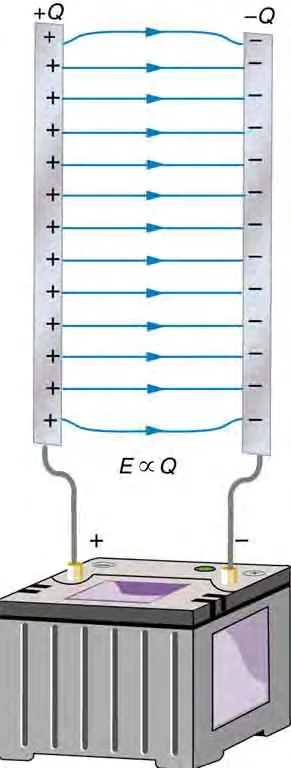
When connected to a supply, electrons are removed from one plate and added to the other, leaving equal and opposite charges.
Charge stored
The quantity Q refers to the magnitude of charge on either plate, and the capacitor as a whole stays electrically neutral.
◀ Previous2 / 3Next ▶
Parallel-plate capacitors and dielectrics: Field lines between charged parallel plates connected to a battery, with the field proportional to the charge.
Circuit symbol
 ⤢ Enlarge
Circuit symbol
The symbol is two short parallel lines, and a polarised capacitor has marked terminals that must be connected the right way.
◀ Previous3 / 3
1Defining Capacitance2Defining Capacitance
1Using C = Q/V2Using C = Q/V
Worked Example
1
Question: A 470 μF capacitor is fully charged by a 12 V supply. Calculate the charge stored on one plate.
2
Convert 470 μF to 470 × 10−6 F.
3
Q = CV = 470 × 10−6 × 12 = 5.64 × 10⁻³ C.
4
Answer: The charge on a plate is 5.6 × 10⁻³ C
which is 5.6 mC.
17.6.1 – Main ideas for the Exam2Common Mistakes