Curriculum
AQA A Level Physics 7408
1. Measurements and Their Errors
0/15
2. Particles and Radiation
0/58
3. Waves
0/39
4. Mechanics and Materials
0/77
5. Electricity
0/25
6. Further Mechanics and Thermal Physics
0/77
7. Fields and Their Consequences
0/111
-
7. Fields and Their Consequences
 Preview
-
4.3.2 Electric Field Strength
Preview
-
4.3.2 Electric Field Strength - Check yourself
 Preview
-
4.4.2 Energy Stored by a Capacitor
Preview
-
4.4.2 Energy Stored by a Capacitor - Check yourself
Preview
-
4.5.3 Magnetic Force on a Current-Carrying Conductor
Preview
-
4.5.3 Magnetic Force on a Current-Carrying Conductor - Check yourself
Preview
-
7.1.1 Force Fields
Preview
-
7.1.1 Force Fields - Check yourself
Preview
-
7.1.3 Representing Gravitational Fields
Preview
-
7.1.3 Representing Gravitational Fields - Check yourself
Preview
-
7.1.4 Newton's Law of Gravitation
Preview
-
7.1.4 Newton's Law of Gravitation - Check yourself
Preview
-
7.1.5 Gravitational Field Strength in a Radial Field
Preview
-
7.1.5 Gravitational Field Strength in a Radial Field - Check yourself
Preview
-
7.2.2 Calculating Gravitational Potential
Preview
-
7.2.2 Calculating Gravitational Potential - Check yourself
Preview
-
7.2.3 Graphical Representation of Gravitational Potential
Preview
-
7.2.3 Graphical Representation of Gravitational Potential - Check yourself
Preview
-
7.2.4 Work Done on a Mass
Preview
-
7.2.4 Work Done on a Mass - Check yourself
Preview
-
7.3.2 Energy of an Orbiting Satellite
Preview
-
7.3.2 Energy of an Orbiting Satellite - Check yourself
Preview
-
7.3.3 Escape Velocity
Preview
-
7.3.3 Escape Velocity - Check yourself
Preview
-
7.4.1 Coulomb's Law
Preview
-
7.4.1 Coulomb's Law - Check yourself
Preview
-
7.4.4 Uniform Electric Field
Preview
-
7.4.4 Uniform Electric Field - Check yourself
Preview
-
7.4.6 Radial Electric Field
Preview
-
7.4.6 Radial Electric Field - Check yourself
Preview
-
7.4.7 Comparing Gravitational and Electrostatic Forces
Preview
-
7.4.7 Comparing Gravitational and Electrostatic Forces - Check yourself
Preview
-
7.5.2 Graphical Representation of Electric Potential
Preview
-
7.5.2 Graphical Representation of Electric Potential - Check yourself
Preview
-
7.5.3 Work Done on a Charge
Preview
-
7.5.3 Work Done on a Charge - Check yourself
Preview
-
7.6.2 Parallel Plate Capacitor
Preview
-
7.6.2 Parallel Plate Capacitor - Check yourself
Preview
-
7.7.1 Charge and Discharge Graphs
Preview
-
7.7.1 Charge and Discharge Graphs - Check yourself
Preview
-
7.7.2 The Time Constant
Preview
-
7.7.2 The Time Constant - Check yourself
Preview
-
7.7.3 Charge and Discharge Equations
Preview
-
7.7.3 Charge and Discharge Equations - Check yourself
Preview
-
7.7.4 Required Practical- Charging and Discharging Capacitors
Preview
-
7.7.4 Required Practical- Charging and Discharging Capacitors - Check yourself
Preview
-
7.8.5 Circular Path of Particles
Preview
-
7.8.5 Circular Path of Particles - Check yourself
Preview
-
7.8.6 Required Practical- Investigating Magnetic Fields in Wires
Preview
-
7.8.6 Required Practical- Investigating Magnetic Fields in Wires - Check yourself
Preview
-
7.9.5 Applications of EM Induction
Preview
-
7.9.5 Applications of EM Induction - Check yourself
Preview
-
7.9.6 Required Practical- Investigating Flux Linkage on a Search Coil
Preview
-
7.9.6 Required Practical- Investigating Flux Linkage on a Search Coil - Check yourself
Preview
-
7.10.2 The Operation of an Oscilloscope
Preview
-
7.10.2 The Operation of an Oscilloscope - Check yourself
Preview
-
7.10.3 The Operation of a Transformer
Preview
-
7.10.3 The Operation of a Transformer - Check yourself
Preview
-
7.10.4 Transformer Efficiency
Preview
-
7.10.4 Transformer Efficiency - Check yourself
Preview
-
7.10.5 Transformer Inefficiencies
Preview
-
7.10.5 Transformer Inefficiencies - Check yourself
Preview
-
13.2.3 Circular Orbits in Gravitational Fields
Preview
-
13.2.3 Circular Orbits in Gravitational Fields - Check yourself
Preview
-
13.2.4 Geostationary Orbits
Preview
-
13.2.4 Geostationary Orbits - Check yourself
Preview
-
13.3.1 Gravitational Field Strength
Preview
-
13.3.1 Gravitational Field Strength - Check yourself
Preview
-
13.4.1 Gravitational Potential
Preview
-
13.4.1 Gravitational Potential - Check yourself
Preview
-
18.1.2 Electric Field Lines
Preview
-
18.1.2 Electric Field Lines - Check yourself
Preview
-
18.2.2 Motion of Charged Particles
Preview
-
18.2.2 Motion of Charged Particles - Check yourself
Preview
-
18.5.1 Electric Potential
Preview
-
18.5.1 Electric Potential - Check yourself
Preview
-
19.1.1 Capacitance
Preview
-
19.1.1 Capacitance - Check yourself
Preview
-
20.2.1 Magnetic Flux Density
Preview
-
20.2.1 Magnetic Flux Density - Check yourself
Preview
-
20.3.1 Fleming's Left-Hand Rule
Preview
-
20.3.1 Fleming's Left-Hand Rule - Check yourself
Preview
-
20.3.2 Force on a Moving Charge
Preview
-
20.3.2 Force on a Moving Charge - Check yourself
Preview
-
20.5.1 Magnetic Flux
Preview
-
20.5.1 Magnetic Flux - Check yourself
Preview
-
20.5.2 Magnetic Flux Linkage
Preview
-
20.5.2 Magnetic Flux Linkage - Check yourself
Preview
-
20.5.3 Principles of Electromagnetic Induction
Preview
-
20.5.3 Principles of Electromagnetic Induction - Check yourself
Preview
-
20.5.4 Faraday's and Lenz's Laws
Preview
-
20.5.4 Faraday's and Lenz's Laws - Check yourself
Preview
-
21.1.1 Alternating Current and Voltage
Preview
-
21.1.1 Alternating Current and Voltage - Check yourself
Preview
-
7.10.1 Alternating Current and Voltage
Preview
-
7.3.1 Circular Orbits in Gravitational Fields
Preview
-
7.3.4 Geostationary Orbits
Preview
-
7.4.2 Electric Field Lines
Preview
-
7.4.3 Electric Field Strength
Preview
-
7.4.5 Motion of Charged Particles
Preview
-
7.6.1 Capacitance
Preview
-
7.6.3 Energy Stored by a Capacitor
Preview
-
7.8.1 Magnetic Flux Density
Preview
-
7.8.2 Magnetic Force on a Current-Carrying Conductor
Preview
-
7.8.3 Fleming's Left Hand Rule
Preview
-
7.8.4 Force on a Moving Charge
Preview
-
7.9.1 Magnetic Flux
Preview
-
7.9.2 Magnetic Flux Linkage
Preview
-
7.9.3 Principles of Electromagnetic Induction
Preview
-
7.9.4 Faraday's and Lenz's Laws
Preview
8. Nuclear Physics
0/56
9. Astrophysics
0/65
10. Medical Physics
0/64
11. Engineering Physics
0/46
12. Turning Points in Physics
0/56
Text lesson
7.1.1 Force Fields
7.1.1 Force Fields — AQA A Level Physics 7408 notes: Explain what a force field is, name the three fields in the AQA course, and define field strength for gravitational and electric fields.
1Action at a distance2Non-contact forces3Non-contact forces
Action at a distance
Action at a distance
Most forces we meet in everyday life need contact: pushing a door, friction, tension in a rope.
But some forces act between objects that are not touching.
The Earth pulls an apple towards it, a magnet attracts a nail across a gap, and two charged balloons repel each other.
1 / 3Next ▶
Non-contact forces
1
We explain such
2
non-contact forces
3
using the idea of a
4
force field
5
: a region of space in which an object experiences a force because of some property it has.
6
A body with the right property (mass, charge, or magnetic character) modifies the space around it so that another body with that property feels a force there. The field is the way the first object influences the second without touching it.
◀ Previous2 / 3Next ▶
Action at a distance and the concept of a field: The electric field lines around a positive charge and a negative charge. A positive test charge placed in the field feels a force in the direction of the field lines.
Non-contact forces
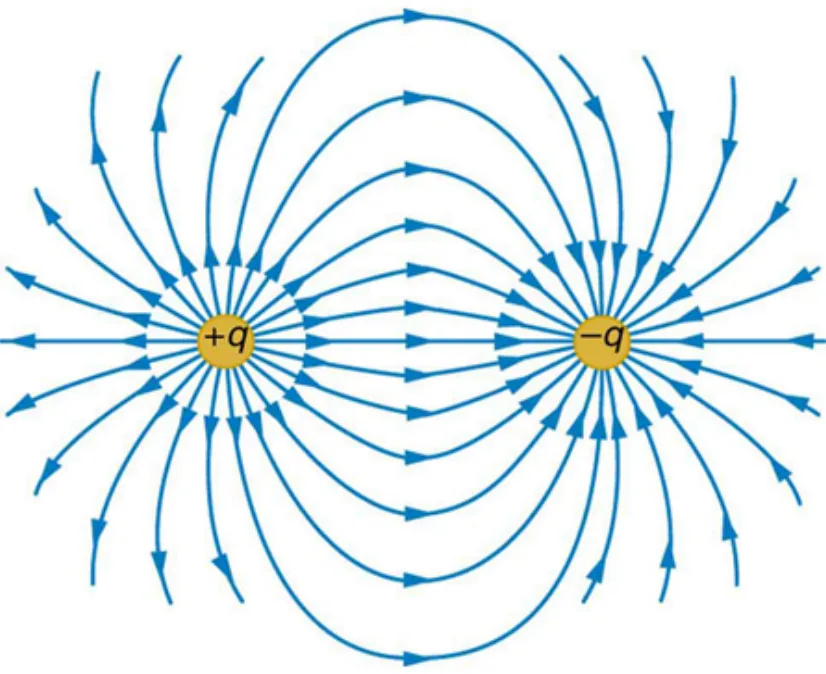
◀ Previous3 / 3
1Three types of field2Three types of field
1Gravitational field strength2Vector3Vector4Vector
Gravitational field strength
1
The gravitational field strength g at a point is the force per unit mass acting on a small test mass placed at that point:
2
g = F / m
3
F is the gravitational force in newtons, m is the mass in kg and g is in N kg−1.
1 / 4Next ▶
Vector
Vector
It is a
vector
: it points in the direction of the force
which is towards the mass creating the field.
Near the Earth’s surface g ≈ 9.8 N kg
−1
which is numerically the same as the acceleration of free fall in m s
◀ Previous2 / 4Next ▶
Vector
1
−2
2
.
3
The weight of an object is W = mg.
4
The test mass must be small so that it does not disturb the field it is measuring. Because g = F/m is independent of the test mass, a field of strength g exerts a force mg on any mass m.
◀ Previous3 / 4Next ▶
Graph of gravitational field strength g against distance r from the centre of the Earth, showing an inverse-square curve
Vector

◀ Previous4 / 4
1Electric field strength2Electric field strength3Electric field strength4Electric field strength
Electric field strength
Electric field strength
The electric field strength E at a point is the force per unit positive charge acting on a small positive test charge placed there:
E = F / Q
What the symbols mean:
E = electric field strength (N C
−1
) · F = force on the charge (N) · Q or q = charge (C)
1 / 4Next ▶
Electric field strength
Electric field strength
F is in newtons, Q in coulombs and E in N C−1 (equivalently V m−1).
◀ Previous2 / 4Next ▶
Electric field strength
1
The direction of E is the direction of the force on a
2
positive
3
test charge.
4
A negative charge in the same field is pushed in the opposite direction to E.
5
The force on a charge Q in a field E is F = QE.
◀ Previous3 / 4Next ▶
Graph of electric field strength E against distance r from a +5.0 nC point charge, a falling inverse-square curve with three labelled points.
Electric field strength

◀ Previous4 / 4
1Comparing the two fields2Comparing the two fields3Comparing the two fields
1Worked examples2Worked examples
Key terms
| Term | Meaning |
|---|---|
| Force field | A region in which a body experiences a non-contact force. |
| Gravitational field strength, g | Force per unit mass, N kg−1. |
| Electric field strength, E | Force per unit positive charge, N C−1. |
| Test mass or charge | A small body used to probe a field without disturbing it. |
| Superposition | The resultant field is the vector sum of the separate fields. |
1Avoid these mistakes2Avoid these mistakes