Curriculum
Edexcel IAL Physics (IAS & A2)
1. Mechanics and Materials
0/97
3.1.1Forces and resultant force3.1.2Newton's second law, F = ma3.1.3Direction and sign of acceleration3.1.4Solving a problem with F = ma3.1.5Forces on a slope and typical force directions3.1.6The experiment: acceleration, force and mass3.1.7Links and consequences3.1.8Key terms3.1.9Avoid these mistakes
2. Waves and Electricity
0/1233. Practical Skills in Physics I
0/414. Further Mechanics, Fields and Particles
0/984.3.1Defining an Electric Field4.3.2Electric Field Strength4.3.3Electric Force between Two Charges4.3.4Electric Field due to a Point Charge4.3.5Electric Field and Potential4.3.7Electric Potential for a Radial Field4.3.8Representing Radial and Uniform Electric Fields4.3.6Electric Field between Parallel Plates
4.6.2The Nuclear Model of the Atom4.6.3Thermionic Emission4.6.4Particle Accelerators and Detectors4.6.5Radius of a Charged Particle in a Magnetic Field4.6.6Interpreting Particle Tracks4.6.7High Energy Particle Collisions4.6.8Annihilation of Matter and Antimatter4.6.9Unit Conversions for Energy and Mass4.6.10Relativistic Situations4.6.1Nucleon and Proton Number
5. Thermodynamics, Radiation, Oscillations and Cosmology
0/956. Practical Skills in Physics II
0/346.1.1Identifying apparatus6.1.2Apparatus for each quantity6.1.3Range and resolution6.1.4Length and mass instruments6.1.5Time, temperature and electrical instruments6.1.6Reducing uncertainty with good technique6.1.7Example: Young modulus of a wire6.1.8Safety and suitability6.1.9Key terms6.1.10Avoid these mistakes
Text lesson
2.3.4 Total Internal Reflection
Total Internal Reflection
2.3.4 Conditions for total internal reflection
Conditions for total internal reflection
Conditions for total internal reflection2→Conditions for total internal reflection
Conditions for total internal reflection
Conditions for total internal reflection
Total internal reflection (TIR)
- the complete reflection of a ray at the boundary between two media, with no refracted ray.
- The light must travel from a more dense to a less dense medium (n1 >
- n2).
- The angle of incidence θ1 must be greater than the critical angle C.
- Critical angle sin C = n2/n1.
- Law of reflection the angle of reflection equals the angle of incidence.
1 / 2Next ▶
Conditions for total internal reflection
Conditions for total internal reflection
- TIR is nearly 100% efficient
- better than a silvered mirror.
◀ Previous, 2 / 2
2.3.4 Total Internal Reflection · 1 / 8
2.3.4 Refraction, critical angle and TIR
Refraction, critical angle and TIR
- Total internal reflection and the critical angle Three ray diagrams show a ray moving from a material with a higher index into one with a lower index: the refracted ray bends away from the normal, reaches 90 degrees at the critical angle, and is totally reflected at a larger incident angle.
- Refraction, critical angle and TIR
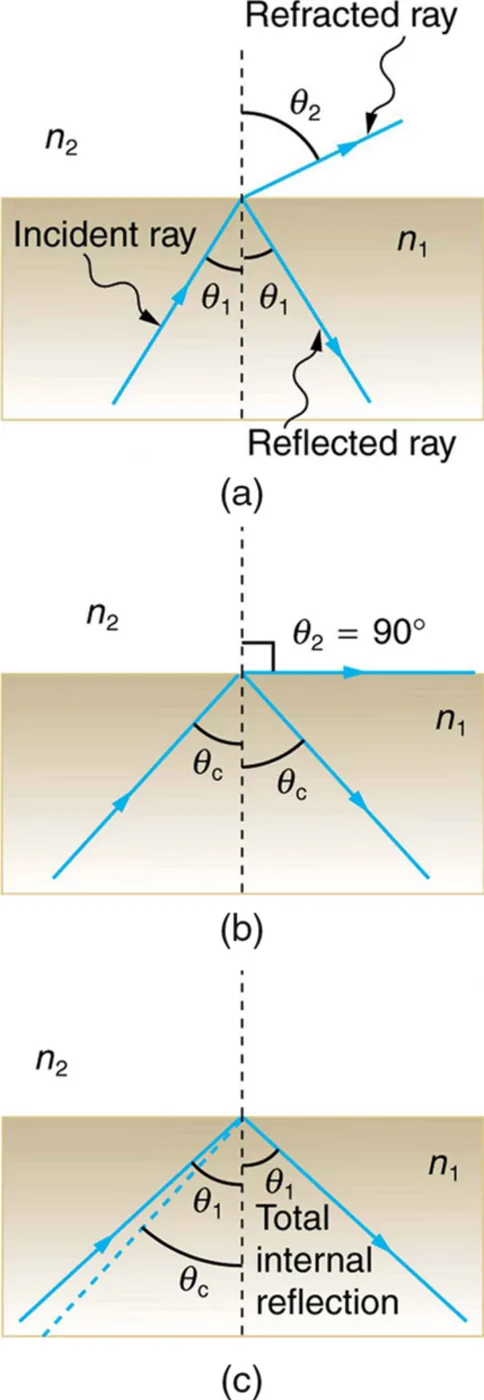
| Angle of incidence | What happens |
|---|---|
| Less than C |
|
| Equal to C | The refracted ray travels along the boundary. |
| Greater than C |
|
2.3.4 Total Internal Reflection · 2 / 8
2.3.4 Optical fibres
Optical fibres
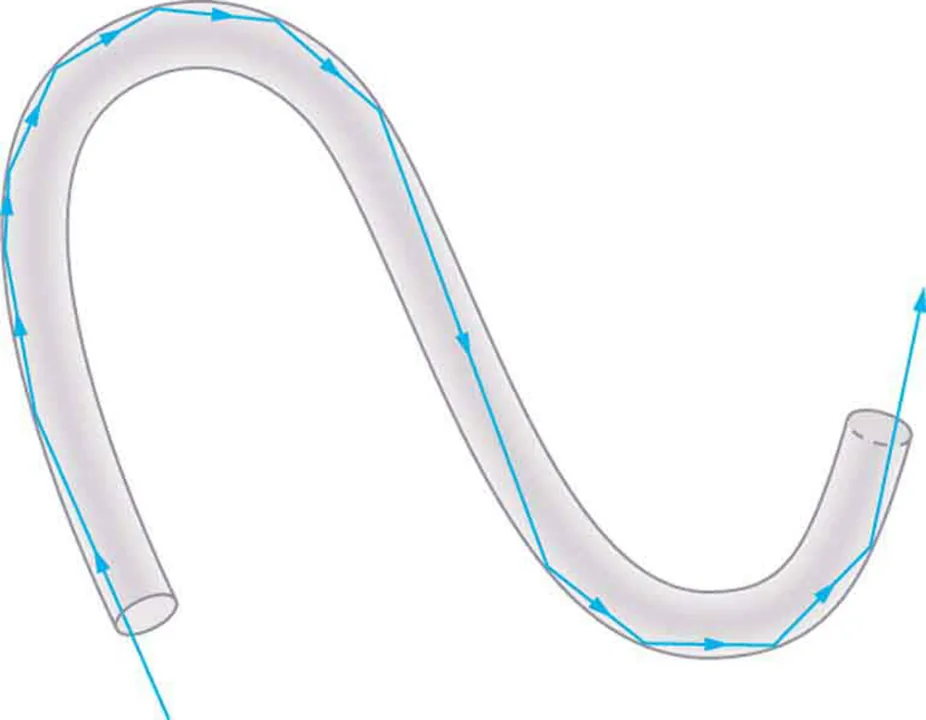
Optical fibres2→Optical fibres
Optical fibres
Optical fibres
- Structure a thin core of higher refractive index ncore, surrounded by cladding of lower index nclad.
- How light travels light enters the core at a small angle to the axis, strikes the boundary above the critical angle (sin C = nclad/ncore) and is totally reflected repeatedly.
- Its lower index is essential for TIR.
- It protects the core from scratches and moisture.
- It stops light leaking between fibres.
- Telecommunications pulses of infrared light travel with little loss and no electrical interference.
1 / 2Next ▶
Fiber optics→endoscopes to telephones: Light entering a thin fiber meets the inside wall at large angles and is completely reflected, so it follows the fiber even around bends.
Optical fibres
⤢ Enlarge
Optical fibres
- Medicine bundles of fibres form an endoscope to see inside the body.
◀ Previous, 2 / 2
2.3.4 Total Internal Reflection · 3 / 8
2.3.4 Pulse broadening in fibres
Pulse broadening in fibres
- Modal dispersion · Material dispersion · Attenuation
Modal dispersion
- rays along the axis take a shorter path than rays that zigzag at steeper angles.
- A short pulse spreads out in time.
- A very narrow single-mode core reduces this.
Material dispersion
- different wavelengths travel at slightly different speeds in glass.
- A monochromatic laser source reduces it.
Attenuation
- absorption and scattering reduce the signal power
- so repeaters amplify the signal every tens of kilometres.
2.3.4 Total Internal Reflection · 4 / 8
2.3.4 Prisms and reflectors
Prisms and reflectors
Prisms and reflectors2→Prisms and reflectors
Prisms and reflectors
Prisms and reflectors
- (45°, 45°, 90°) — the critical angle for ordinary glass is about 42°.
- A ray hitting the hypotenuse at 45° is totally reflected.
- Turning a ray through 90° used in periscopes and binoculars.
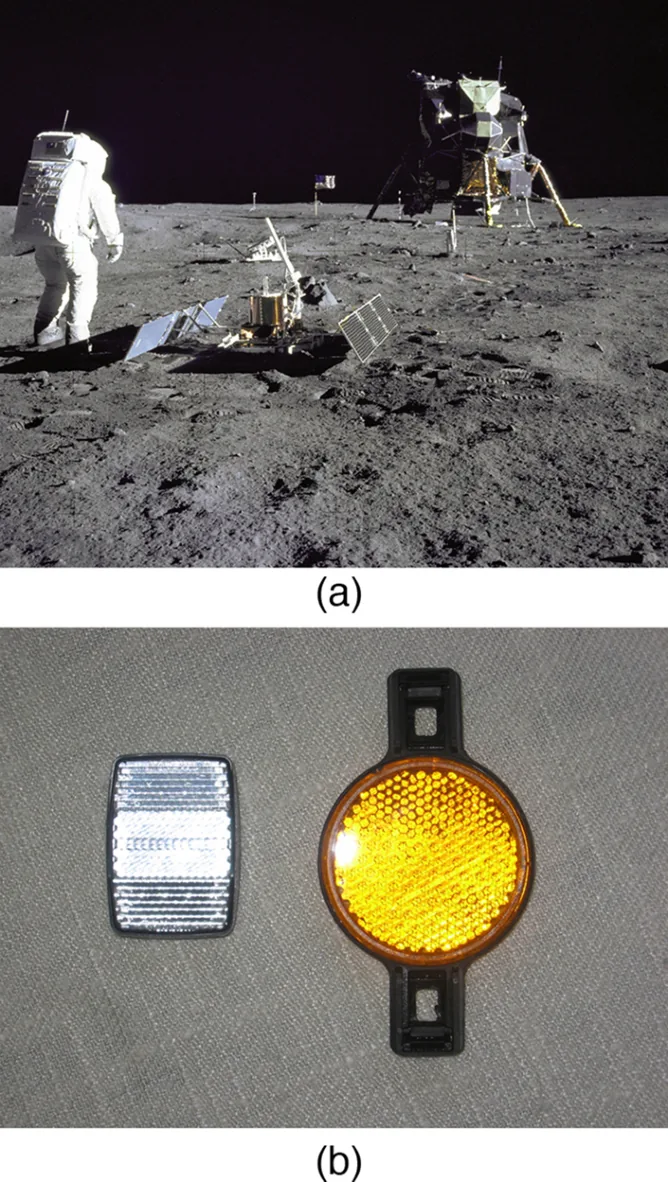
- Turning a ray through 180° used in bicycle reflectors and road signs.
- Image quality the almost lossless reflection gives bright, clear images.
1 / 2Next ▶
Corner reflectors→An astronaut’s corner reflector on the Moon, and a bicycle reflector whose bright spots are reflections of a camera flash.
Prisms and reflectors
⤢ Enlarge
◀ Previous, 2 / 2
2.3.4 Total Internal Reflection · 5 / 8
2.3.4 Limits of TIR
Limits of TIR
- Smooth, clean boundary · Frustrated TIR · Scratches2 Pure silica
- Smooth, clean boundary · Frustrated TIR · Scratches
Smooth, clean boundary
- TIR needs a clean boundary that is smooth on the scale of a wavelength.
Frustrated TIR
- water or a finger on the outside of a prism raises the index beyond the boundary
- so light can escape.
Scratches
- they scatter light and reduce the signal in a fibre.
1 / 2Next ▶
Pure silica
Pure silica
- ultra-pure fibres lose only a fraction of a decibel per kilometre.
- Light slows down in a denser medium, and this change in speed is what causes refraction at a boundary.
- Entering a denser medium bends a ray towards the normal
- while entering a less dense medium bends it away from the normal.
- A ray meeting a boundary along the normal does not change direction, even though its speed still changes.
- Air is taken to have a refractive index of about 1, and no transparent material has a refractive index below 1.
◀ Previous, 2 / 2
2.3.4 Total Internal Reflection · 6 / 8
2.3.4 Key terms
Key terms
- Key terms
| Term | Meaning |
|---|---|
| Total internal reflection | Complete reflection of light at a boundary with a less dense medium when the angle of incidence exceeds the critical angle. |
| Core |
|
| Cladding | The lower-index layer surrounding the core. |
| Modal dispersion | Pulse broadening because different paths have different lengths. |
| Attenuation | The loss of signal power along a fibre. |
2.3.4 Total Internal Reflection · 7 / 8
2.3.4 Avoid these mistakes
Avoid these mistakes
Avoid these mistakes2→Avoid these mistakes
Avoid these mistakes
Avoid this
- Applying TIR to light moving from air into glass
- it must start in the denser medium.
Avoid this
- Thinking TIR occurs at exactly the critical angle
- it occurs above it.
Avoid this
- Saying cladding is only for strength
- its lower refractive index is essential for TIR.
1 / 2Next ▶
Avoid these mistakes
Avoid this
- Measuring the angle from the surface instead of from the normal.Avoid this
◀ Previous, 2 / 2
2.3.4 Total Internal Reflection · 8 / 8
Well done! You finished this lesson
What would you like to do next?