Curriculum
Edexcel IAL Physics (IAS & A2)
1. Mechanics and Materials
0/71
-
1. Mechanics and Materials
 Preview
-
1.1.1 Equations of Motion
Preview
-
1.1.3 Slope and Area of Motion Graphs
Preview
-
1.1.5 Resolving Vectors
Preview
-
1.1.5 Resolving Vectors - Check yourself
 Preview
-
1.1.6 Adding Vectors
Preview
-
1.1.6 Adding Vectors - Check yourself
Preview
-
1.1.7 Components of Velocity
Preview
-
1.1.7 Components of Velocity - Check yourself
Preview
-
1.1.8 Free-body Force Diagrams
Preview
-
1.1.8 Free-body Force Diagrams - Check yourself
Preview
-
1.2.2 Mass, Weight and Gravitational Field Strength
Preview
-
1.2.2 Mass, Weight and Gravitational Field Strength - Check yourself
Preview
-
1.2.3 Core Practical 1- Investigating the Acceleration of Freefall
Preview
-
1.2.3 Core Practical 1- Investigating the Acceleration of Freefall - Check yourself
Preview
-
1.2.4 Newton's Third Law of Motion
Preview
-
1.2.4 Newton's Third Law of Motion - Check yourself
Preview
-
1.2.5 Momentum
Preview
-
1.2.5 Momentum - Check yourself
Preview
-
1.2.6 Conservation of Linear Momentum
Preview
-
1.2.6 Conservation of Linear Momentum - Check yourself
Preview
-
1.3.2 Centre of Gravity and The Principle of Moments
Preview
-
1.3.2 Centre of Gravity and The Principle of Moments - Check yourself
Preview
-
1.4.1 Scalars and Vectors
Preview
-
1.4.1 Scalars and Vectors - Check yourself
Preview
-
1.4.1 Work
Preview
-
1.4.1 Work - Check yourself
Preview
-
1.5.3 Viscous Drag
Preview
-
1.5.3 Viscous Drag - Check yourself
Preview
-
1.5.4 Core Practical 2- Investigating Viscosity
Preview
-
1.5.4 Core Practical 2- Investigating Viscosity - Check yourself
Preview
-
1.6.2 Stress, Strain and The Young Modulus
Preview
-
1.6.2 Stress, Strain and The Young Modulus - Check yourself
Preview
-
1.6.3 Force-Extension Graphs
Preview
-
1.6.3 Force-Extension Graphs - Check yourself
Preview
-
1.6.4 Stress-Strain Graphs
Preview
-
1.6.4 Stress-Strain Graphs - Check yourself
Preview
-
1.6.5 Core Practical 3- Investigating Young Modulus
Preview
-
1.6.5 Core Practical 3- Investigating Young Modulus - Check yourself
Preview
-
1.6.6 Elastic Strain Energy
Preview
-
1.6.6 Elastic Strain Energy - Check yourself
Preview
-
2.1.2 Motion Graphs
Preview
-
3.1.2 Force and Acceleration
Preview
-
3.1.2 Force and Acceleration - Check yourself
Preview
-
4.1.2 Moments
Preview
-
4.1.2 Moments - Check yourself
Preview
-
4.3.1 Density
Preview
-
4.3.1 Density - Check yourself
Preview
-
4.3.4 Upthrust
Preview
-
4.3.4 Upthrust - Check yourself
Preview
-
5.1.2 The Principle of Conservation of Energy
Preview
-
5.1.2 The Principle of Conservation of Energy - Check yourself
Preview
-
5.1.3 Efficiency
Preview
-
5.1.3 Efficiency - Check yourself
Preview
-
5.1.4 Power
Preview
-
5.1.4 Power - Check yourself
Preview
-
5.2.1 Gravitational Potential Energy
Preview
-
5.2.1 Gravitational Potential Energy - Check yourself
Preview
-
5.2.2 Kinetic Energy
Preview
-
5.2.2 Kinetic Energy - Check yourself
Preview
-
6.1.2 Hooke's Law
Preview
-
6.1.2 Hooke's Law - Check yourself
Preview
-
Edexcel International AS Physics — Complete unit: 1. Mechanics and Materials
Preview
-
1.1.4 Scalars and Vectors
Preview
-
1.2.1 Force and Acceleration
Preview
-
1.4.3 Gravitational Potential Energy
Preview
-
1.4.4 The Principle of Conservation of Energy
Preview
-
1.4.5 Power
Preview
-
1.4.6 Efficiency
Preview
-
1.5.2 Upthrust
Preview
-
1.6.1 Hooke's Law
Preview
2. Waves and Electricity
0/108
3. Practical Skills in Physics I
0/52
4. Further Mechanics, Fields and Particles
0/90
5. Thermodynamics, Radiation, Oscillations and Cosmology
0/96
6. Practical Skills in Physics II
0/11
Text lesson
1.4.1 Work
1.4.1 Work — EDEXCEL IAL PHYSICS (IAS & A2) notes: Calculate the work done by a force, including forces at an angle and from force–displacement graphs.
1Work done2Equation3Unit4Scalar
Work done
Work done
the amount of energy transferred when an external force moves an object over a distance.
1 / 4Next ▶
Equation
1
W = Fs,
when the force is parallel to the displacement.What the symbols mean: W = work done = energy transferred (J) · F = force (N) · d, s or x = distance moved in the direction of the force (m)
2
W is work done in joules (J).
3
F is the average force in the direction of motion (N).
4
s is the displacement (m).
◀ Previous2 / 4Next ▶
Unit
Unit
1 J is the work done when a force of 1 N moves its point of application 1 m in the direction of the force.
◀ Previous3 / 4Next ▶
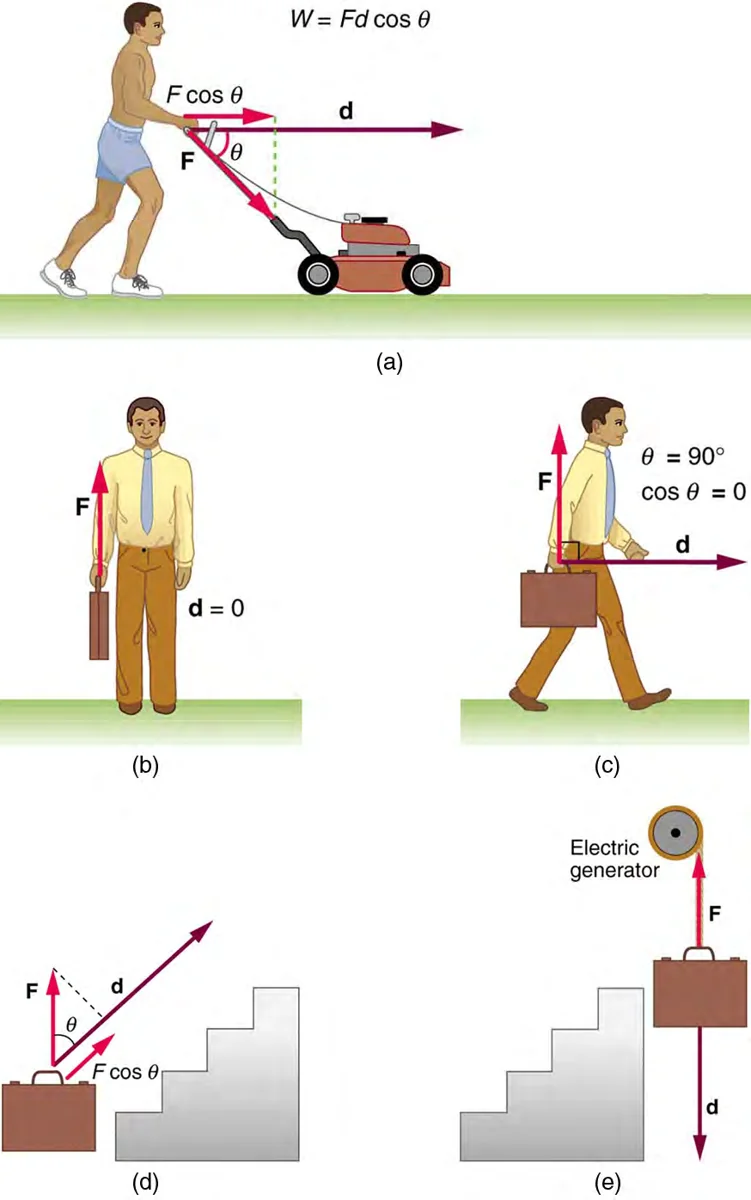
Work by a force: the dot product and the integral: Work depends on the angle between force and displacement, in several example cases.
Scalar
 ⤢ Enlarge
Scalar
work is a scalar quantity.
◀ Previous4 / 4
Force at an angle
1
W = Fs cos θ
where θ is the angle between the force and the displacement.
2
Only the component of force parallel to the motion does work.
3
If the angle is measured from the vertical, the parallel component uses sine instead.
4
Resolve first find the force component along the direction of motion before using W = Fs.
5
Suitcase example pulling a suitcase at 30° above the horizontal does work F s cos 30°.
Special cases of the angle
| Angle | Work done | Meaning |
|---|---|---|
| θ = 0° | W = Fs (maximum) | Force along the motion, e.g. pushing a trolley along the floor. |
| θ = 90° | W = 0 | Force perpendicular to the motion, e.g. a normal reaction or a satellite’s centripetal force. |
| θ = 180° | W = −Fs | Force opposes the motion, e.g. friction, which removes kinetic energy as thermal energy. |
Energy transfer by work
Force along the motion
the object gains energy.
Force opposite to the motion
the object loses energy.
Pushing a block
work is done against friction, and the kinetic energy is transferred to heat and sound.
Work against gravity
lifting a mass m through height h at constant speed does work mgh, stored as gravitational potential energy.
Work–energy relationship · Equation
Work–energy relationship
the work done by the resultant force equals the change in kinetic energy.
Equation
W = ΔEk = 1/2mv2 − 1/2mu2.
It follows from F = ma and v2 = u2 + 2as.
1Area under the graph · Constant force · Spring2Irregular curves · Negative area
1Base units · Larger units2Moment versus work
More from the specification
Work Done and Energy Transfer along a Slope
- Work done represents energy transferred when a force acts through a distance (W = F·s·cos θ); pulling an object up an inclined slope or lifting a volume of water converts mechanical work into gravitational potential energy (ΔEp = m·g·h).
Mechanical Power and Rate of Energy Conversion
- Power is defined as the rate at which energy is converted or work is done by a system, measured in watts (W,
- (P = W / t = F·v)
What the symbols mean: P = power (W = J s−1) · W or E = work done / energy transferred (J) · t = time (s) · F = force (N) · v = velocity (m s−1)
- (P = W / t = F·v)
- where 1 W = 1 J·s−1).
Conservation of Energy and System Efficiency
- By the principle of conservation of energy, total input energy in a closed system equals final energy; efficiency is calculated as the ratio of useful output power to total input power,
- which means energy converted to internal thermal energy reduces useful performance.
Gravitational field
- Region where mass experiences gravitational force.
Final speed
- Speed at the end, v
Significant figures
- Digits carrying meaningful information in a number.
Efficiency
- Useful output divided by total input.
Key terms
| Term | Meaning |
|---|---|
| Work done | Energy transferred when a force moves its point of application; W = Fs cos θ. |
| Joule | The unit of work and energy; 1 J = 1 N m. |
| Work–energy relationship | The work done by the resultant force equals the change in kinetic energy. |
| Negative work | Work done by a force that opposes the displacement. |
| Area under a force–displacement graph | The work done by the force. |
1Avoid these mistakes2Avoid these mistakes