Curriculum
Edexcel IAL Physics (IAS & A2)
1. Mechanics and Materials
0/71
2. Waves and Electricity
0/108
3. Practical Skills in Physics I
0/52
4. Further Mechanics, Fields and Particles
0/90
-
4. Further Mechanics, Fields and Particles
 Preview
-
3.3.2 Elastic and Inelastic Collisions
Preview
-
3.3.2 Elastic and Inelastic Collisions - Check yourself
 Preview
-
4.1.1 Impulse
Preview
-
4.1.1 Impulse - Check yourself
Preview
-
4.1.2 Core Practical 9- Investigating Impulse
Preview
-
4.1.2 Core Practical 9- Investigating Impulse - Check yourself
Preview
-
4.1.3 Applying Conservation of Linear Momentum
Preview
-
4.1.3 Applying Conservation of Linear Momentum - Check yourself
Preview
-
4.1.4 Core Practical 10- Investigating Collisions using ICT
Preview
-
4.1.4 Core Practical 10- Investigating Collisions using ICT - Check yourself
Preview
-
4.1.6 Energy-Momentum Relation
Preview
-
4.1.6 Energy-Momentum Relation - Check yourself
Preview
-
4.2.2 Angular Velocity
Preview
-
4.2.4 Maintaining Circular Motion
Preview
-
4.2.5 Centripetal Force
Preview
-
4.2.5 Centripetal Force - Check yourself
Preview
-
4.3.1 Defining an Electric Field
Preview
-
4.3.1 Defining an Electric Field - Check yourself
Preview
-
4.3.2 Electric Field Strength
Preview
-
4.3.2 Electric Field Strength - Check yourself
Preview
-
4.3.3 Electric Force between Two Charges
Preview
-
4.3.3 Electric Force between Two Charges - Check yourself
Preview
-
4.3.4 Electric Field due to a Point Charge
Preview
-
4.3.4 Electric Field due to a Point Charge - Check yourself
Preview
-
4.3.5 Electric Field and Potential
Preview
-
4.3.5 Electric Field and Potential - Check yourself
Preview
-
4.3.7 Electric Potential for a Radial Field
Preview
-
4.3.7 Electric Potential for a Radial Field - Check yourself
Preview
-
4.3.8 Representing Radial and Uniform Electric Fields
Preview
-
4.3.8 Representing Radial and Uniform Electric Fields - Check yourself
Preview
-
4.4.2 Energy Stored by a Capacitor
Preview
-
4.4.2 Energy Stored by a Capacitor - Check yourself
Preview
-
4.4.3 Charge and Discharge Curves
Preview
-
4.4.3 Charge and Discharge Curves - Check yourself
Preview
-
4.4.4 Core Practical 11- Investigating Capacitor Charge and Discharge
Preview
-
4.4.4 Core Practical 11- Investigating Capacitor Charge and Discharge - Check yourself
Preview
-
4.4.5 Exponential Discharge in a Capacitor
Preview
-
4.4.5 Exponential Discharge in a Capacitor - Check yourself
Preview
-
4.5.1 Magnetic Flux Density, Flux and Flux Linkage
Preview
-
4.5.1 Magnetic Flux Density, Flux and Flux Linkage - Check yourself
Preview
-
4.5.2 Magnetic Force on a Charged Particle
Preview
-
4.5.2 Magnetic Force on a Charged Particle - Check yourself
Preview
-
4.5.3 Magnetic Force on a Current-Carrying Conductor
Preview
-
4.5.3 Magnetic Force on a Current-Carrying Conductor - Check yourself
Preview
-
4.5.4 Induced E.M.F in a Moving Coil
Preview
-
4.5.4 Induced E.M.F in a Moving Coil - Check yourself
Preview
-
4.5.5 Induced E.M.F between Linked Coils
Preview
-
4.5.5 Induced E.M.F between Linked Coils - Check yourself
Preview
-
4.5.6 Faraday and Lenz's Law
Preview
-
4.5.6 Faraday and Lenz's Law - Check yourself
Preview
-
4.6.2 The Nuclear Model of the Atom
Preview
-
4.6.2 The Nuclear Model of the Atom - Check yourself
Preview
-
4.6.3 Thermionic Emission
Preview
-
4.6.3 Thermionic Emission - Check yourself
Preview
-
4.6.4 Particle Accelerators and Detectors
Preview
-
4.6.4 Particle Accelerators and Detectors - Check yourself
Preview
-
4.6.5 Radius of a Charged Particle in a Magnetic Field
Preview
-
4.6.5 Radius of a Charged Particle in a Magnetic Field - Check yourself
Preview
-
4.6.6 Interpreting Particle Tracks
Preview
-
4.6.6 Interpreting Particle Tracks - Check yourself
Preview
-
4.6.7 High Energy Particle Collisions
Preview
-
4.6.7 High Energy Particle Collisions - Check yourself
Preview
-
4.6.8 Annihilation of Matter and Antimatter
Preview
-
4.6.8 Annihilation of Matter and Antimatter - Check yourself
Preview
-
4.6.9 Unit Conversions for Energy and Mass
Preview
-
4.6.9 Unit Conversions for Energy and Mass - Check yourself
Preview
-
4.6.10 Relativistic Situations
Preview
-
4.6.10 Relativistic Situations - Check yourself
Preview
-
4.7.1 The Standard Model
Preview
-
4.7.1 The Standard Model - Check yourself
Preview
-
4.7.2 Antimatter
Preview
-
4.7.2 Antimatter - Check yourself
Preview
-
4.7.3 Conservation Laws in Particle Physics
Preview
-
4.7.3 Conservation Laws in Particle Physics - Check yourself
Preview
-
4.7.4 Particle Interaction Equations
Preview
-
4.7.4 Particle Interaction Equations - Check yourself
Preview
-
11.1.3 Nucleon and Proton Number
Preview
-
12.1.1 Radians and Angular Displacement
Preview
-
12.1.1 Radians and Angular Displacement - Check yourself
Preview
-
12.2.1 Centripetal Acceleration
Preview
-
18.2.1 Electric Field Between Parallel Plates
Preview
-
18.2.1 Electric Field Between Parallel Plates - Check yourself
Preview
-
19.1.1 Capacitance
Preview
-
19.1.1 Capacitance - Check yourself
Preview
-
4.1.5 Elastic and Inelastic Collisions
Preview
-
4.2.1 Radians and Angular Displacement
Preview
-
4.2.3 Centripetal Acceleration
Preview
-
4.3.6 Electric Field between Parallel Plates
Preview
-
4.6.1 Nucleon and Proton Number
Preview
5. Thermodynamics, Radiation, Oscillations and Cosmology
0/96
6. Practical Skills in Physics II
0/11
Text lesson
4.2.4 Maintaining Circular Motion
4.2.4 Maintaining Circular Motion — EDEXCEL IAL PHYSICS (IAS & A2) notes: Explain why a resultant force towards the centre is required for circular motion and identify which force provides it in different situations.
Why a force is needed
Why a force is needed
Newton’s first law an object continues in a straight line at constant speed unless a resultant force acts
Changing direction circular motion needs continuous change of velocity
so there is acceleration and therefore a resultant force
Not in equilibrium an object moving in a circle has a resultant force on it
Centripetal force = the resultant force towards the centre of the circle that keeps a body in uniform circular motion
Direction it is always directed towards the centre and acts at right angles to the velocity
Link to acceleration centripetal force and centripetal acceleration act in the same direction by Newton’s second law
1Perpendicular · Effect · Non-perpendicular force2Force removed
What provides the centripetal force
What provides the centripetal force
Not a new force
centripetal force is the name for whichever real force, or combination of forces, gives the resultant towards the centre
Free-body diagram
draw only real forces, take the resultant towards the centre, and never add ‘centripetal force’ as an extra arrow
| Situation | Force providing centripetal force |
|---|---|
| Mass swung on a string in a horizontal circle | Tension |
| Planet or satellite in orbit | Gravitational attraction |
| Car on a flat bend | Friction between tyres and road |
| Clothes in a spin dryer | Normal contact force from the drum wall |
| Electron orbiting a nucleus (classical picture) | Electric force |
| Charged particle in a magnetic field | Magnetic force, always at 90° to the velocity |
| Banked track or leaning cyclist | Component of the normal reaction |
1Varying speed · Top of the circle · Bottom of the circle2Minimum speed at the top
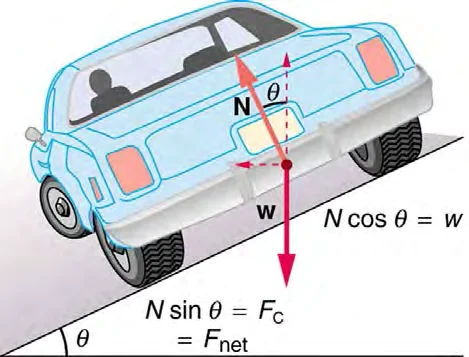
Flat and banked curves: A car on a banked curve with the normal force split so its horizontal part supplies the centripetal force.
Banked tracks
 ⤢ Enlarge
Banked tracks
Horizontal component the horizontal component of the normal reaction can supply the centripetal force without friction at one particular speed
Leaning a cyclist or aircraft leans or banks for the same reason
1Feeling · Explanation · Inertial frame2Real force
Feeling · Explanation · Inertial frame
Feeling
a passenger in a car turning left feels pushed to the right
Explanation
this is inertia, the tendency to continue in a straight line while the car turns, not an outward force
Inertial frame
in the ground-based frame no outward force is needed
1 / 2Next ▶
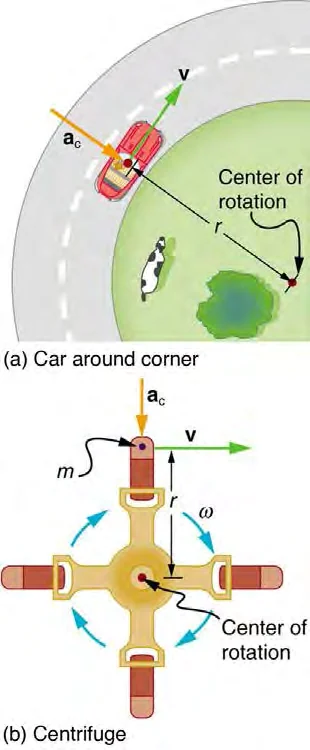
Centripetal acceleration and centripetal force: A car turning a corner and a centrifuge, each with acceleration pointing to the centre of rotation.
Real force
 ⤢ Enlarge
Real force
the only real force towards the centre on the passenger is the contact force from the seat or door
◀ Previous2 / 2
1Testing a circular motion situation2Testing a circular motion situation
More from the specification
Angular Displacement and Radians
- Angular displacement (θ) measures the angle through which an object rotates along a circular path, expressed in radians where 2π radians equals 360 degrees, related to linear arc length by s = rθ.
Angular Speed and Linear Velocity
- Angular velocity is the rate of change of angular displacement; linear speed is calculated using the equation v = rω.
- (ω = Δθ / Δt, measured in rad s−1)
Centripetal Acceleration and Net Force
- An object executing uniform circular motion experiences a centripetal acceleration directed toward the centre of magnitude a = v2/r = rω2, requiring a net inward centripetal force F = mv2/r = mrω2.
Vertical Circular Motion Dynamics
- For an object moving in a vertical circle, gravitational force alters string tension: at the highest point, tension is T = (mv2/r) – mg,
- while at the lowest point, tension reaches its maximum magnitude T = (mv2/r) + mg.
Radians
- Angle unit required in W = τθ.
Linear
- A graph that is a straight line through the origin, so resistance is constant.
Displacement
- Change in position.
Radian
- Arc length divided by radius; 2π rad = 360°.
Length
- Resistance is directly proportional to the length of a wire.
Vector
- Quantity with magnitude and direction.
Angular displacement
- Angle turned, in radians.
Key terms
| Term | Meaning |
|---|---|
| Centripetal force | The resultant force towards the centre that keeps a body moving in a circle. |
| Centripetal acceleration | Acceleration towards the centre of a circle. |
| Tangent | A line touching the circle at a point, along which the object moves if released. |
| Inertia | The tendency of a body to continue in uniform motion in a straight line. |
| Banked track | A curved track tilted so the normal reaction helps provide the centripetal force. |
1Avoid these mistakes2Avoid these mistakes