Curriculum
Edexcel IAL Physics (IAS & A2)
1. Mechanics and Materials
0/71
2. Waves and Electricity
0/108
-
2. Waves and Electricity
 Preview
-
2.1.1 Properties of Waves
Preview
-
2.1.1 Properties of Waves - Check yourself
 Preview
-
2.1.3 Longitudinal Waves
Preview
-
2.1.3 Longitudinal Waves - Check yourself
Preview
-
2.1.4 Transverse Waves
Preview
-
2.1.4 Transverse Waves - Check yourself
Preview
-
2.1.5 Representing Waves on Graphs
Preview
-
2.1.6 Core Practical 4- Investigating the Speed of Sound
Preview
-
2.2.1 Interference and Superposition of Waves
Preview
-
2.2.1 Interference and Superposition of Waves - Check yourself
Preview
-
2.2.2 Phase and Path Difference
Preview
-
2.2.2 Phase and Path Difference - Check yourself
Preview
-
2.2.4 Wave Speed on a Stretched String
Preview
-
2.2.4 Wave Speed on a Stretched String - Check yourself
Preview
-
2.2.5 Core Practical 5- Investigating Stationary Waves
Preview
-
2.2.5 Core Practical 5- Investigating Stationary Waves - Check yourself
Preview
-
2.3.1 Equation for the Intensity of Radiation
Preview
-
2.3.1 Equation for the Intensity of Radiation - Check yourself
Preview
-
2.3.2 Refraction and Refractive Index
Preview
-
2.3.2 Refraction and Refractive Index - Check yourself
Preview
-
2.3.3 Critical Angle
Preview
-
2.3.3 Critical Angle - Check yourself
Preview
-
2.3.4 Total Internal Reflection
Preview
-
2.3.4 Total Internal Reflection - Check yourself
Preview
-
2.3.5 Measuring Refractive Index
Preview
-
2.3.5 Measuring Refractive Index - Check yourself
Preview
-
2.3.6 Plane Polarisation
Preview
-
2.3.6 Plane Polarisation - Check yourself
Preview
-
2.4.2 The Diffraction Grating Equation
Preview
-
2.4.2 The Diffraction Grating Equation - Check yourself
Preview
-
2.4.3 Core Practical 6- Investigating Diffraction Gratings
Preview
-
2.4.3 Core Practical 6- Investigating Diffraction Gratings - Check yourself
Preview
-
2.4.4 The Wave Nature of Electrons
Preview
-
2.4.5 The de Broglie Equation
Preview
-
2.4.5 The de Broglie Equation - Check yourself
Preview
-
2.4.6 Transmission and Reflection of Waves
Preview
-
2.4.6 Transmission and Reflection of Waves - Check yourself
Preview
-
2.4.7 Pulse-Echo Technique
Preview
-
2.4.7 Pulse-Echo Technique - Check yourself
Preview
-
2.4.9 Energy of a Photon
Preview
-
2.4.9 Energy of a Photon - Check yourself
Preview
-
2.5.1 The Photoelectric Effect
Preview
-
2.5.1 The Photoelectric Effect - Check yourself
Preview
-
2.5.2 The Photoelectric Equation
Preview
-
2.5.2 The Photoelectric Equation - Check yourself
Preview
-
2.5.4 The Particle Nature of EM Radiation
Preview
-
2.5.4 The Particle Nature of EM Radiation - Check yourself
Preview
-
2.5.5 Atomic Line Spectra
Preview
-
2.5.5 Atomic Line Spectra - Check yourself
Preview
-
2.6.4 Charge Conservation in Circuits
Preview
-
2.6.4 Charge Conservation in Circuits - Check yourself
Preview
-
2.6.5 Energy Conservation in Circuits
Preview
-
2.6.5 Energy Conservation in Circuits - Check yourself
Preview
-
2.6.6 Resistance in Series and Parallel
Preview
-
2.6.6 Resistance in Series and Parallel - Check yourself
Preview
-
2.6.8 Current-Potential Difference Graphs
Preview
-
2.6.8 Current-Potential Difference Graphs - Check yourself
Preview
-
2.7.1 Electrical Resistivity
Preview
-
2.7.1 Electrical Resistivity - Check yourself
Preview
-
2.7.2 Core Practical 7- Investigating Resistivity
Preview
-
2.7.2 Core Practical 7- Investigating Resistivity - Check yourself
Preview
-
2.7.3 Calculating Current and Drift Velocity
Preview
-
2.7.3 Calculating Current and Drift Velocity - Check yourself
Preview
-
2.7.4 Potential Difference and Conductor Length
Preview
-
2.7.4 Potential Difference and Conductor Length - Check yourself
Preview
-
2.7.6 Potential Dividers and Variable Resistance
Preview
-
2.7.6 Potential Dividers and Variable Resistance - Check yourself
Preview
-
2.8.3 E.M.F. vs. Terminal Potential Difference
Preview
-
2.8.3 E.M.F. vs. Terminal Potential Difference - Check yourself
Preview
-
2.8.4 Core Practical 8- Investigating E.M.F. and Internal Resistance
Preview
-
2.8.4 Core Practical 8- Investigating E.M.F. and Internal Resistance - Check yourself
Preview
-
2.8.5 Resistance and Temperature
Preview
-
2.8.5 Resistance and Temperature - Check yourself
Preview
-
2.8.6 Resistance and Illumination
Preview
-
2.8.6 Resistance and Illumination - Check yourself
Preview
-
7.1.3 The Wave Equation
Preview
-
7.1.3 The Wave Equation - Check yourself
Preview
-
8.1.2 Stationary Waves
Preview
-
8.1.2 Stationary Waves - Check yourself
Preview
-
8.2.1 Diffraction
Preview
-
8.2.1 Diffraction - Check yourself
Preview
-
9.1.1 Electric Current
Preview
-
9.1.1 Electric Current - Check yourself
Preview
-
9.2.1 Potential Difference
Preview
-
9.2.1 Potential Difference - Check yourself
Preview
-
9.2.2 Electrical Power
Preview
-
9.2.2 Electrical Power - Check yourself
Preview
-
9.3.2 Ohm's Law
Preview
-
9.3.2 Ohm's Law - Check yourself
Preview
-
10.1.2 Electromotive Force
Preview
-
10.1.2 Electromotive Force - Check yourself
Preview
-
10.1.3 Internal Resistance
Preview
-
10.1.3 Internal Resistance - Check yourself
Preview
-
10.3.1 Potential Dividers
Preview
-
10.3.1 Potential Dividers - Check yourself
Preview
-
22.1.3 The Electronvolt
Preview
-
22.1.3 The Electronvolt - Check yourself
Preview
-
22.3.1 Wave-Particle Duality
Preview
-
22.3.1 Wave-Particle Duality - Check yourself
Preview
-
Edexcel International AS Physics — Complete unit: 2. Waves and Electricity
Preview
-
2.1.2 The Wave Equation
Preview
-
2.4.8 Wave-Particle Duality
Preview
-
2.5.3 The Electronvolt
Preview
-
2.6.1 Electric Current
Preview
-
2.6.3 Ohm's Law
Preview
-
2.6.7 Electrical Power
Preview
-
2.8.1 Electromotive Force
Preview
3. Practical Skills in Physics I
0/52
4. Further Mechanics, Fields and Particles
0/90
5. Thermodynamics, Radiation, Oscillations and Cosmology
0/96
6. Practical Skills in Physics II
0/11
Text lesson
2.6.1 Electric Current
2.6.1 Electric Current: Define electric current as the rate of flow of charge, use I = ΔQ/Δt and distinguish between conventional current and electron flow.
1Charge in Motion2Definition · Unit · Charge carriers3Conventional current
Charge in Motion
 ⤢ Enlarge
Charge in Motion
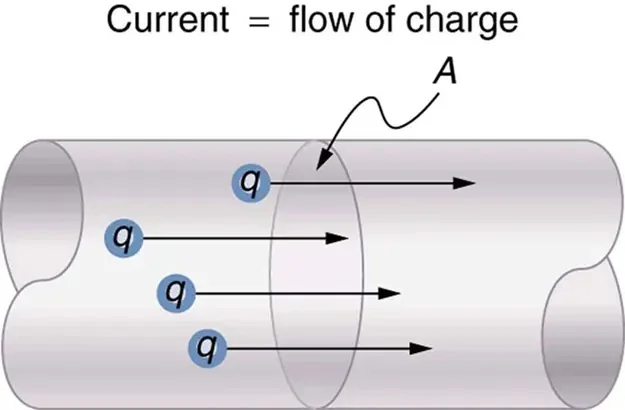
A current exists whenever charged particles move in a definite direction.
1 / 3Next ▶
Definition · Unit · Charge carriers
Definition
Electric current is the rate of flow of charge past a point
so I = ΔQ/Δt.
Unit
The SI unit is the ampere, and one ampere equals one coulomb of charge passing a point each second.
Charge carriers
In metals the carriers are free electrons
while in electrolytes and plasmas they can be positive and negative ions.
◀ Previous2 / 3Next ▶
Electric current as a rate of charge flow: Charge carriers crossing a wire’s cross-section, which defines current as charge per unit time.
Conventional current
 ⤢ Enlarge
Conventional current
Conventional current is drawn from the positive terminal to the negative terminal
which is opposite to the flow of electrons.
| Quantity | Symbol | Unit |
|---|---|---|
| Current | I | A |
| Charge | Q | C |
| Time | t | s |
◀ Previous3 / 3
1Charge and Electrons2Charge and Electrons
Charge and Electrons
Charge and Electrons
All charge is a whole-number multiple of the elementary charge e = 1.60 × 10⁻¹⁹ C.
The number of electrons passing a point is the total charge Q divided by the elementary charge e.
The same current passes every point in a series circuit
because charge is not used up in the components.
Current is measured by an ammeter connected in series with the component so that the current flows through it.
Current flows whenever two oppositely charged conductors are joined by a wire
because charge then moves between them.
Electric current occurs in household wiring and in electrical appliances.
1 / 2Next ▶
Charge carriers and drift velocity: Charge carriers moving at drift velocity through a wire segment of known volume.
Charge and Electrons
 ⤢ Enlarge
Charge and Electrons
In the current equation, Δt means the change in time over which the charge flows.
◀ Previous2 / 2
1Solving Current Problems2Solving Current Problems3Solving Current Problems
Solving Current Problems
1
1
2
Write down the known quantities, converting minutes to seconds and milliamps or microamps to amps.
3
2
4
Use Q = It to find the charge that has passed, or I = Q/t when the charge and time are given.
5
3
6
To find the number of electrons, divide the charge by 1.60 × 10⁻¹⁹ C.
1 / 3Next ▶
Solving Current Problems
Solving Current Problems
4
Remember that the direction of conventional current is opposite to the movement of electrons.
5
State the final answer with a unit and, for large numbers of electrons, in standard form.
◀ Previous2 / 3Next ▶
Two graphs: charge against time is a straight line whose gradient is the current, and current against time is a rectangle whose area is the charge.
Solving Current Problems

◀ Previous3 / 3
Worked Example
Worked Example
Question: A current of 0.50 A flows through a lamp for 2.0 minutes. Calculate the charge that passes and the number of electrons involved. (e = 1.60 × 10⁻¹⁹ C)
Time: 2.0 min = 120 s.
Charge: Q = It = 0.50 × 120 = 60 C.What the symbols mean: Q = charge (C) · I = current (A) · t = time (s)
Number of electrons: N = Q/e = 60 ÷ 1.60 × 10−19 = 3.75 × 10²⁰.
Answer: Q = 60 C and N ≈ 3.8 × 10²⁰ electrons
12.6.1 – Main ideas for the Exam2Common Mistakes