Curriculum
Edexcel IAL Physics (IAS & A2)
1. Mechanics and Materials
0/71
2. Waves and Electricity
0/108
-
2. Waves and Electricity
 Preview
-
2.1.1 Properties of Waves
Preview
-
2.1.1 Properties of Waves - Check yourself
 Preview
-
2.1.3 Longitudinal Waves
Preview
-
2.1.3 Longitudinal Waves - Check yourself
Preview
-
2.1.4 Transverse Waves
Preview
-
2.1.4 Transverse Waves - Check yourself
Preview
-
2.1.5 Representing Waves on Graphs
Preview
-
2.1.6 Core Practical 4- Investigating the Speed of Sound
Preview
-
2.2.1 Interference and Superposition of Waves
Preview
-
2.2.1 Interference and Superposition of Waves - Check yourself
Preview
-
2.2.2 Phase and Path Difference
Preview
-
2.2.2 Phase and Path Difference - Check yourself
Preview
-
2.2.4 Wave Speed on a Stretched String
Preview
-
2.2.4 Wave Speed on a Stretched String - Check yourself
Preview
-
2.2.5 Core Practical 5- Investigating Stationary Waves
Preview
-
2.2.5 Core Practical 5- Investigating Stationary Waves - Check yourself
Preview
-
2.3.1 Equation for the Intensity of Radiation
Preview
-
2.3.1 Equation for the Intensity of Radiation - Check yourself
Preview
-
2.3.2 Refraction and Refractive Index
Preview
-
2.3.2 Refraction and Refractive Index - Check yourself
Preview
-
2.3.3 Critical Angle
Preview
-
2.3.3 Critical Angle - Check yourself
Preview
-
2.3.4 Total Internal Reflection
Preview
-
2.3.4 Total Internal Reflection - Check yourself
Preview
-
2.3.5 Measuring Refractive Index
Preview
-
2.3.5 Measuring Refractive Index - Check yourself
Preview
-
2.3.6 Plane Polarisation
Preview
-
2.3.6 Plane Polarisation - Check yourself
Preview
-
2.4.2 The Diffraction Grating Equation
Preview
-
2.4.2 The Diffraction Grating Equation - Check yourself
Preview
-
2.4.3 Core Practical 6- Investigating Diffraction Gratings
Preview
-
2.4.3 Core Practical 6- Investigating Diffraction Gratings - Check yourself
Preview
-
2.4.4 The Wave Nature of Electrons
Preview
-
2.4.5 The de Broglie Equation
Preview
-
2.4.5 The de Broglie Equation - Check yourself
Preview
-
2.4.6 Transmission and Reflection of Waves
Preview
-
2.4.6 Transmission and Reflection of Waves - Check yourself
Preview
-
2.4.7 Pulse-Echo Technique
Preview
-
2.4.7 Pulse-Echo Technique - Check yourself
Preview
-
2.4.9 Energy of a Photon
Preview
-
2.4.9 Energy of a Photon - Check yourself
Preview
-
2.5.1 The Photoelectric Effect
Preview
-
2.5.1 The Photoelectric Effect - Check yourself
Preview
-
2.5.2 The Photoelectric Equation
Preview
-
2.5.2 The Photoelectric Equation - Check yourself
Preview
-
2.5.4 The Particle Nature of EM Radiation
Preview
-
2.5.4 The Particle Nature of EM Radiation - Check yourself
Preview
-
2.5.5 Atomic Line Spectra
Preview
-
2.5.5 Atomic Line Spectra - Check yourself
Preview
-
2.6.4 Charge Conservation in Circuits
Preview
-
2.6.4 Charge Conservation in Circuits - Check yourself
Preview
-
2.6.5 Energy Conservation in Circuits
Preview
-
2.6.5 Energy Conservation in Circuits - Check yourself
Preview
-
2.6.6 Resistance in Series and Parallel
Preview
-
2.6.6 Resistance in Series and Parallel - Check yourself
Preview
-
2.6.8 Current-Potential Difference Graphs
Preview
-
2.6.8 Current-Potential Difference Graphs - Check yourself
Preview
-
2.7.1 Electrical Resistivity
Preview
-
2.7.1 Electrical Resistivity - Check yourself
Preview
-
2.7.2 Core Practical 7- Investigating Resistivity
Preview
-
2.7.2 Core Practical 7- Investigating Resistivity - Check yourself
Preview
-
2.7.3 Calculating Current and Drift Velocity
Preview
-
2.7.3 Calculating Current and Drift Velocity - Check yourself
Preview
-
2.7.4 Potential Difference and Conductor Length
Preview
-
2.7.4 Potential Difference and Conductor Length - Check yourself
Preview
-
2.7.6 Potential Dividers and Variable Resistance
Preview
-
2.7.6 Potential Dividers and Variable Resistance - Check yourself
Preview
-
2.8.3 E.M.F. vs. Terminal Potential Difference
Preview
-
2.8.3 E.M.F. vs. Terminal Potential Difference - Check yourself
Preview
-
2.8.4 Core Practical 8- Investigating E.M.F. and Internal Resistance
Preview
-
2.8.4 Core Practical 8- Investigating E.M.F. and Internal Resistance - Check yourself
Preview
-
2.8.5 Resistance and Temperature
Preview
-
2.8.5 Resistance and Temperature - Check yourself
Preview
-
2.8.6 Resistance and Illumination
Preview
-
2.8.6 Resistance and Illumination - Check yourself
Preview
-
7.1.3 The Wave Equation
Preview
-
7.1.3 The Wave Equation - Check yourself
Preview
-
8.1.2 Stationary Waves
Preview
-
8.1.2 Stationary Waves - Check yourself
Preview
-
8.2.1 Diffraction
Preview
-
8.2.1 Diffraction - Check yourself
Preview
-
9.1.1 Electric Current
Preview
-
9.1.1 Electric Current - Check yourself
Preview
-
9.2.1 Potential Difference
Preview
-
9.2.1 Potential Difference - Check yourself
Preview
-
9.2.2 Electrical Power
Preview
-
9.2.2 Electrical Power - Check yourself
Preview
-
9.3.2 Ohm's Law
Preview
-
9.3.2 Ohm's Law - Check yourself
Preview
-
10.1.2 Electromotive Force
Preview
-
10.1.2 Electromotive Force - Check yourself
Preview
-
10.1.3 Internal Resistance
Preview
-
10.1.3 Internal Resistance - Check yourself
Preview
-
10.3.1 Potential Dividers
Preview
-
10.3.1 Potential Dividers - Check yourself
Preview
-
22.1.3 The Electronvolt
Preview
-
22.1.3 The Electronvolt - Check yourself
Preview
-
22.3.1 Wave-Particle Duality
Preview
-
22.3.1 Wave-Particle Duality - Check yourself
Preview
-
Edexcel International AS Physics — Complete unit: 2. Waves and Electricity
Preview
-
2.1.2 The Wave Equation
Preview
-
2.4.8 Wave-Particle Duality
Preview
-
2.5.3 The Electronvolt
Preview
-
2.6.1 Electric Current
Preview
-
2.6.3 Ohm's Law
Preview
-
2.6.7 Electrical Power
Preview
-
2.8.1 Electromotive Force
Preview
3. Practical Skills in Physics I
0/52
4. Further Mechanics, Fields and Particles
0/90
5. Thermodynamics, Radiation, Oscillations and Cosmology
0/96
6. Practical Skills in Physics II
0/11
Text lesson
2.6.7 Electrical Power
2.6.7 Electrical Power: Use P = VI, P = I2R and P = V2/R to calculate the power dissipated in a component and the electrical energy transferred in a given time.
1Power in Circuits2Basic equation · From Ohm’s law · Other form3Energy
Power in Circuits
 ⤢ Enlarge
Power in Circuits
Charges moving through a potential difference transfer energy, and the rate of this transfer is the power.
1 / 3Next ▶
Basic equation · From Ohm’s law · Other form
Basic equation
The power transferred is the product of the potential difference and the current, P = VI.
From Ohm’s law
Substituting V = IR gives P = I2R
which is useful when the current is known.
Other form
Substituting I = V/R gives P = V2/R
which is useful when the potential difference is known.
◀ Previous2 / 3Next ▶
Energy
Energy
The electrical energy transferred in time t is W = VIt
which equals Pt.
| Known quantities | Equation for power |
|---|---|
| V and I | P = VI |
| I and R | P = I2R |
| V and R | P = V2/R |
◀ Previous3 / 3
1Heating and Transmission2Heating and Transmission
Heating and Transmission
Heating and Transmission
Current in a resistor transfers electrical energy to thermal energy because charge carriers collide with vibrating ions.
A cable with a larger resistance loses more power as heat for the same current, since the loss is I2R.
Appliances are rated with a power and a mains potential difference, from which the current drawn can be found.
Electrical energy is often measured in kilowatt hours, found by multiplying the power in kilowatts by the time in hours.
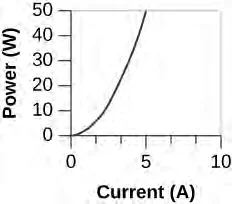
Doubling either the current or the potential difference at fixed resistance makes the power four times greater.
For a given power, doubling the resistance lowers the current and raises the potential difference.
1 / 2Next ▶
Power transmission chain from power station through step-up transformer, cable resistance and step-down transformer to home, with worked loss numbers
Heating and Transmission
 ⤢ Enlarge
Heating and Transmission
Potential difference is work done per unit charge
so the energy transferred equals the charge multiplied by the potential difference.
◀ Previous2 / 2
1Choosing and Applying the Right Equation2Choosing and Applying the Right Equation3Choosing and Applying the Right Equation
Choosing and Applying the Right Equation
1
1
2
List the quantities given in the question and note whether energy, power or current is required.
3
2
4
Choose P = VI when both potential difference and current are known.
5
3
6
Choose P = I2R or P = V2/R when the resistance is known together with only one other quantity.
1 / 3Next ▶
Choosing and Applying the Right Equation
Choosing and Applying the Right Equation
4
Calculate the power in watts
then multiply by the time in seconds if energy in joules is required.
5
Check the answer by comparing it with the stated rating of the device, if one is given.
◀ Previous2 / 3Next ▶
Electrical power: Power plotted against current for a resistor, curving upward as the square of the current.
Choosing and Applying the Right Equation
◀ Previous3 / 3
Worked Example
Worked Example
Question: A kettle is rated 2.0 kW at 230 V. Calculate the current it draws, its resistance and the energy transferred in 3.0 minutes.
Current: I = P/V = 2000 ÷ 230 = 8.70 A.
Resistance: R = V2/P = 2302 ÷ 2000 = 26.45 Ω.
Energy: W = Pt = 2000 × 180 = 360 000 J.
Answer: I ≈ 8.7 A, R ≈ 26 Ω and W = 3.6 × 10⁵ J
12.6.7 – Main ideas for the Exam2Common Mistakes