Curriculum
Edexcel IAL Physics (IAS & A2)
1. Mechanics and Materials
0/71
2. Waves and Electricity
0/108
-
2. Waves and Electricity
 Preview
-
2.1.1 Properties of Waves
Preview
-
2.1.1 Properties of Waves - Check yourself
 Preview
-
2.1.3 Longitudinal Waves
Preview
-
2.1.3 Longitudinal Waves - Check yourself
Preview
-
2.1.4 Transverse Waves
Preview
-
2.1.4 Transverse Waves - Check yourself
Preview
-
2.1.5 Representing Waves on Graphs
Preview
-
2.1.6 Core Practical 4- Investigating the Speed of Sound
Preview
-
2.2.1 Interference and Superposition of Waves
Preview
-
2.2.1 Interference and Superposition of Waves - Check yourself
Preview
-
2.2.2 Phase and Path Difference
Preview
-
2.2.2 Phase and Path Difference - Check yourself
Preview
-
2.2.4 Wave Speed on a Stretched String
Preview
-
2.2.4 Wave Speed on a Stretched String - Check yourself
Preview
-
2.2.5 Core Practical 5- Investigating Stationary Waves
Preview
-
2.2.5 Core Practical 5- Investigating Stationary Waves - Check yourself
Preview
-
2.3.1 Equation for the Intensity of Radiation
Preview
-
2.3.1 Equation for the Intensity of Radiation - Check yourself
Preview
-
2.3.2 Refraction and Refractive Index
Preview
-
2.3.2 Refraction and Refractive Index - Check yourself
Preview
-
2.3.3 Critical Angle
Preview
-
2.3.3 Critical Angle - Check yourself
Preview
-
2.3.4 Total Internal Reflection
Preview
-
2.3.4 Total Internal Reflection - Check yourself
Preview
-
2.3.5 Measuring Refractive Index
Preview
-
2.3.5 Measuring Refractive Index - Check yourself
Preview
-
2.3.6 Plane Polarisation
Preview
-
2.3.6 Plane Polarisation - Check yourself
Preview
-
2.4.2 The Diffraction Grating Equation
Preview
-
2.4.2 The Diffraction Grating Equation - Check yourself
Preview
-
2.4.3 Core Practical 6- Investigating Diffraction Gratings
Preview
-
2.4.3 Core Practical 6- Investigating Diffraction Gratings - Check yourself
Preview
-
2.4.4 The Wave Nature of Electrons
Preview
-
2.4.5 The de Broglie Equation
Preview
-
2.4.5 The de Broglie Equation - Check yourself
Preview
-
2.4.6 Transmission and Reflection of Waves
Preview
-
2.4.6 Transmission and Reflection of Waves - Check yourself
Preview
-
2.4.7 Pulse-Echo Technique
Preview
-
2.4.7 Pulse-Echo Technique - Check yourself
Preview
-
2.4.9 Energy of a Photon
Preview
-
2.4.9 Energy of a Photon - Check yourself
Preview
-
2.5.1 The Photoelectric Effect
Preview
-
2.5.1 The Photoelectric Effect - Check yourself
Preview
-
2.5.2 The Photoelectric Equation
Preview
-
2.5.2 The Photoelectric Equation - Check yourself
Preview
-
2.5.4 The Particle Nature of EM Radiation
Preview
-
2.5.4 The Particle Nature of EM Radiation - Check yourself
Preview
-
2.5.5 Atomic Line Spectra
Preview
-
2.5.5 Atomic Line Spectra - Check yourself
Preview
-
2.6.4 Charge Conservation in Circuits
Preview
-
2.6.4 Charge Conservation in Circuits - Check yourself
Preview
-
2.6.5 Energy Conservation in Circuits
Preview
-
2.6.5 Energy Conservation in Circuits - Check yourself
Preview
-
2.6.6 Resistance in Series and Parallel
Preview
-
2.6.6 Resistance in Series and Parallel - Check yourself
Preview
-
2.6.8 Current-Potential Difference Graphs
Preview
-
2.6.8 Current-Potential Difference Graphs - Check yourself
Preview
-
2.7.1 Electrical Resistivity
Preview
-
2.7.1 Electrical Resistivity - Check yourself
Preview
-
2.7.2 Core Practical 7- Investigating Resistivity
Preview
-
2.7.2 Core Practical 7- Investigating Resistivity - Check yourself
Preview
-
2.7.3 Calculating Current and Drift Velocity
Preview
-
2.7.3 Calculating Current and Drift Velocity - Check yourself
Preview
-
2.7.4 Potential Difference and Conductor Length
Preview
-
2.7.4 Potential Difference and Conductor Length - Check yourself
Preview
-
2.7.6 Potential Dividers and Variable Resistance
Preview
-
2.7.6 Potential Dividers and Variable Resistance - Check yourself
Preview
-
2.8.3 E.M.F. vs. Terminal Potential Difference
Preview
-
2.8.3 E.M.F. vs. Terminal Potential Difference - Check yourself
Preview
-
2.8.4 Core Practical 8- Investigating E.M.F. and Internal Resistance
Preview
-
2.8.4 Core Practical 8- Investigating E.M.F. and Internal Resistance - Check yourself
Preview
-
2.8.5 Resistance and Temperature
Preview
-
2.8.5 Resistance and Temperature - Check yourself
Preview
-
2.8.6 Resistance and Illumination
Preview
-
2.8.6 Resistance and Illumination - Check yourself
Preview
-
7.1.3 The Wave Equation
Preview
-
7.1.3 The Wave Equation - Check yourself
Preview
-
8.1.2 Stationary Waves
Preview
-
8.1.2 Stationary Waves - Check yourself
Preview
-
8.2.1 Diffraction
Preview
-
8.2.1 Diffraction - Check yourself
Preview
-
9.1.1 Electric Current
Preview
-
9.1.1 Electric Current - Check yourself
Preview
-
9.2.1 Potential Difference
Preview
-
9.2.1 Potential Difference - Check yourself
Preview
-
9.2.2 Electrical Power
Preview
-
9.2.2 Electrical Power - Check yourself
Preview
-
9.3.2 Ohm's Law
Preview
-
9.3.2 Ohm's Law - Check yourself
Preview
-
10.1.2 Electromotive Force
Preview
-
10.1.2 Electromotive Force - Check yourself
Preview
-
10.1.3 Internal Resistance
Preview
-
10.1.3 Internal Resistance - Check yourself
Preview
-
10.3.1 Potential Dividers
Preview
-
10.3.1 Potential Dividers - Check yourself
Preview
-
22.1.3 The Electronvolt
Preview
-
22.1.3 The Electronvolt - Check yourself
Preview
-
22.3.1 Wave-Particle Duality
Preview
-
22.3.1 Wave-Particle Duality - Check yourself
Preview
-
Edexcel International AS Physics — Complete unit: 2. Waves and Electricity
Preview
-
2.1.2 The Wave Equation
Preview
-
2.4.8 Wave-Particle Duality
Preview
-
2.5.3 The Electronvolt
Preview
-
2.6.1 Electric Current
Preview
-
2.6.3 Ohm's Law
Preview
-
2.6.7 Electrical Power
Preview
-
2.8.1 Electromotive Force
Preview
3. Practical Skills in Physics I
0/52
4. Further Mechanics, Fields and Particles
0/90
5. Thermodynamics, Radiation, Oscillations and Cosmology
0/96
6. Practical Skills in Physics II
0/11
Text lesson
2.4.2 The Diffraction Grating Equation
2.4.2 The Diffraction Grating Equation — EDEXCEL IAL PHYSICS (IAS & A2) notes: Use nλ = d sin θ to find wavelengths, angles of maxima and the highest visible order for a diffraction grating.
1Diffraction grating · Pattern · Coherent sources2Slit spacing
Diffraction grating · Pattern · Coherent sources
Diffraction grating
a plate with a very large number of parallel, identical, close-spaced slits.
Pattern
monochromatic light gives a pattern of narrow bright fringes on a screen.
Coherent sources
all slits are lit by the same wave
so the wavelets are coherent and superpose.
1 / 2Next ▶
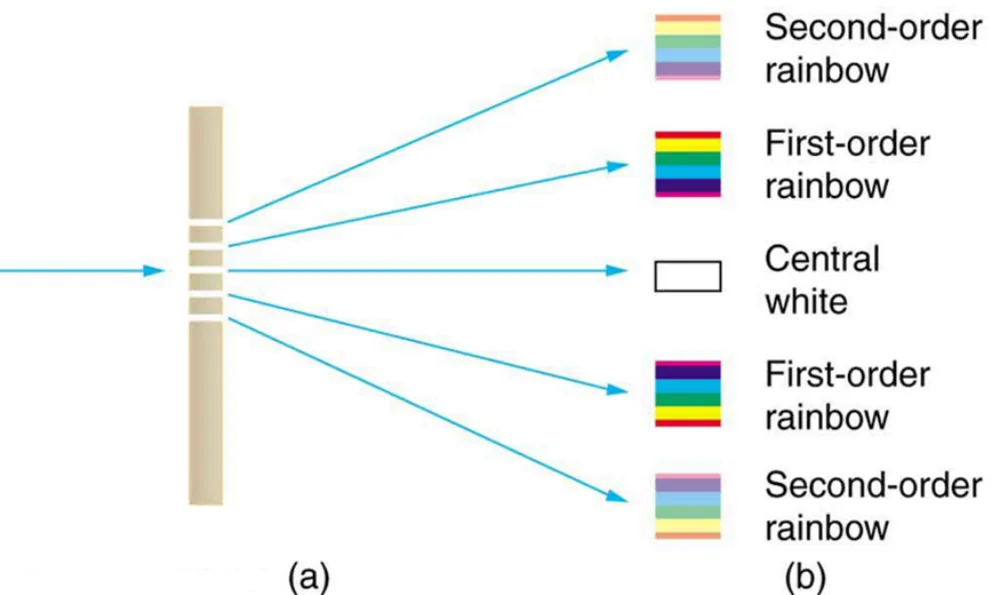
Diffraction gratings: A grating of many parallel slits gives a bright pattern at several angles, and white light spreads into a rainbow with a white central band.
Slit spacing
 ⤢ Enlarge
1
d is the distance between the centres of adjacent slits.
2
For N lines per metre, d = 1/N.
3
For N in lines per mm, d = 1/(N × 103) m.
◀ Previous2 / 2
1Equation2Origin · Central maximum3Symmetry
Equation
Equation
nλ = d sin θ gives the angles of the maxima.
(constructive interference)
n is the order of the maximum (0, 1, 2 …).
λ is the wavelength (m).
d is the slit spacing (m).
θ is the angle between the order-n beam and the central maximum.
1 / 3Next ▶
Origin · Central maximum
Origin
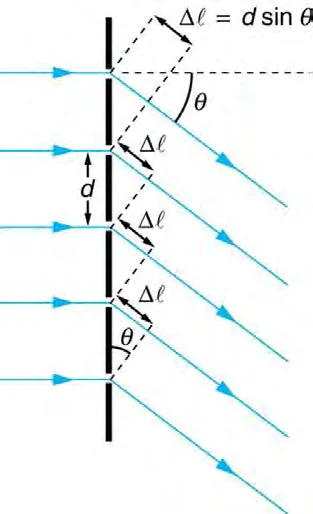
light from adjacent slits has a path difference d sin θ, and a whole number of wavelengths gives constructive interference.
Central maximum
n = 0 lies at θ = 0 for every wavelength.
◀ Previous2 / 3Next ▶
Diffraction gratings: Path difference d sin theta between rays from neighbouring slits of a grating.
Symmetry
 ⤢ Enlarge
Symmetry
orders appear on both sides of the central maximum.
◀ Previous3 / 3
1Finding θ · Measured from the centre · Angular separation2Both sides
1Limit · Highest order · Rounding2Number of maxima · Grating spacing
1Sharp maxima2White light
Sharp maxima
Sharp maxima
with many slits, a small departure from the exact angle makes distant slits arrive out of phase and cancel,
so the maxima are narrow and bright.
1 / 2Next ▶
Diffraction gratings: A grating spreads white light into a central white maximum and rainbow orders on each side.
White light
 ⤢ Enlarge
1
The central maximum is white.
2
Higher orders are spread into spectra, with violet nearer the centre and red further out.
3
Neighbouring spectra overlap at large orders.
◀ Previous2 / 2
1Spectroscopy · Laser wavelength · X-ray crystallography2Double slit comparison
More from the specification
Diffraction Grating Equation
- Described by d sin θ = nλ, where transmitted light waves of wavelength λ form sharp spectral maxima at specific diffraction angles θ.
Wave-Particle Duality and de Broglie Wavelength
- Moving particles such as electrons exhibit wave properties with a de Broglie wavelength given by λ = h/p,
- allowing electron diffraction around obstacle boundaries.
Photon Energy
- A photon is a discrete quantum packet of electromagnetic energy given by E = hf = hc/λ, transferring energy during interactions with matter.
Wave Reflection and Transmission
- When sound or ultrasound waves encounter a boundary between media of different acoustic impedances, part of the wave energy is reflected and part is transmitted.
Transmission
- Sending electricity along power cables from the power station to consumers.
Boundary
- Surface between two media at which waves are partially reflected
Wave-particle duality
- The property that radiation and matter show both wave and particle behaviour.
Photoelectric effect
- The emission of electrons from a metal surface when electromagnetic radiation of high enough frequency is absorbed.
Percentage uncertainty
- The absolute uncertainty divided by the value, times 100%.
Photon
- A quantum of electromagnetic energy, E = hf
What the symbols mean: E = energy of one photon (J) · h = Planck constant (6.63 × 10⁻³⁴ J s) · f = frequency (Hz)
Ultrasound
- Sound with a frequency above 20 kHz
Electron
- Negatively charged particle in an atom.
Theory
- A well-tested, wide-ranging explanation supported by evidence.
Frequency
- Revolutions per second, f = 1/T.
What the symbols mean: T = period, the time for one complete wave (s) · f = frequency (Hz)
Reflection
- Light bouncing off a surface.
Key terms
| Term | Meaning |
|---|---|
| Diffraction grating | A plate with many closely spaced, equally spaced parallel slits. |
| Order | The integer n in nλ = d sin θ that labels each maximum. |
| Grating spacing | The distance d between adjacent slit centres. |
| Monochromatic | Light of a single wavelength. |
| Angular separation | The difference between the angles of two maxima. |
1Avoid these mistakes2Avoid these mistakes