Curriculum
Edexcel IAL Physics (IAS & A2)
1. Mechanics and Materials
0/71
2. Waves and Electricity
0/108
3. Practical Skills in Physics I
0/52
4. Further Mechanics, Fields and Particles
0/90
5. Thermodynamics, Radiation, Oscillations and Cosmology
0/96
-
5. Thermodynamics, Radiation, Oscillations and Cosmology
 Preview
-
5.1.1 Specific Heat Capacity and Latent Heat
Preview
-
5.1.1 Specific Heat Capacity and Latent Heat - Check yourself
 Preview
-
5.1.2 Core Practical 12- Calibrating a Thermistor
Preview
-
5.1.2 Core Practical 12- Calibrating a Thermistor - Check yourself
Preview
-
5.1.3 Core Practical 13- Investigating Specific Latent Heat
Preview
-
5.1.3 Core Practical 13- Investigating Specific Latent Heat - Check yourself
Preview
-
5.2.2 Temperature and Absolute Zero
Preview
-
5.2.4 Core Practical 14- Investigating Gas Pressure and Volume
Preview
-
5.2.4 Core Practical 14- Investigating Gas Pressure and Volume - Check yourself
Preview
-
5.2.5 Average Molecular Kinetic Energy
Preview
-
5.2.5 Average Molecular Kinetic Energy - Check yourself
Preview
-
5.3.1 Nuclear Binding Energy and Mass Deficit
Preview
-
5.3.1 Nuclear Binding Energy and Mass Deficit - Check yourself
Preview
-
5.3.2 Atomic Mass Unit
Preview
-
5.3.2 Atomic Mass Unit - Check yourself
Preview
-
5.3.3 Binding Energy per Nucleon Graph
Preview
-
5.3.3 Binding Energy per Nucleon Graph - Check yourself
Preview
-
5.3.4 Nuclear Fusion
Preview
-
5.3.4 Nuclear Fusion - Check yourself
Preview
-
5.4.1 Background Radiation
Preview
-
5.4.1 Background Radiation - Check yourself
Preview
-
5.4.2 Alpha, Beta and Gamma Radiation
Preview
-
5.4.2 Alpha, Beta and Gamma Radiation - Check yourself
Preview
-
5.4.3 Nuclear Decay Equations
Preview
-
5.4.3 Nuclear Decay Equations - Check yourself
Preview
-
5.4.4 Core Practical 15- Investigating Gamma Radiation Absorption
Preview
-
5.4.4 Core Practical 15- Investigating Gamma Radiation Absorption - Check yourself
Preview
-
5.4.5 The Random Nature of Nuclear Decay
Preview
-
5.4.5 The Random Nature of Nuclear Decay - Check yourself
Preview
-
5.4.6 Equations for Nuclear Physics
Preview
-
5.4.6 Equations for Nuclear Physics - Check yourself
Preview
-
5.5.1 Conditions for Simple Harmonic Motion
Preview
-
5.5.1 Conditions for Simple Harmonic Motion - Check yourself
Preview
-
5.5.2 Equations for Simple Harmonic Motion
Preview
-
5.5.2 Equations for Simple Harmonic Motion - Check yourself
Preview
-
5.5.3 Period of Simple Harmonic Oscillators
Preview
-
5.5.3 Period of Simple Harmonic Oscillators - Check yourself
Preview
-
5.5.4 Displacement-Time Graph for an Oscillator
Preview
-
5.5.4 Displacement-Time Graph for an Oscillator - Check yourself
Preview
-
5.5.5 Velocity-Time Graph for an Oscillator
Preview
-
5.5.5 Velocity-Time Graph for an Oscillator - Check yourself
Preview
-
5.6.2 Core Practical 16- Investigating Resonance
Preview
-
5.6.2 Core Practical 16- Investigating Resonance - Check yourself
Preview
-
5.6.3 Damped and Undamped Oscillating Systems
Preview
-
5.6.3 Damped and Undamped Oscillating Systems - Check yourself
Preview
-
5.6.4 Free and Forced Oscillations
Preview
-
5.6.4 Free and Forced Oscillations - Check yourself
Preview
-
5.6.5 Resonance Graphs
Preview
-
5.6.5 Resonance Graphs - Check yourself
Preview
-
5.6.6 Damping and Plastic Deformation
Preview
-
5.6.6 Damping and Plastic Deformation - Check yourself
Preview
-
5.7.3 Newton’s Law of Universal Gravitation
Preview
-
5.7.3 Newton’s Law of Universal Gravitation - Check yourself
Preview
-
5.7.4 Gravitational Field due to a Point Mass
Preview
-
5.7.4 Gravitational Field due to a Point Mass - Check yourself
Preview
-
5.7.5 Gravitational Potential for a Radial Field
Preview
-
5.7.5 Gravitational Potential for a Radial Field - Check yourself
Preview
-
5.7.6 Comparing Electric and Gravitational Fields
Preview
-
5.7.6 Comparing Electric and Gravitational Fields - Check yourself
Preview
-
5.7.7 Orbital Motion
Preview
-
5.7.7 Orbital Motion - Check yourself
Preview
-
5.8.1 Black Body Radiation
Preview
-
5.8.1 Black Body Radiation - Check yourself
Preview
-
5.8.2 Stefan-Boltzmann Law
Preview
-
5.8.2 Stefan-Boltzmann Law - Check yourself
Preview
-
5.8.3 Wien’s Law
Preview
-
5.8.3 Wien’s Law - Check yourself
Preview
-
5.9.1 Inverse Square Law of Flux
Preview
-
5.9.1 Inverse Square Law of Flux - Check yourself
Preview
-
5.9.2 Parallax
Preview
-
5.9.2 Parallax - Check yourself
Preview
-
5.9.3 Standard Candles
Preview
-
5.9.3 Standard Candles - Check yourself
Preview
-
5.9.4 The Hertzsprung-Russell Diagram
Preview
-
5.9.4 The Hertzsprung-Russell Diagram - Check yourself
Preview
-
5.9.5 The Life Cycle of Stars
Preview
-
5.9.5 The Life Cycle of Stars - Check yourself
Preview
-
5.10.1 Doppler Shift
Preview
-
5.10.1 Doppler Shift - Check yourself
Preview
-
5.10.2 Equations for Cosmology
Preview
-
5.10.2 Equations for Cosmology - Check yourself
Preview
-
5.10.3 Cosmology
Preview
-
5.10.3 Cosmology - Check yourself
Preview
-
13.1.1 Gravitational Fields
Preview
-
13.1.1 Gravitational Fields - Check yourself
Preview
-
13.3.1 Gravitational Field Strength
Preview
-
13.3.1 Gravitational Field Strength - Check yourself
Preview
-
15.2.2 Ideal Gas Equation
Preview
-
15.2.2 Ideal Gas Equation - Check yourself
Preview
-
16.1.1 Internal energy
Preview
-
16.1.1 Internal energy - Check yourself
Preview
-
17.3.2 Resonance
Preview
-
17.3.2 Resonance - Check yourself
Preview
-
5.2.1 Internal Energy
Preview
-
5.2.3 Ideal Gas Equation
Preview
6. Practical Skills in Physics II
0/11
Text lesson
5.10.3 Cosmology
5.10.3 Cosmology — EDEXCEL IAL PHYSICS (IAS & A2) notes: Describe the Big Bang model and its evidence, the CMB, dark matter and dark energy, and the fate of the universe.
1Expansion · Age · Meaning2Cooling
Expansion · Age · Meaning
Expansion
the observed expansion implies that matter was once closer together and hotter.
Age
tracing back about 13.8 billion years, all of space was in a hot, dense state.
Meaning
the Big Bang was the beginning of the expansion of space itself, not an explosion in existing space.
1 / 2Next ▶
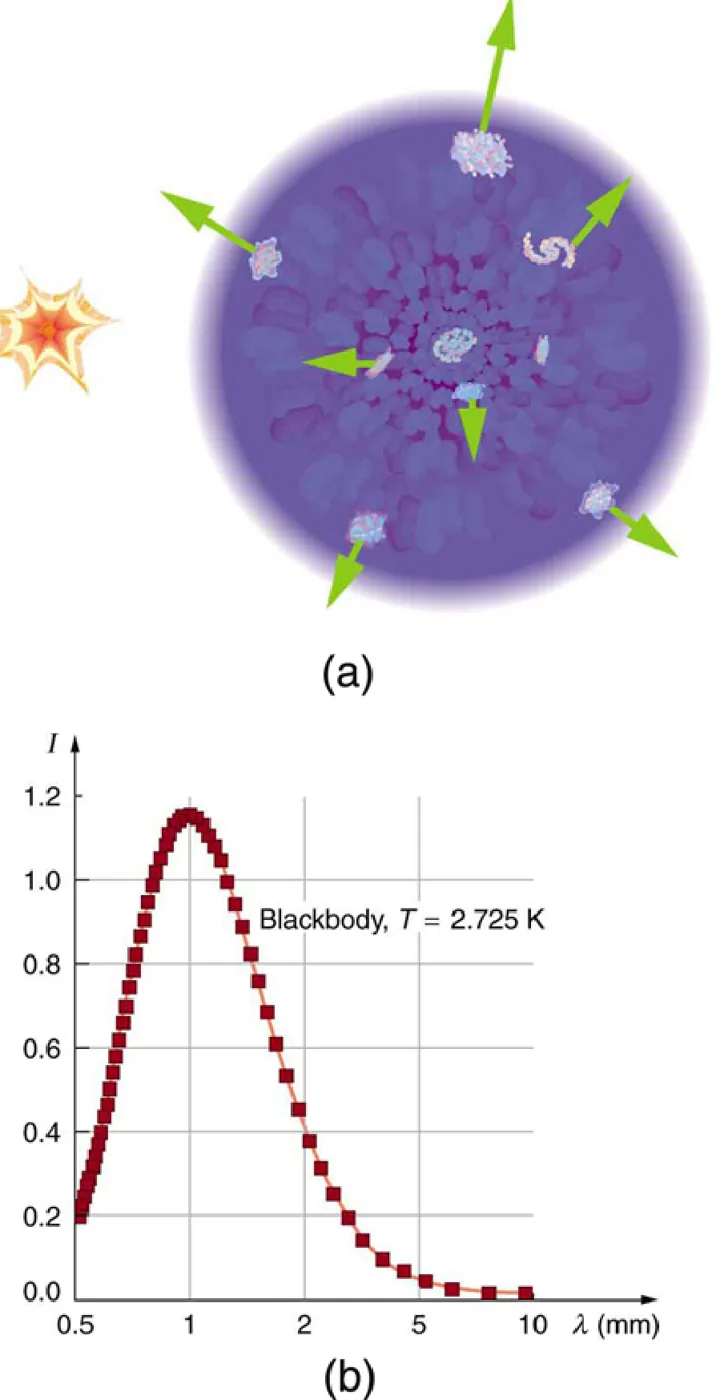
The Big Bang and the cosmic microwave background: Left: a sketch of the Big Bang explosion, after which galaxies formed inside the cooled remnants of the early fireball. Right: the measured spectrum of the cosmic microwave background, which matches a blackbody at 2.725 K from every direction in space not blocked by other sources.
Cooling
 ⤢ Enlarge
Cooling
the universe cooled as it expanded.
◀ Previous2 / 2
Evolution of the universe from the Big Bang: The evolution of the universe from the Big Bang onward is tied to the laws of physics, especially particle physics at the earliest stages. The universe has been relativistic throughout its history, and theories of unified forces at high energy may be tested by their effects on its evolution.
Timeline of the early universe
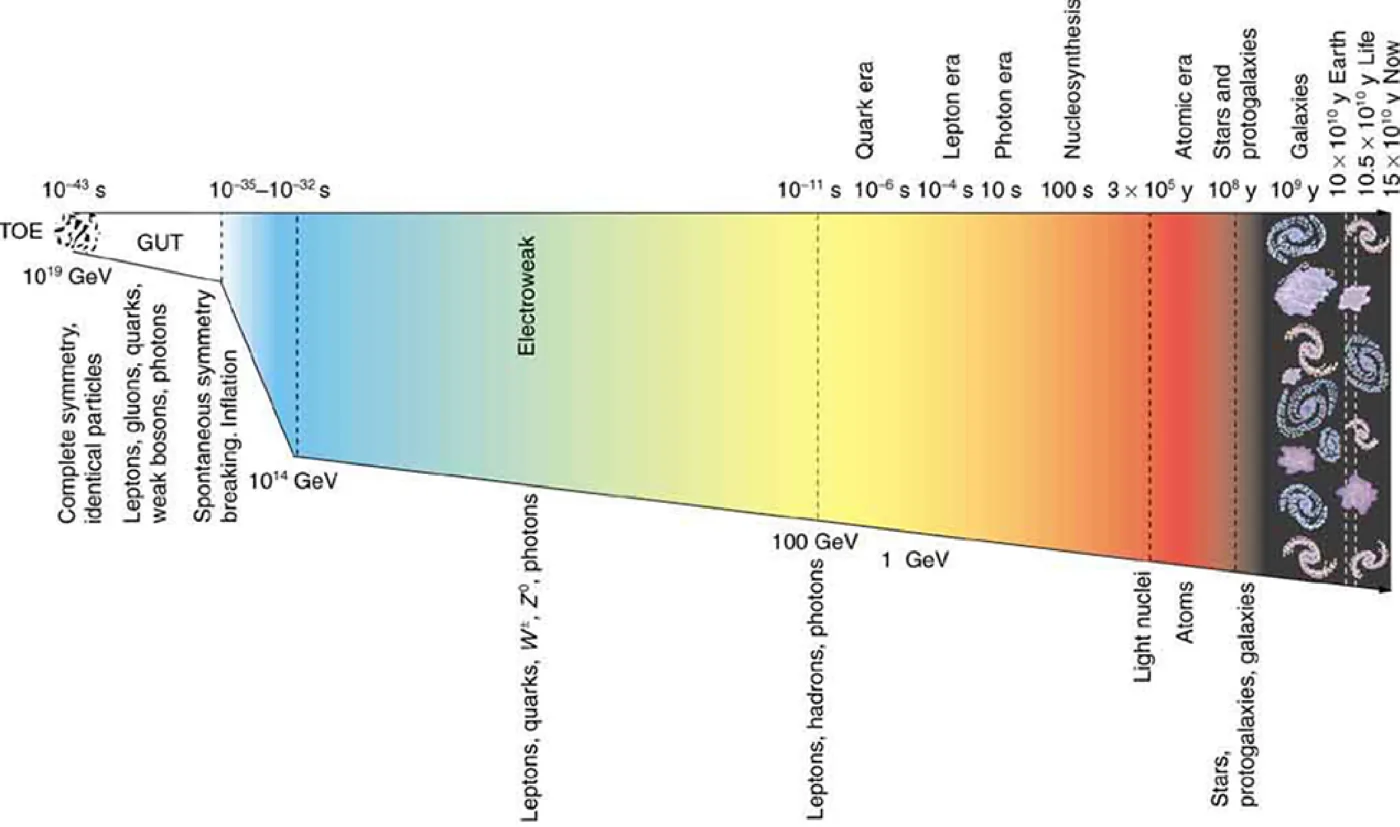
| Time | Event |
|---|---|
| Immediately | Extremely hot and dense, radiation and fundamental particles |
| About 1 microsecond | Quarks combine into protons and neutrons |
| About 3 minutes | Temperature about 109 K; fusion forms helium and traces of lithium |
| About 380 000 years | Atoms form at about 3000 K; light travels freely (the CMB) |
| A few hundred million years | Gravity gathers gas into the first stars and galaxies |
1Origin · Observation · Peak2Cooling3Variations
Origin · Observation · Peak
Origin
light released when atoms formed has travelled freely ever since.
Observation
it arrives uniformly from all directions as an almost perfect black-body spectrum at 2.7 K.
Peak
Wien’s law gives 2.90 × 10⁻³/2.7 ≈ 1 mm, in the microwave region.
1 / 3Next ▶
Cooling
Cooling
it was emitted at about 3000 K and expansion stretched wavelengths by a factor of about 1100.
◀ Previous2 / 3Next ▶
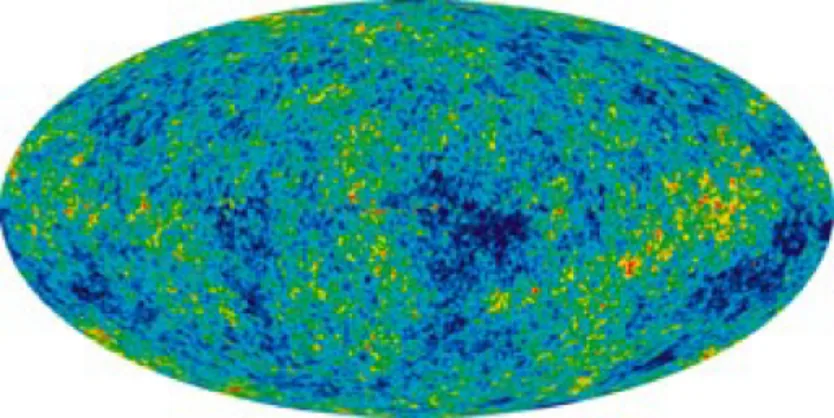
Wrinkles in the cosmic microwave background: A map of the whole sky colored by the small temperature fluctuations in the microwave background, measured by the WMAP spacecraft. Red marks slightly hotter, denser regions and blue marks slightly cooler ones; these tiny differences are thought to have led to the formation of galaxies.
Variations
 ⤢ Enlarge
Variations
tiny temperature differences of about one part in 105 are the seeds of galaxies.
◀ Previous3 / 3
1Redshift · CMB · Light elements2Olbers’ paradox
1Dark matter · Evidence from rotation · Other evidence2Amount · Detection
Evidence · Dark energy · Ordinary matter
Evidence
Type Ia supernovae show that the expansion is accelerating.
Dark energy
the unknown cause, making up about 68% of the total.
Ordinary matter
only about 5% of the total.
1Controlling factors · Current evidence · Expected outcome2Big crunch
1Planck estimate2Accuracy3Accuracy
More from the specification
Cosmic microwave background waves
- Cosmic microwave background waves redshifted relict electromagnetic waves stretching across the cosmos provide definitive evidence supporting the expanding universe model.
Doppler Effect for Light
- The observed change in wavelength or frequency of radiation from an astronomical source moving relative to Earth: Δλ / λ ≈ Δf / f ≈ v / c.
Redshift and Recession Velocity
- When an astronomical object moves away from Earth, its spectral lines shift to lower frequencies (redshift), indicating positive recessional velocity.
Blueshift for Approaching Sources
- If a distant celestial body moves towards Earth, the observed frequency increases and wavelength decreases, producing a blueshift.
Hubble's Law and Cosmological Expansion
- Hubble’s law (v = H₀ d) states that the recession velocity of distant galaxies is directly proportional to their distance,
- where H₀ is the Hubble constant.
Doppler shift
- Change of observed wavelength due to relative motion.
Doppler effect
- Change in observed wavelength and frequency due to the motion of a source.
Spectral lines
- Dark or bright lines in a spectrum at wavelengths characteristic of elements.
Source
- Reservoir at TH providing heat QH
Frequency
- Revolutions per second, f = 1/T.
What the symbols mean: T = period, the time for one complete wave (s) · f = frequency (Hz)
Constant
- Not changing.
Velocity
- Rate of change of displacement.
Wavefront
- Line joining points on a wave that are in step
- Equation
- ΔE = m × c × Δθ
What the symbols mean: E, Q or q = energy transferred (J) · m = mass (kg; g in chemistry calorimetry) · c = specific heat capacity (J kg−1 °C−1; water 4.18 J g−1 °C−1) · ΔT or Δθ = temperature change (°C or K)
- ΔE = m × c × Δθ
Key terms
| Term | Meaning |
|---|---|
| Big Bang | Beginning of the expansion of space and time about 13.8 billion years ago. |
| Cosmic microwave background | Relic radiation from the early universe, now at 2.7 K. |
| Dark matter | Non-luminous matter detected through its gravitational effects. |
| Dark energy | Unknown cause of the accelerating expansion of the universe. |
| Olbers’ paradox | Question why the night sky is dark if the universe is infinite and static. |
1Avoid these mistakes2Avoid these mistakes