Curriculum
Edexcel IAL Physics (IAS & A2)
1. Mechanics and Materials
0/71
-
1. Mechanics and Materials
 Preview
-
1.1.1 Equations of Motion
Preview
-
1.1.3 Slope and Area of Motion Graphs
Preview
-
1.1.5 Resolving Vectors
Preview
-
1.1.5 Resolving Vectors - Check yourself
 Preview
-
1.1.6 Adding Vectors
Preview
-
1.1.6 Adding Vectors - Check yourself
Preview
-
1.1.7 Components of Velocity
Preview
-
1.1.7 Components of Velocity - Check yourself
Preview
-
1.1.8 Free-body Force Diagrams
Preview
-
1.1.8 Free-body Force Diagrams - Check yourself
Preview
-
1.2.2 Mass, Weight and Gravitational Field Strength
Preview
-
1.2.2 Mass, Weight and Gravitational Field Strength - Check yourself
Preview
-
1.2.3 Core Practical 1- Investigating the Acceleration of Freefall
Preview
-
1.2.3 Core Practical 1- Investigating the Acceleration of Freefall - Check yourself
Preview
-
1.2.4 Newton's Third Law of Motion
Preview
-
1.2.4 Newton's Third Law of Motion - Check yourself
Preview
-
1.2.5 Momentum
Preview
-
1.2.5 Momentum - Check yourself
Preview
-
1.2.6 Conservation of Linear Momentum
Preview
-
1.2.6 Conservation of Linear Momentum - Check yourself
Preview
-
1.3.2 Centre of Gravity and The Principle of Moments
Preview
-
1.3.2 Centre of Gravity and The Principle of Moments - Check yourself
Preview
-
1.4.1 Scalars and Vectors
Preview
-
1.4.1 Scalars and Vectors - Check yourself
Preview
-
1.4.1 Work
Preview
-
1.4.1 Work - Check yourself
Preview
-
1.5.3 Viscous Drag
Preview
-
1.5.3 Viscous Drag - Check yourself
Preview
-
1.5.4 Core Practical 2- Investigating Viscosity
Preview
-
1.5.4 Core Practical 2- Investigating Viscosity - Check yourself
Preview
-
1.6.2 Stress, Strain and The Young Modulus
Preview
-
1.6.2 Stress, Strain and The Young Modulus - Check yourself
Preview
-
1.6.3 Force-Extension Graphs
Preview
-
1.6.3 Force-Extension Graphs - Check yourself
Preview
-
1.6.4 Stress-Strain Graphs
Preview
-
1.6.4 Stress-Strain Graphs - Check yourself
Preview
-
1.6.5 Core Practical 3- Investigating Young Modulus
Preview
-
1.6.5 Core Practical 3- Investigating Young Modulus - Check yourself
Preview
-
1.6.6 Elastic Strain Energy
Preview
-
1.6.6 Elastic Strain Energy - Check yourself
Preview
-
2.1.2 Motion Graphs
Preview
-
3.1.2 Force and Acceleration
Preview
-
3.1.2 Force and Acceleration - Check yourself
Preview
-
4.1.2 Moments
Preview
-
4.1.2 Moments - Check yourself
Preview
-
4.3.1 Density
Preview
-
4.3.1 Density - Check yourself
Preview
-
4.3.4 Upthrust
Preview
-
4.3.4 Upthrust - Check yourself
Preview
-
5.1.2 The Principle of Conservation of Energy
Preview
-
5.1.2 The Principle of Conservation of Energy - Check yourself
Preview
-
5.1.3 Efficiency
Preview
-
5.1.3 Efficiency - Check yourself
Preview
-
5.1.4 Power
Preview
-
5.1.4 Power - Check yourself
Preview
-
5.2.1 Gravitational Potential Energy
Preview
-
5.2.1 Gravitational Potential Energy - Check yourself
Preview
-
5.2.2 Kinetic Energy
Preview
-
5.2.2 Kinetic Energy - Check yourself
Preview
-
6.1.2 Hooke's Law
Preview
-
6.1.2 Hooke's Law - Check yourself
Preview
-
Edexcel International AS Physics — Complete unit: 1. Mechanics and Materials
Preview
-
1.1.4 Scalars and Vectors
Preview
-
1.2.1 Force and Acceleration
Preview
-
1.4.3 Gravitational Potential Energy
Preview
-
1.4.4 The Principle of Conservation of Energy
Preview
-
1.4.5 Power
Preview
-
1.4.6 Efficiency
Preview
-
1.5.2 Upthrust
Preview
-
1.6.1 Hooke's Law
Preview
2. Waves and Electricity
0/108
3. Practical Skills in Physics I
0/52
4. Further Mechanics, Fields and Particles
0/90
5. Thermodynamics, Radiation, Oscillations and Cosmology
0/96
6. Practical Skills in Physics II
0/11
Text lesson
1.4.5 Power
1.4.5 Power: Define power as the rate of transferring energy or doing work, and use P = W/t and P = Fv to solve problems.
1Defining Power2Definition · Unit · Average and instantaneous3Larger units
Defining Power
 ⤢ Enlarge
Defining Power
Power tells us how quickly energy is transferred, not how much energy is transferred in total.
1 / 3Next ▶
Definition · Unit · Average and instantaneous
Definition
Power is the rate at which work is done or energy is transferred
so P = ΔW/Δt or P = ΔE/Δt.
Unit
The SI unit is the watt
where 1 W is a transfer of one joule every second (1 W = 1 J/s).
Average and instantaneous
Dividing total energy by total time gives the average power
while a very short time interval gives the power at an instant.
◀ Previous2 / 3Next ▶
What is power?: A rocket on the Space Shuttle lifting off, doing work and using energy at a very high rate.
Larger units
 ⤢ Enlarge
Larger units
Kilowatts (103 W) and megawatts (106 W) are used for engines and power stations, and 1 kW h is an energy unit equal to 3.6 × 10⁶ J.
| Quantity | Equation | Unit |
|---|---|---|
| Power from energy | P = E / t | W |
| Power from work | P = W / t | W |
| Power from force and speed | P = Fv | W |
◀ Previous3 / 3
1Power, Force and Velocity2Power, Force and Velocity
1Working Through a Calculation2Working Through a Calculation
1Worked Example2Worked Example
Worked Example
1
Question: A crane lifts a 400 kg load through a vertical height of 12 m in 20 s at constant speed. Calculate the useful power output. (g = 9.81 N/kg)
2
Work done = mgh = 400 × 9.81 × 12 = 47 088 J.
3
Power = W/t = 47 088 ÷ 20 = 2354 W.
4
Answer: P ≈ 2.4 kW (2.35 × 10³ W)
1 / 2Next ▶
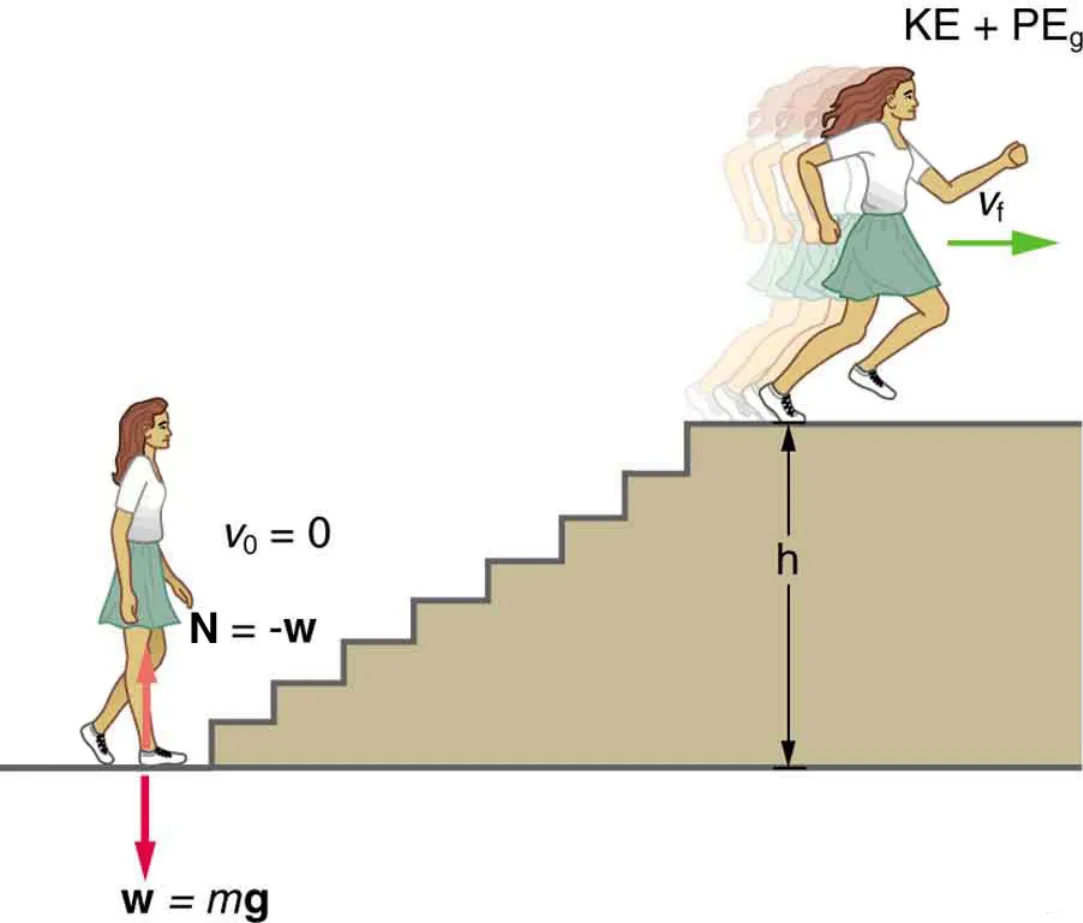
Worked examples: A woman running up a flight of stairs from rest, converting chemical energy from food into kinetic and gravitational potential energy.
Worked Example
◀ Previous2 / 2
11.4.5 – Main ideas for the Exam2Common Mistakes