Curriculum
Edexcel IAL Physics (IAS & A2)
1. Mechanics and Materials
0/71
2. Waves and Electricity
0/108
-
2. Waves and Electricity
 Preview
-
2.1.1 Properties of Waves
Preview
-
2.1.1 Properties of Waves - Check yourself
 Preview
-
2.1.3 Longitudinal Waves
Preview
-
2.1.3 Longitudinal Waves - Check yourself
Preview
-
2.1.4 Transverse Waves
Preview
-
2.1.4 Transverse Waves - Check yourself
Preview
-
2.1.5 Representing Waves on Graphs
Preview
-
2.1.6 Core Practical 4- Investigating the Speed of Sound
Preview
-
2.2.1 Interference and Superposition of Waves
Preview
-
2.2.1 Interference and Superposition of Waves - Check yourself
Preview
-
2.2.2 Phase and Path Difference
Preview
-
2.2.2 Phase and Path Difference - Check yourself
Preview
-
2.2.4 Wave Speed on a Stretched String
Preview
-
2.2.4 Wave Speed on a Stretched String - Check yourself
Preview
-
2.2.5 Core Practical 5- Investigating Stationary Waves
Preview
-
2.2.5 Core Practical 5- Investigating Stationary Waves - Check yourself
Preview
-
2.3.1 Equation for the Intensity of Radiation
Preview
-
2.3.1 Equation for the Intensity of Radiation - Check yourself
Preview
-
2.3.2 Refraction and Refractive Index
Preview
-
2.3.2 Refraction and Refractive Index - Check yourself
Preview
-
2.3.3 Critical Angle
Preview
-
2.3.3 Critical Angle - Check yourself
Preview
-
2.3.4 Total Internal Reflection
Preview
-
2.3.4 Total Internal Reflection - Check yourself
Preview
-
2.3.5 Measuring Refractive Index
Preview
-
2.3.5 Measuring Refractive Index - Check yourself
Preview
-
2.3.6 Plane Polarisation
Preview
-
2.3.6 Plane Polarisation - Check yourself
Preview
-
2.4.2 The Diffraction Grating Equation
Preview
-
2.4.2 The Diffraction Grating Equation - Check yourself
Preview
-
2.4.3 Core Practical 6- Investigating Diffraction Gratings
Preview
-
2.4.3 Core Practical 6- Investigating Diffraction Gratings - Check yourself
Preview
-
2.4.4 The Wave Nature of Electrons
Preview
-
2.4.5 The de Broglie Equation
Preview
-
2.4.5 The de Broglie Equation - Check yourself
Preview
-
2.4.6 Transmission and Reflection of Waves
Preview
-
2.4.6 Transmission and Reflection of Waves - Check yourself
Preview
-
2.4.7 Pulse-Echo Technique
Preview
-
2.4.7 Pulse-Echo Technique - Check yourself
Preview
-
2.4.9 Energy of a Photon
Preview
-
2.4.9 Energy of a Photon - Check yourself
Preview
-
2.5.1 The Photoelectric Effect
Preview
-
2.5.1 The Photoelectric Effect - Check yourself
Preview
-
2.5.2 The Photoelectric Equation
Preview
-
2.5.2 The Photoelectric Equation - Check yourself
Preview
-
2.5.4 The Particle Nature of EM Radiation
Preview
-
2.5.4 The Particle Nature of EM Radiation - Check yourself
Preview
-
2.5.5 Atomic Line Spectra
Preview
-
2.5.5 Atomic Line Spectra - Check yourself
Preview
-
2.6.4 Charge Conservation in Circuits
Preview
-
2.6.4 Charge Conservation in Circuits - Check yourself
Preview
-
2.6.5 Energy Conservation in Circuits
Preview
-
2.6.5 Energy Conservation in Circuits - Check yourself
Preview
-
2.6.6 Resistance in Series and Parallel
Preview
-
2.6.6 Resistance in Series and Parallel - Check yourself
Preview
-
2.6.8 Current-Potential Difference Graphs
Preview
-
2.6.8 Current-Potential Difference Graphs - Check yourself
Preview
-
2.7.1 Electrical Resistivity
Preview
-
2.7.1 Electrical Resistivity - Check yourself
Preview
-
2.7.2 Core Practical 7- Investigating Resistivity
Preview
-
2.7.2 Core Practical 7- Investigating Resistivity - Check yourself
Preview
-
2.7.3 Calculating Current and Drift Velocity
Preview
-
2.7.3 Calculating Current and Drift Velocity - Check yourself
Preview
-
2.7.4 Potential Difference and Conductor Length
Preview
-
2.7.4 Potential Difference and Conductor Length - Check yourself
Preview
-
2.7.6 Potential Dividers and Variable Resistance
Preview
-
2.7.6 Potential Dividers and Variable Resistance - Check yourself
Preview
-
2.8.3 E.M.F. vs. Terminal Potential Difference
Preview
-
2.8.3 E.M.F. vs. Terminal Potential Difference - Check yourself
Preview
-
2.8.4 Core Practical 8- Investigating E.M.F. and Internal Resistance
Preview
-
2.8.4 Core Practical 8- Investigating E.M.F. and Internal Resistance - Check yourself
Preview
-
2.8.5 Resistance and Temperature
Preview
-
2.8.5 Resistance and Temperature - Check yourself
Preview
-
2.8.6 Resistance and Illumination
Preview
-
2.8.6 Resistance and Illumination - Check yourself
Preview
-
7.1.3 The Wave Equation
Preview
-
7.1.3 The Wave Equation - Check yourself
Preview
-
8.1.2 Stationary Waves
Preview
-
8.1.2 Stationary Waves - Check yourself
Preview
-
8.2.1 Diffraction
Preview
-
8.2.1 Diffraction - Check yourself
Preview
-
9.1.1 Electric Current
Preview
-
9.1.1 Electric Current - Check yourself
Preview
-
9.2.1 Potential Difference
Preview
-
9.2.1 Potential Difference - Check yourself
Preview
-
9.2.2 Electrical Power
Preview
-
9.2.2 Electrical Power - Check yourself
Preview
-
9.3.2 Ohm's Law
Preview
-
9.3.2 Ohm's Law - Check yourself
Preview
-
10.1.2 Electromotive Force
Preview
-
10.1.2 Electromotive Force - Check yourself
Preview
-
10.1.3 Internal Resistance
Preview
-
10.1.3 Internal Resistance - Check yourself
Preview
-
10.3.1 Potential Dividers
Preview
-
10.3.1 Potential Dividers - Check yourself
Preview
-
22.1.3 The Electronvolt
Preview
-
22.1.3 The Electronvolt - Check yourself
Preview
-
22.3.1 Wave-Particle Duality
Preview
-
22.3.1 Wave-Particle Duality - Check yourself
Preview
-
Edexcel International AS Physics — Complete unit: 2. Waves and Electricity
Preview
-
2.1.2 The Wave Equation
Preview
-
2.4.8 Wave-Particle Duality
Preview
-
2.5.3 The Electronvolt
Preview
-
2.6.1 Electric Current
Preview
-
2.6.3 Ohm's Law
Preview
-
2.6.7 Electrical Power
Preview
-
2.8.1 Electromotive Force
Preview
3. Practical Skills in Physics I
0/52
4. Further Mechanics, Fields and Particles
0/90
5. Thermodynamics, Radiation, Oscillations and Cosmology
0/96
6. Practical Skills in Physics II
0/11
Text lesson
9.2.2 Electrical Power
9.2.2 Electrical Power — AS PHYSICS 9702 notes: Define electrical power and use P = IV = I2R = V2/R.
1Power · Potential difference · Current2Combined3Combined
Power · Potential difference · Current
Power
the rate of doing work.
Potential difference
the work done per unit charge.
Current
the rate of flow of charge.
1 / 3Next ▶
Combined
1
the power dissipated by an electrical device is P = IV.
2
P is power in W.
3
I is current in A.
4
V is potential difference in V.
◀ Previous2 / 3Next ▶
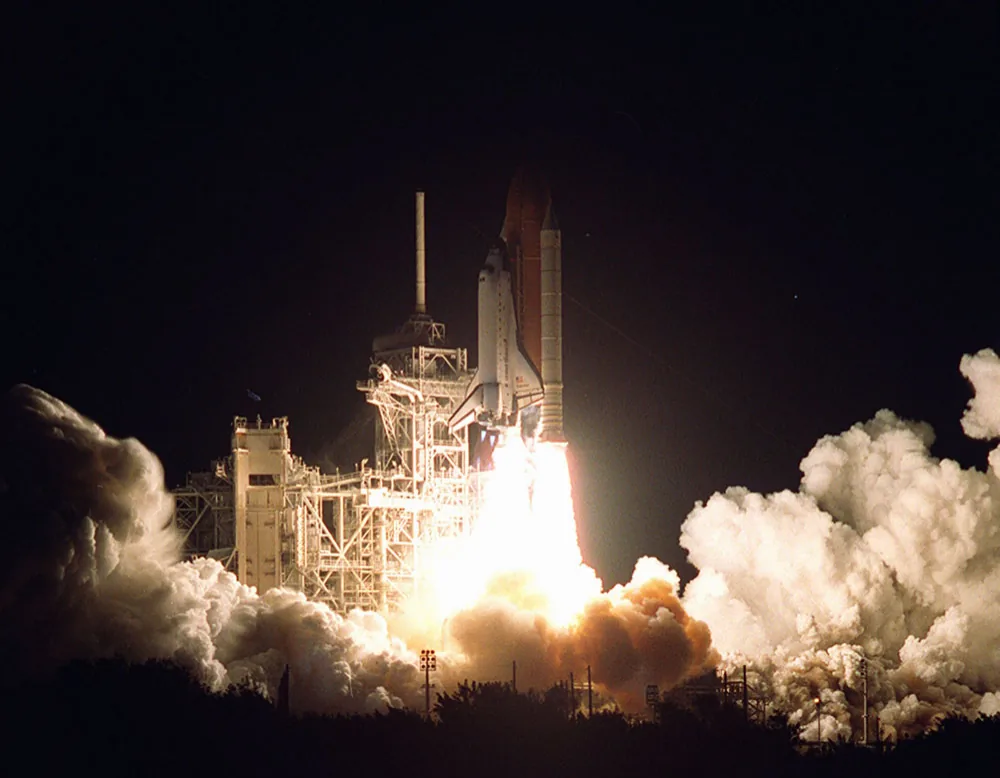
What is power?: A rocket on the Space Shuttle lifting off, doing work and using energy at a very high rate.
Combined
◀ Previous3 / 3
1Resistance · In terms of current · In terms of p.d.2Choosing
1Doubling2Reason
Doubling
Doubling
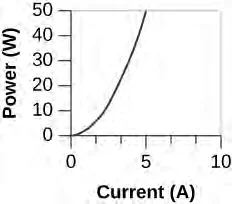
for a given resistance, doubling the current or the p.d. makes the power four times greater.
1 / 2Next ▶
Electrical power: Power plotted against current for a resistor, curving upward as the square of the current.
Reason
 ⤢ Enlarge
Reason
power is proportional to I2 and to V2.
◀ Previous2 / 2
Same current · Normal brightness · Check
Same current
in a series circuit the same current flows through every component.
Normal brightness
a lamp works normally when its current equals the rated current I = P/V.
Check
find I = P/V for each lamp and compare with the current in the circuit.
1Terminal power delivery in circuits
- Terminal power delivery in circuits measuring circuit current and potential drop provides a direct analytical means to compute consumed electrical power.
2Power dissipation in filament lamps
- Power dissipation in filament lamps multiplying terminal voltage by circuit current determines the rate of electrical energy dissipation across glowing filament lamps.
3Voltmeter
- Instrument that measures p.d., connected in parallel.
4Parallel
- Components on separate branches, each with the full e.m.f.
5Parallel circuit
- Circuit with branches; same p.d. across each branch.
6Same current, different p.d.
- Same current, different p.d. each coulomb transfers more energy in a 240 V lamp than in a 12 V lamp, so it glows brighter.
- Supply
- Low voltage, below about 15 V, so a large current does not change the component’s resistance by heating
Key terms
| Term | Meaning |
|---|---|
| Power | Rate of doing work or transferring energy, in watts. |
| P = IV | Electrical power equals current multiplied by potential difference. |
| Resistance | Ratio of potential difference to current, R = V/I. |
| Watt | Unit of power, one joule per second. |
1Avoid these mistakes2Avoid these mistakes