Curriculum
Edexcel IAL Physics (IAS & A2)
1. Mechanics and Materials
0/71
2. Waves and Electricity
0/108
-
2. Waves and Electricity
 Preview
-
2.1.1 Properties of Waves
Preview
-
2.1.1 Properties of Waves - Check yourself
 Preview
-
2.1.3 Longitudinal Waves
Preview
-
2.1.3 Longitudinal Waves - Check yourself
Preview
-
2.1.4 Transverse Waves
Preview
-
2.1.4 Transverse Waves - Check yourself
Preview
-
2.1.5 Representing Waves on Graphs
Preview
-
2.1.6 Core Practical 4- Investigating the Speed of Sound
Preview
-
2.2.1 Interference and Superposition of Waves
Preview
-
2.2.1 Interference and Superposition of Waves - Check yourself
Preview
-
2.2.2 Phase and Path Difference
Preview
-
2.2.2 Phase and Path Difference - Check yourself
Preview
-
2.2.4 Wave Speed on a Stretched String
Preview
-
2.2.4 Wave Speed on a Stretched String - Check yourself
Preview
-
2.2.5 Core Practical 5- Investigating Stationary Waves
Preview
-
2.2.5 Core Practical 5- Investigating Stationary Waves - Check yourself
Preview
-
2.3.1 Equation for the Intensity of Radiation
Preview
-
2.3.1 Equation for the Intensity of Radiation - Check yourself
Preview
-
2.3.2 Refraction and Refractive Index
Preview
-
2.3.2 Refraction and Refractive Index - Check yourself
Preview
-
2.3.3 Critical Angle
Preview
-
2.3.3 Critical Angle - Check yourself
Preview
-
2.3.4 Total Internal Reflection
Preview
-
2.3.4 Total Internal Reflection - Check yourself
Preview
-
2.3.5 Measuring Refractive Index
Preview
-
2.3.5 Measuring Refractive Index - Check yourself
Preview
-
2.3.6 Plane Polarisation
Preview
-
2.3.6 Plane Polarisation - Check yourself
Preview
-
2.4.2 The Diffraction Grating Equation
Preview
-
2.4.2 The Diffraction Grating Equation - Check yourself
Preview
-
2.4.3 Core Practical 6- Investigating Diffraction Gratings
Preview
-
2.4.3 Core Practical 6- Investigating Diffraction Gratings - Check yourself
Preview
-
2.4.4 The Wave Nature of Electrons
Preview
-
2.4.5 The de Broglie Equation
Preview
-
2.4.5 The de Broglie Equation - Check yourself
Preview
-
2.4.6 Transmission and Reflection of Waves
Preview
-
2.4.6 Transmission and Reflection of Waves - Check yourself
Preview
-
2.4.7 Pulse-Echo Technique
Preview
-
2.4.7 Pulse-Echo Technique - Check yourself
Preview
-
2.4.9 Energy of a Photon
Preview
-
2.4.9 Energy of a Photon - Check yourself
Preview
-
2.5.1 The Photoelectric Effect
Preview
-
2.5.1 The Photoelectric Effect - Check yourself
Preview
-
2.5.2 The Photoelectric Equation
Preview
-
2.5.2 The Photoelectric Equation - Check yourself
Preview
-
2.5.4 The Particle Nature of EM Radiation
Preview
-
2.5.4 The Particle Nature of EM Radiation - Check yourself
Preview
-
2.5.5 Atomic Line Spectra
Preview
-
2.5.5 Atomic Line Spectra - Check yourself
Preview
-
2.6.4 Charge Conservation in Circuits
Preview
-
2.6.4 Charge Conservation in Circuits - Check yourself
Preview
-
2.6.5 Energy Conservation in Circuits
Preview
-
2.6.5 Energy Conservation in Circuits - Check yourself
Preview
-
2.6.6 Resistance in Series and Parallel
Preview
-
2.6.6 Resistance in Series and Parallel - Check yourself
Preview
-
2.6.8 Current-Potential Difference Graphs
Preview
-
2.6.8 Current-Potential Difference Graphs - Check yourself
Preview
-
2.7.1 Electrical Resistivity
Preview
-
2.7.1 Electrical Resistivity - Check yourself
Preview
-
2.7.2 Core Practical 7- Investigating Resistivity
Preview
-
2.7.2 Core Practical 7- Investigating Resistivity - Check yourself
Preview
-
2.7.3 Calculating Current and Drift Velocity
Preview
-
2.7.3 Calculating Current and Drift Velocity - Check yourself
Preview
-
2.7.4 Potential Difference and Conductor Length
Preview
-
2.7.4 Potential Difference and Conductor Length - Check yourself
Preview
-
2.7.6 Potential Dividers and Variable Resistance
Preview
-
2.7.6 Potential Dividers and Variable Resistance - Check yourself
Preview
-
2.8.3 E.M.F. vs. Terminal Potential Difference
Preview
-
2.8.3 E.M.F. vs. Terminal Potential Difference - Check yourself
Preview
-
2.8.4 Core Practical 8- Investigating E.M.F. and Internal Resistance
Preview
-
2.8.4 Core Practical 8- Investigating E.M.F. and Internal Resistance - Check yourself
Preview
-
2.8.5 Resistance and Temperature
Preview
-
2.8.5 Resistance and Temperature - Check yourself
Preview
-
2.8.6 Resistance and Illumination
Preview
-
2.8.6 Resistance and Illumination - Check yourself
Preview
-
7.1.3 The Wave Equation
Preview
-
7.1.3 The Wave Equation - Check yourself
Preview
-
8.1.2 Stationary Waves
Preview
-
8.1.2 Stationary Waves - Check yourself
Preview
-
8.2.1 Diffraction
Preview
-
8.2.1 Diffraction - Check yourself
Preview
-
9.1.1 Electric Current
Preview
-
9.1.1 Electric Current - Check yourself
Preview
-
9.2.1 Potential Difference
Preview
-
9.2.1 Potential Difference - Check yourself
Preview
-
9.2.2 Electrical Power
Preview
-
9.2.2 Electrical Power - Check yourself
Preview
-
9.3.2 Ohm's Law
Preview
-
9.3.2 Ohm's Law - Check yourself
Preview
-
10.1.2 Electromotive Force
Preview
-
10.1.2 Electromotive Force - Check yourself
Preview
-
10.1.3 Internal Resistance
Preview
-
10.1.3 Internal Resistance - Check yourself
Preview
-
10.3.1 Potential Dividers
Preview
-
10.3.1 Potential Dividers - Check yourself
Preview
-
22.1.3 The Electronvolt
Preview
-
22.1.3 The Electronvolt - Check yourself
Preview
-
22.3.1 Wave-Particle Duality
Preview
-
22.3.1 Wave-Particle Duality - Check yourself
Preview
-
Edexcel International AS Physics — Complete unit: 2. Waves and Electricity
Preview
-
2.1.2 The Wave Equation
Preview
-
2.4.8 Wave-Particle Duality
Preview
-
2.5.3 The Electronvolt
Preview
-
2.6.1 Electric Current
Preview
-
2.6.3 Ohm's Law
Preview
-
2.6.7 Electrical Power
Preview
-
2.8.1 Electromotive Force
Preview
3. Practical Skills in Physics I
0/52
4. Further Mechanics, Fields and Particles
0/90
5. Thermodynamics, Radiation, Oscillations and Cosmology
0/96
6. Practical Skills in Physics II
0/11
Text lesson
22.1.3 The Electronvolt
22.1.3 The Electronvolt — AS PHYSICS 9702 notes: Define the electronvolt, convert between electronvolts and joules, and use it for particles accelerated through a potential difference.
Small energies · Convenient unit · Status
Small energies
Quantum and atomic energies are far smaller than 1 joule, for example a visible photon has about 3 × 10⁻¹⁹ J.
Convenient unit
The electronvolt (eV) gives numbers of a sensible size for these energies.
Status
It is not an SI unit but is widely accepted in atomic and nuclear physics.
1Electronvolt · Origin · Value2Multiples
Electronvolt · Origin · Value
Electronvolt
the energy gained by an electron travelling through a potential difference of one volt.
Origin
Potential difference V = E/Q
so the energy transferred is E = QV.
For an electron, Q = 1.60 × 10⁻¹⁹ C and V = 1 V.
Value
1 eV = 1.60 × 10⁻¹⁹ J.
1 / 2Next ▶
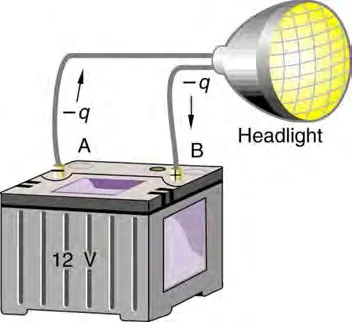
Potential difference and sources of potential difference: A battery does work on charges to maintain a potential difference across a circuit.
Multiples
 ⤢ Enlarge
Multiples
keV = 103 eV, MeV = 106 eV, GeV = 109 eV.
◀ Previous2 / 2
1Converting between eV and joules2Converting between eV and joules
Typical energies
Typical energies
Use
Knowing these values helps to judge whether an answer is sensible.
| Quantity | Typical value |
|---|---|
| Visible photons | about 1.8 eV (red) to 3.1 eV (violet) |
| Ionisation energy of hydrogen | 13.6 eV |
| Work functions of metals | about 2 to 5 eV |
| X-ray photons in medical imaging | tens of keV |
| Binding energy per nucleon | about 8 MeV |
Conversion of hc · Quick relation · Consistent units
Conversion of hc
hc = 1.99 × 10⁻²⁵ J m = 1.24 × 10⁻⁶ eV m.
Quick relation
E (eV) ≈ 1240 / λ (nm) when the wavelength is in nanometres.
It is a quick check
full calculations should still use h and c.
Consistent units
Choose joules or eV at the start and convert everything to that unit.
For the photoelectric effect eV is convenient because work functions are quoted in eV.
1Particles accelerated through a potential difference2Particles accelerated through a potential difference
Particles accelerated through a potential difference
1
A particle of charge q accelerated from rest through a p.d.
2
V gains kinetic energy qV.
3
Electron eV = ½mv2
where e is the electron charge, V the p.d., m the mass and v the speed.
4
Rearranging gives v = √(2eV/m).
5
For a singly charged particle the kinetic energy in eV equals the accelerating voltage numerically.
6
This idea is used in X-ray tubes, electron microscopes and stopping potential in the photoelectric effect.
1 / 2Next ▶
Graph of kinetic energy gained against accelerating potential difference for an electron and a helium nucleus, with the 2000 V electron point marked.
Particles accelerated through a potential difference
 ⤢ Enlarge
Particles accelerated through a potential difference
Energy levels within an atom are given in electronvolts (eV).
A photon’s energy is directly proportional to its frequency, given by E = hf.
Because E = hc/λ, a photon with a shorter wavelength carries more energy.
◀ Previous2 / 2
1The electronvolt unit
- The electronvolt (eV) is defined as the energy transferred when an electron is accelerated through a potential difference of 1 V, equal to 1 eV = 1.60 x 10⁻¹⁹ J.
2Photon energy and electromagnetic frequency
- The energy of a photon of light or electromagnetic radiation is directly proportional to its frequency f, given by the Planck equation E = h f = h c / lambda.
3Photon momentum and radiation pressure
- A photon carries momentum defined by the de Broglie equation p = E / c = h / lambda;
- when incident radiation is completely absorbed by a metal plate surface, each photon transfers momentum p.
4Radiation force and laser beam power
- For a laser beam of power P incident normally on a totally absorbing surface, the rate of photon energy arrival is P,
- resulting in an exerted radiation force F = delta_p / delta_t = P / c.
5The electronvolt unit
- The electronvolt (eV) is defined as the energy transferred when an electron is accelerated through a potential difference of 1 V, equal to 1 eV = 1.60 x 10⁻¹⁹ J.
6Photon energy and electromagnetic frequency
- The energy of a photon of light or electromagnetic radiation is directly proportional to its frequency f, given by the Planck equation E = h f = h c / lambda.
7Photon momentum and radiation pressure
- A photon carries momentum defined by the de Broglie equation p = E / c = h / lambda;
- when incident radiation is completely absorbed by a metal plate surface, each photon transfers momentum p.
8Radiation force and laser beam power
- For a laser beam of power P incident normally on a totally absorbing surface, the rate of photon energy arrival is P,
- resulting in an exerted radiation force F = delta_p / delta_t = P / c.
9Momentum
- P = mv, a vector.
10Radiation
- Transfer by electromagnetic waves, requiring no medium
11Frequency
- Revolutions per second, f = 1/T.
What the symbols mean: T = period, the time for one complete wave (s) · f = frequency (Hz)
12Pressure
- Force per unit area, P = F/A.
What the symbols mean: p = pressure (Pa = N m−2) · F = force acting at right angles to the surface (N) · A = area (m2)
13Theory
- A well-tested, wide-ranging explanation supported by evidence.
14E = hf
What the symbols mean: E = energy of one photon (J) · h = Planck constant (6.63 × 10⁻³⁴ J s) · f = frequency (Hz)
- Definition
- Energy needed to raise the temperature of 1 kg of a substance by 1 °C
Key terms
| Term | Meaning |
|---|---|
| Electronvolt (eV) | The energy gained by an electron travelling through a potential difference of one volt, 1.60 × 10⁻¹⁹ J. |
| Potential difference | The energy transferred per unit charge between two points, V = E/Q. |
| keV, MeV, GeV | Multiples of the electronvolt equal to 103, 106 and 109 eV. |
| Elementary charge (e) | The charge of an electron in magnitude, 1.60 × 10⁻¹⁹ C. |
1Avoid these mistakes2Avoid these mistakes3Avoid these mistakes