Curriculum
Edexcel IAL Physics (IAS & A2)
1. Mechanics and Materials
0/71
-
1. Mechanics and Materials
 Preview
-
1.1.1 Equations of Motion
Preview
-
1.1.3 Slope and Area of Motion Graphs
Preview
-
1.1.5 Resolving Vectors
Preview
-
1.1.5 Resolving Vectors - Check yourself
 Preview
-
1.1.6 Adding Vectors
Preview
-
1.1.6 Adding Vectors - Check yourself
Preview
-
1.1.7 Components of Velocity
Preview
-
1.1.7 Components of Velocity - Check yourself
Preview
-
1.1.8 Free-body Force Diagrams
Preview
-
1.1.8 Free-body Force Diagrams - Check yourself
Preview
-
1.2.2 Mass, Weight and Gravitational Field Strength
Preview
-
1.2.2 Mass, Weight and Gravitational Field Strength - Check yourself
Preview
-
1.2.3 Core Practical 1- Investigating the Acceleration of Freefall
Preview
-
1.2.3 Core Practical 1- Investigating the Acceleration of Freefall - Check yourself
Preview
-
1.2.4 Newton's Third Law of Motion
Preview
-
1.2.4 Newton's Third Law of Motion - Check yourself
Preview
-
1.2.5 Momentum
Preview
-
1.2.5 Momentum - Check yourself
Preview
-
1.2.6 Conservation of Linear Momentum
Preview
-
1.2.6 Conservation of Linear Momentum - Check yourself
Preview
-
1.3.2 Centre of Gravity and The Principle of Moments
Preview
-
1.3.2 Centre of Gravity and The Principle of Moments - Check yourself
Preview
-
1.4.1 Scalars and Vectors
Preview
-
1.4.1 Scalars and Vectors - Check yourself
Preview
-
1.4.1 Work
Preview
-
1.4.1 Work - Check yourself
Preview
-
1.5.3 Viscous Drag
Preview
-
1.5.3 Viscous Drag - Check yourself
Preview
-
1.5.4 Core Practical 2- Investigating Viscosity
Preview
-
1.5.4 Core Practical 2- Investigating Viscosity - Check yourself
Preview
-
1.6.2 Stress, Strain and The Young Modulus
Preview
-
1.6.2 Stress, Strain and The Young Modulus - Check yourself
Preview
-
1.6.3 Force-Extension Graphs
Preview
-
1.6.3 Force-Extension Graphs - Check yourself
Preview
-
1.6.4 Stress-Strain Graphs
Preview
-
1.6.4 Stress-Strain Graphs - Check yourself
Preview
-
1.6.5 Core Practical 3- Investigating Young Modulus
Preview
-
1.6.5 Core Practical 3- Investigating Young Modulus - Check yourself
Preview
-
1.6.6 Elastic Strain Energy
Preview
-
1.6.6 Elastic Strain Energy - Check yourself
Preview
-
2.1.2 Motion Graphs
Preview
-
3.1.2 Force and Acceleration
Preview
-
3.1.2 Force and Acceleration - Check yourself
Preview
-
4.1.2 Moments
Preview
-
4.1.2 Moments - Check yourself
Preview
-
4.3.1 Density
Preview
-
4.3.1 Density - Check yourself
Preview
-
4.3.4 Upthrust
Preview
-
4.3.4 Upthrust - Check yourself
Preview
-
5.1.2 The Principle of Conservation of Energy
Preview
-
5.1.2 The Principle of Conservation of Energy - Check yourself
Preview
-
5.1.3 Efficiency
Preview
-
5.1.3 Efficiency - Check yourself
Preview
-
5.1.4 Power
Preview
-
5.1.4 Power - Check yourself
Preview
-
5.2.1 Gravitational Potential Energy
Preview
-
5.2.1 Gravitational Potential Energy - Check yourself
Preview
-
5.2.2 Kinetic Energy
Preview
-
5.2.2 Kinetic Energy - Check yourself
Preview
-
6.1.2 Hooke's Law
Preview
-
6.1.2 Hooke's Law - Check yourself
Preview
-
Edexcel International AS Physics — Complete unit: 1. Mechanics and Materials
Preview
-
1.1.4 Scalars and Vectors
Preview
-
1.2.1 Force and Acceleration
Preview
-
1.4.3 Gravitational Potential Energy
Preview
-
1.4.4 The Principle of Conservation of Energy
Preview
-
1.4.5 Power
Preview
-
1.4.6 Efficiency
Preview
-
1.5.2 Upthrust
Preview
-
1.6.1 Hooke's Law
Preview
2. Waves and Electricity
0/108
3. Practical Skills in Physics I
0/52
4. Further Mechanics, Fields and Particles
0/90
5. Thermodynamics, Radiation, Oscillations and Cosmology
0/96
6. Practical Skills in Physics II
0/11
Text lesson
5.1.4 Power
5.1.4 Power — AS PHYSICS 9702 notes: Define power as the rate of energy transfer and use P = W/t = E/t.
1Power · Equation2The watt
Power · Equation
Power
the rate of energy transfer.
Since work done equals energy transferred, power is also work done per unit time.
Equation
P = E/t = W/t.What the symbols mean: P = power (W = J s−1) · W or E = work done / energy transferred (J) · t = time (s) · F = force (N) · v = velocity (m s−1)
P is power in watts (W), E is energy in joules (J), W is work done in joules (J) or N m, t is time in seconds (s).
1 / 2Next ▶
What is power?: A rocket on the Space Shuttle lifting off, doing work and using energy at a very high rate.
The watt
 ⤢ Enlarge
1
1 W = 1 J s−1.
2
A household power rating such as 60 W or 1000 W is the energy transferred electrically from the mains each second.
◀ Previous2 / 2
Work and force · Combined problems · Memory aid
Work and force
substituting W = Fs into P = W/t gives P = Fs/t.
Convert distances and times to SI units before substituting.
Combined problems
power questions often include work, energy and efficiency.
Find the work or energy first
then divide by the time.
Memory aid
think of power as energy per second.
Energy–time graph · Power–time graph · Average power
Energy–time graph
the gradient at any point is the power.
Power–time graph
the area under the graph is the energy transferred.
Average power
total energy transferred divided by total time taken.
1Electrical devices · Moving objects2Efficiency
Electrical devices · Moving objects
Electrical devices
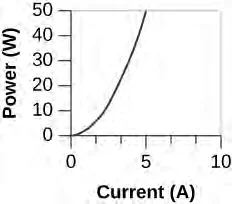
P = VI = I2R = V2/R.What the symbols mean: P = power (W) · I = current (A) · V = potential difference (V)
Moving objects
P = Fv for a constant force and constant velocity.
1 / 2Next ▶
Power in a resistor: Power dissipated in a resistor grows with the square of the current.
Efficiency
 ⤢ Enlarge
Efficiency
efficiency = useful output power ÷ total input power.
◀ Previous2 / 2
More from the specification
Mechanical power at constant speed
- Mechanical power at constant speed multiplying driving tractive force by instantaneous vehicle speed directly determines mechanical power output.
Gravitational Potential Energy and Kinetic Energy Stores
- As an object moves along an inclined slope or falls vertically, energy shifts between its gravitational potential store (Ep = mgh) and its kinetic store (Ek = ½mv2).
What the symbols mean: Ep = gravitational potential energy gained (J) · m = mass (kg) · g = 9.81 N kg−1 · h = change in height (m)
Work Done Against Applied and Resistive Forces
- When an external force is applied to move a body up a slope or through a fluid like water, mechanical work is transferred in the direction of displacement (W = F·s).
What the symbols mean: W = work done = energy transferred (J) · F = force (N) · d, s or x = distance moved in the direction of the force (m)
Power Output in Dynamic Systems
- Power is the rate of energy transfer or work done per unit time (P = W/t); for a vehicle or pumping system moving at constant velocity v against resistive forces, power equals applied force multiplied by velocity (P = F·v).
Weight
- Gravitational force on a mass.
Parallel
- Components on separate branches, each with the full e.m.f.
Thermal
- A convection current in the air.
Energy store
- Where energy is held, such as kinetic or chemical.
Gravitational potential
- Work done per unit mass in bringing a test mass from infinity to the point.
Kinetic energy
- K = ½mv2, energy of motion.
Thermal store
- Energy held in the moving particles of a material.
Mains supply
- Domestic a.c. supply, rated 230 V rms at 50 Hz in the UK.
- Conservation
- A quantity stays constant; the total before equals the total after.
Key terms
| Term | Meaning |
|---|---|
| Power | Rate of energy transfer, or work done per unit time. |
| Watt | Unit of power, equal to one joule per second. |
| Work done | Energy transferred by a force, W = Fs. |
| Average power | Total energy transferred divided by total time taken. |
| Kilowatt-hour | Unit of energy equal to 3.6 × 10⁶ J. |
1Avoid these mistakes2Avoid these mistakes