Curriculum
Edexcel IAL Physics (IAS & A2)
1. Mechanics and Materials
0/71
2. Waves and Electricity
0/108
-
2. Waves and Electricity
 Preview
-
2.1.1 Properties of Waves
Preview
-
2.1.1 Properties of Waves - Check yourself
 Preview
-
2.1.3 Longitudinal Waves
Preview
-
2.1.3 Longitudinal Waves - Check yourself
Preview
-
2.1.4 Transverse Waves
Preview
-
2.1.4 Transverse Waves - Check yourself
Preview
-
2.1.5 Representing Waves on Graphs
Preview
-
2.1.6 Core Practical 4- Investigating the Speed of Sound
Preview
-
2.2.1 Interference and Superposition of Waves
Preview
-
2.2.1 Interference and Superposition of Waves - Check yourself
Preview
-
2.2.2 Phase and Path Difference
Preview
-
2.2.2 Phase and Path Difference - Check yourself
Preview
-
2.2.4 Wave Speed on a Stretched String
Preview
-
2.2.4 Wave Speed on a Stretched String - Check yourself
Preview
-
2.2.5 Core Practical 5- Investigating Stationary Waves
Preview
-
2.2.5 Core Practical 5- Investigating Stationary Waves - Check yourself
Preview
-
2.3.1 Equation for the Intensity of Radiation
Preview
-
2.3.1 Equation for the Intensity of Radiation - Check yourself
Preview
-
2.3.2 Refraction and Refractive Index
Preview
-
2.3.2 Refraction and Refractive Index - Check yourself
Preview
-
2.3.3 Critical Angle
Preview
-
2.3.3 Critical Angle - Check yourself
Preview
-
2.3.4 Total Internal Reflection
Preview
-
2.3.4 Total Internal Reflection - Check yourself
Preview
-
2.3.5 Measuring Refractive Index
Preview
-
2.3.5 Measuring Refractive Index - Check yourself
Preview
-
2.3.6 Plane Polarisation
Preview
-
2.3.6 Plane Polarisation - Check yourself
Preview
-
2.4.2 The Diffraction Grating Equation
Preview
-
2.4.2 The Diffraction Grating Equation - Check yourself
Preview
-
2.4.3 Core Practical 6- Investigating Diffraction Gratings
Preview
-
2.4.3 Core Practical 6- Investigating Diffraction Gratings - Check yourself
Preview
-
2.4.4 The Wave Nature of Electrons
Preview
-
2.4.5 The de Broglie Equation
Preview
-
2.4.5 The de Broglie Equation - Check yourself
Preview
-
2.4.6 Transmission and Reflection of Waves
Preview
-
2.4.6 Transmission and Reflection of Waves - Check yourself
Preview
-
2.4.7 Pulse-Echo Technique
Preview
-
2.4.7 Pulse-Echo Technique - Check yourself
Preview
-
2.4.9 Energy of a Photon
Preview
-
2.4.9 Energy of a Photon - Check yourself
Preview
-
2.5.1 The Photoelectric Effect
Preview
-
2.5.1 The Photoelectric Effect - Check yourself
Preview
-
2.5.2 The Photoelectric Equation
Preview
-
2.5.2 The Photoelectric Equation - Check yourself
Preview
-
2.5.4 The Particle Nature of EM Radiation
Preview
-
2.5.4 The Particle Nature of EM Radiation - Check yourself
Preview
-
2.5.5 Atomic Line Spectra
Preview
-
2.5.5 Atomic Line Spectra - Check yourself
Preview
-
2.6.4 Charge Conservation in Circuits
Preview
-
2.6.4 Charge Conservation in Circuits - Check yourself
Preview
-
2.6.5 Energy Conservation in Circuits
Preview
-
2.6.5 Energy Conservation in Circuits - Check yourself
Preview
-
2.6.6 Resistance in Series and Parallel
Preview
-
2.6.6 Resistance in Series and Parallel - Check yourself
Preview
-
2.6.8 Current-Potential Difference Graphs
Preview
-
2.6.8 Current-Potential Difference Graphs - Check yourself
Preview
-
2.7.1 Electrical Resistivity
Preview
-
2.7.1 Electrical Resistivity - Check yourself
Preview
-
2.7.2 Core Practical 7- Investigating Resistivity
Preview
-
2.7.2 Core Practical 7- Investigating Resistivity - Check yourself
Preview
-
2.7.3 Calculating Current and Drift Velocity
Preview
-
2.7.3 Calculating Current and Drift Velocity - Check yourself
Preview
-
2.7.4 Potential Difference and Conductor Length
Preview
-
2.7.4 Potential Difference and Conductor Length - Check yourself
Preview
-
2.7.6 Potential Dividers and Variable Resistance
Preview
-
2.7.6 Potential Dividers and Variable Resistance - Check yourself
Preview
-
2.8.3 E.M.F. vs. Terminal Potential Difference
Preview
-
2.8.3 E.M.F. vs. Terminal Potential Difference - Check yourself
Preview
-
2.8.4 Core Practical 8- Investigating E.M.F. and Internal Resistance
Preview
-
2.8.4 Core Practical 8- Investigating E.M.F. and Internal Resistance - Check yourself
Preview
-
2.8.5 Resistance and Temperature
Preview
-
2.8.5 Resistance and Temperature - Check yourself
Preview
-
2.8.6 Resistance and Illumination
Preview
-
2.8.6 Resistance and Illumination - Check yourself
Preview
-
7.1.3 The Wave Equation
Preview
-
7.1.3 The Wave Equation - Check yourself
Preview
-
8.1.2 Stationary Waves
Preview
-
8.1.2 Stationary Waves - Check yourself
Preview
-
8.2.1 Diffraction
Preview
-
8.2.1 Diffraction - Check yourself
Preview
-
9.1.1 Electric Current
Preview
-
9.1.1 Electric Current - Check yourself
Preview
-
9.2.1 Potential Difference
Preview
-
9.2.1 Potential Difference - Check yourself
Preview
-
9.2.2 Electrical Power
Preview
-
9.2.2 Electrical Power - Check yourself
Preview
-
9.3.2 Ohm's Law
Preview
-
9.3.2 Ohm's Law - Check yourself
Preview
-
10.1.2 Electromotive Force
Preview
-
10.1.2 Electromotive Force - Check yourself
Preview
-
10.1.3 Internal Resistance
Preview
-
10.1.3 Internal Resistance - Check yourself
Preview
-
10.3.1 Potential Dividers
Preview
-
10.3.1 Potential Dividers - Check yourself
Preview
-
22.1.3 The Electronvolt
Preview
-
22.1.3 The Electronvolt - Check yourself
Preview
-
22.3.1 Wave-Particle Duality
Preview
-
22.3.1 Wave-Particle Duality - Check yourself
Preview
-
Edexcel International AS Physics — Complete unit: 2. Waves and Electricity
Preview
-
2.1.2 The Wave Equation
Preview
-
2.4.8 Wave-Particle Duality
Preview
-
2.5.3 The Electronvolt
Preview
-
2.6.1 Electric Current
Preview
-
2.6.3 Ohm's Law
Preview
-
2.6.7 Electrical Power
Preview
-
2.8.1 Electromotive Force
Preview
3. Practical Skills in Physics I
0/52
4. Further Mechanics, Fields and Particles
0/90
5. Thermodynamics, Radiation, Oscillations and Cosmology
0/96
6. Practical Skills in Physics II
0/11
Text lesson
8.2.1 Diffraction
8.2.1 Diffraction — AS PHYSICS 9702 notes: Describe diffraction of waves at gaps and edges and how its extent depends on gap width and wavelength.
1Definition · Extent · Most prominent2Edges3Any wave
Definition · Extent · Most prominent
Definition
the spreading out of waves when they pass an obstruction, typically a narrow slit or aperture.
Extent
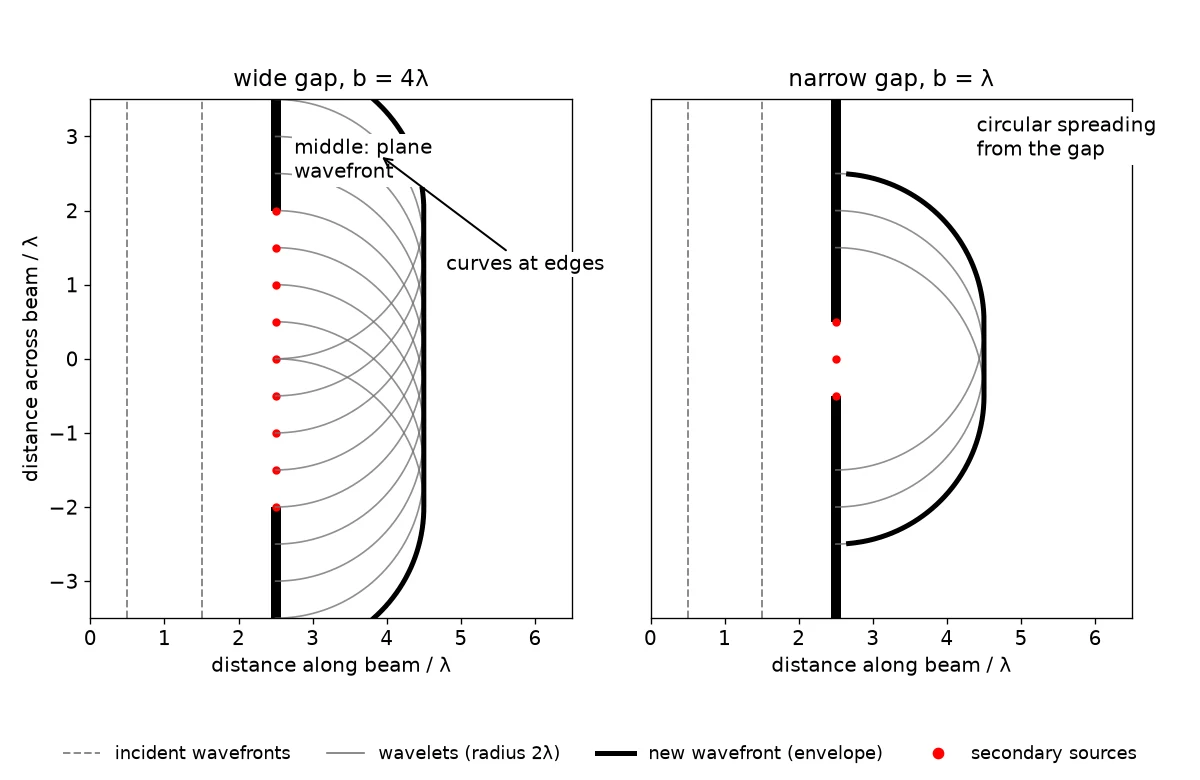
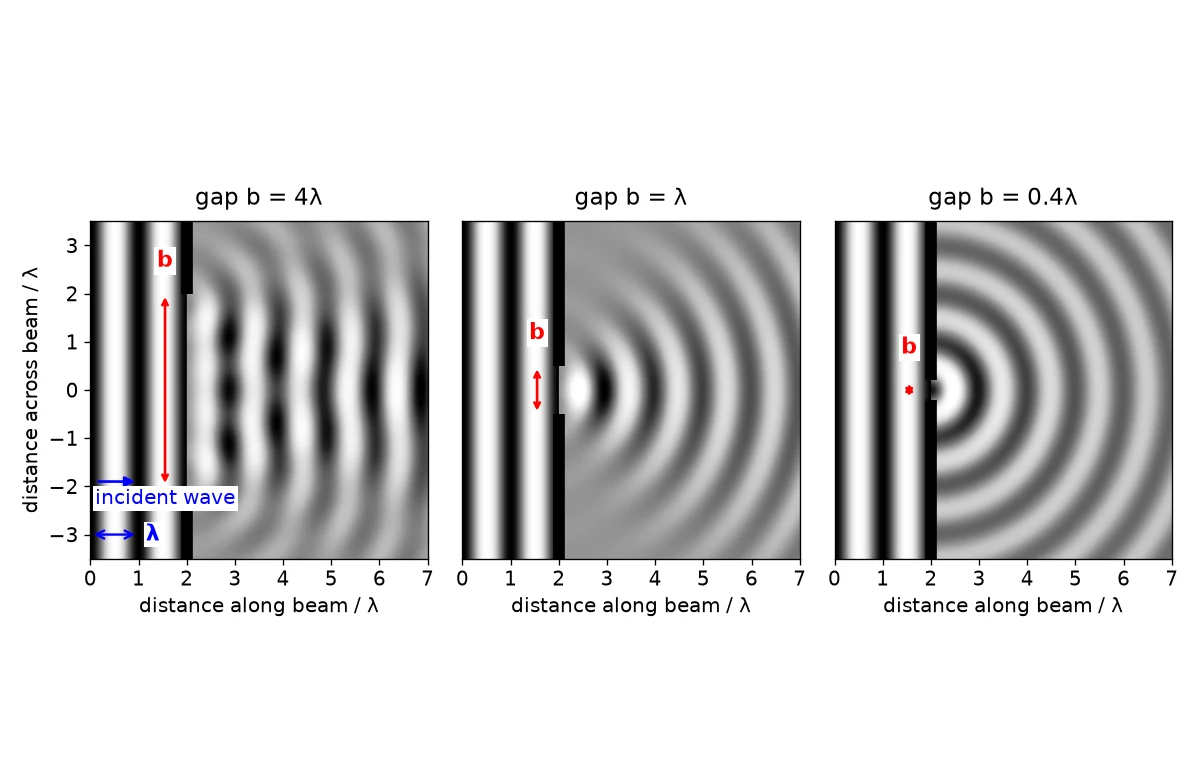
it depends on the width of the gap compared with the wavelength.
Most prominent
when the slit width is approximately equal to the wavelength.
1 / 3Next ▶
Edges
Edges
diffraction also occurs when waves curve around the edge of a barrier.
◀ Previous2 / 3Next ▶
Huygens construction: secondary wavelets from points in a wide gap form a plane middle wavefront with curved edges; a narrow gap gives a circular arc
Any wave
 ⤢ Enlarge
Any wave
sound, light and water waves can all be diffracted.
◀ Previous3 / 3
Only amplitude changes · Reason · Drawing
Only amplitude changes
wavelength, frequency and speed stay the same.
Reason
some energy is dissipated when the wave passes through the gap.
Drawing
keep the wavelength constant when drawing diffracted wavefronts.
Three panels of plane waves meeting a barrier with gaps of 4λ, λ and 0.4λ, showing increasing spreading as the gap narrows
Gap size and wavelength
| Gap compared with wavelength | Effect |
|---|---|
| Much smaller | The wave spreads out significantly after passing through. |
| About equal | Diffraction is most pronounced. |
| Much bigger | The wave passes through with little diffraction. |
1Use · Changing the effect · Wide gap2Example
1Method · X-rays · UV and gate posts2Sound
More from the specification
Diffraction at Slits and Obstacles
- Diffraction is the spreading of wavefronts as they pass through an aperture or around the edge of an obstacle; diffraction effects become most pronounced when the aperture width is approximately equal to the wavelength.
Diffraction Demonstrations in Ripple Tanks
- Ripple tanks provide clear visual demonstrations of water wave diffraction,
- where plane straight wavefronts passing through a narrow barrier slit spread out into circular wavefronts.
Radio Wave Propagation and Obstacle Diffraction
- Long-wavelength radio waves diffract around large physical structures such as hills and buildings,
- allowing radio broadcast signals to reach ground receivers located beyond direct line of sight.
X-Ray Diffraction in Crystalline Solids
- X-rays possess wavelengths (~10-10 m) comparable to the atomic plane spacing in a crystalline solid, undergoing constructive and destructive interference upon diffraction to produce characteristic crystal structure patterns.
Radio wave
- Longest-wavelength electromagnetic wave
Key terms
| Term | Meaning |
|---|---|
| Diffraction | Spreading out of waves when they pass through a gap or around an edge. |
| Aperture | Gap or slit through which a wave passes. |
| Wavefront | Line joining points of a wave in the same phase. |
| Ripple tank | Shallow water tank used to show wave properties. |
1Avoid these mistakes2Avoid these mistakes