Curriculum
Edexcel IAL Physics (IAS & A2)
1. Mechanics and Materials
0/71
-
1. Mechanics and Materials
 Preview
-
1.1.1 Equations of Motion
Preview
-
1.1.3 Slope and Area of Motion Graphs
Preview
-
1.1.5 Resolving Vectors
Preview
-
1.1.5 Resolving Vectors - Check yourself
 Preview
-
1.1.6 Adding Vectors
Preview
-
1.1.6 Adding Vectors - Check yourself
Preview
-
1.1.7 Components of Velocity
Preview
-
1.1.7 Components of Velocity - Check yourself
Preview
-
1.1.8 Free-body Force Diagrams
Preview
-
1.1.8 Free-body Force Diagrams - Check yourself
Preview
-
1.2.2 Mass, Weight and Gravitational Field Strength
Preview
-
1.2.2 Mass, Weight and Gravitational Field Strength - Check yourself
Preview
-
1.2.3 Core Practical 1- Investigating the Acceleration of Freefall
Preview
-
1.2.3 Core Practical 1- Investigating the Acceleration of Freefall - Check yourself
Preview
-
1.2.4 Newton's Third Law of Motion
Preview
-
1.2.4 Newton's Third Law of Motion - Check yourself
Preview
-
1.2.5 Momentum
Preview
-
1.2.5 Momentum - Check yourself
Preview
-
1.2.6 Conservation of Linear Momentum
Preview
-
1.2.6 Conservation of Linear Momentum - Check yourself
Preview
-
1.3.2 Centre of Gravity and The Principle of Moments
Preview
-
1.3.2 Centre of Gravity and The Principle of Moments - Check yourself
Preview
-
1.4.1 Scalars and Vectors
Preview
-
1.4.1 Scalars and Vectors - Check yourself
Preview
-
1.4.1 Work
Preview
-
1.4.1 Work - Check yourself
Preview
-
1.5.3 Viscous Drag
Preview
-
1.5.3 Viscous Drag - Check yourself
Preview
-
1.5.4 Core Practical 2- Investigating Viscosity
Preview
-
1.5.4 Core Practical 2- Investigating Viscosity - Check yourself
Preview
-
1.6.2 Stress, Strain and The Young Modulus
Preview
-
1.6.2 Stress, Strain and The Young Modulus - Check yourself
Preview
-
1.6.3 Force-Extension Graphs
Preview
-
1.6.3 Force-Extension Graphs - Check yourself
Preview
-
1.6.4 Stress-Strain Graphs
Preview
-
1.6.4 Stress-Strain Graphs - Check yourself
Preview
-
1.6.5 Core Practical 3- Investigating Young Modulus
Preview
-
1.6.5 Core Practical 3- Investigating Young Modulus - Check yourself
Preview
-
1.6.6 Elastic Strain Energy
Preview
-
1.6.6 Elastic Strain Energy - Check yourself
Preview
-
2.1.2 Motion Graphs
Preview
-
3.1.2 Force and Acceleration
Preview
-
3.1.2 Force and Acceleration - Check yourself
Preview
-
4.1.2 Moments
Preview
-
4.1.2 Moments - Check yourself
Preview
-
4.3.1 Density
Preview
-
4.3.1 Density - Check yourself
Preview
-
4.3.4 Upthrust
Preview
-
4.3.4 Upthrust - Check yourself
Preview
-
5.1.2 The Principle of Conservation of Energy
Preview
-
5.1.2 The Principle of Conservation of Energy - Check yourself
Preview
-
5.1.3 Efficiency
Preview
-
5.1.3 Efficiency - Check yourself
Preview
-
5.1.4 Power
Preview
-
5.1.4 Power - Check yourself
Preview
-
5.2.1 Gravitational Potential Energy
Preview
-
5.2.1 Gravitational Potential Energy - Check yourself
Preview
-
5.2.2 Kinetic Energy
Preview
-
5.2.2 Kinetic Energy - Check yourself
Preview
-
6.1.2 Hooke's Law
Preview
-
6.1.2 Hooke's Law - Check yourself
Preview
-
Edexcel International AS Physics — Complete unit: 1. Mechanics and Materials
Preview
-
1.1.4 Scalars and Vectors
Preview
-
1.2.1 Force and Acceleration
Preview
-
1.4.3 Gravitational Potential Energy
Preview
-
1.4.4 The Principle of Conservation of Energy
Preview
-
1.4.5 Power
Preview
-
1.4.6 Efficiency
Preview
-
1.5.2 Upthrust
Preview
-
1.6.1 Hooke's Law
Preview
2. Waves and Electricity
0/108
3. Practical Skills in Physics I
0/52
4. Further Mechanics, Fields and Particles
0/90
5. Thermodynamics, Radiation, Oscillations and Cosmology
0/96
6. Practical Skills in Physics II
0/11
Text lesson
2.1.2 Motion Graphs
2.1.2 Motion Graphs — AS PHYSICS 9702 notes: Interpret distance-time, displacement-time, speed-time, velocity-time and acceleration-time graphs.
Five types of motion graph
Distance-time
the slope is speed.
Displacement-time
the slope is velocity.
Speed-time
the slope is acceleration and the area is distance.
Velocity-time
the slope is acceleration and the area is displacement.
Acceleration-time
the area is the change in velocity.
Distance-time graphs
1
Slope equals speed.
2
The y-intercept equals the initial position.
3
A straight diagonal line constant speed, a curved line is acceleration and a horizontal line is rest.
4
The slope is never negative because distance is a scalar.
5
The area under the curve is meaningless.
1Displacement-time graphs2Displacement-time graphs
Displacement-time graphs
Displacement-time graphs
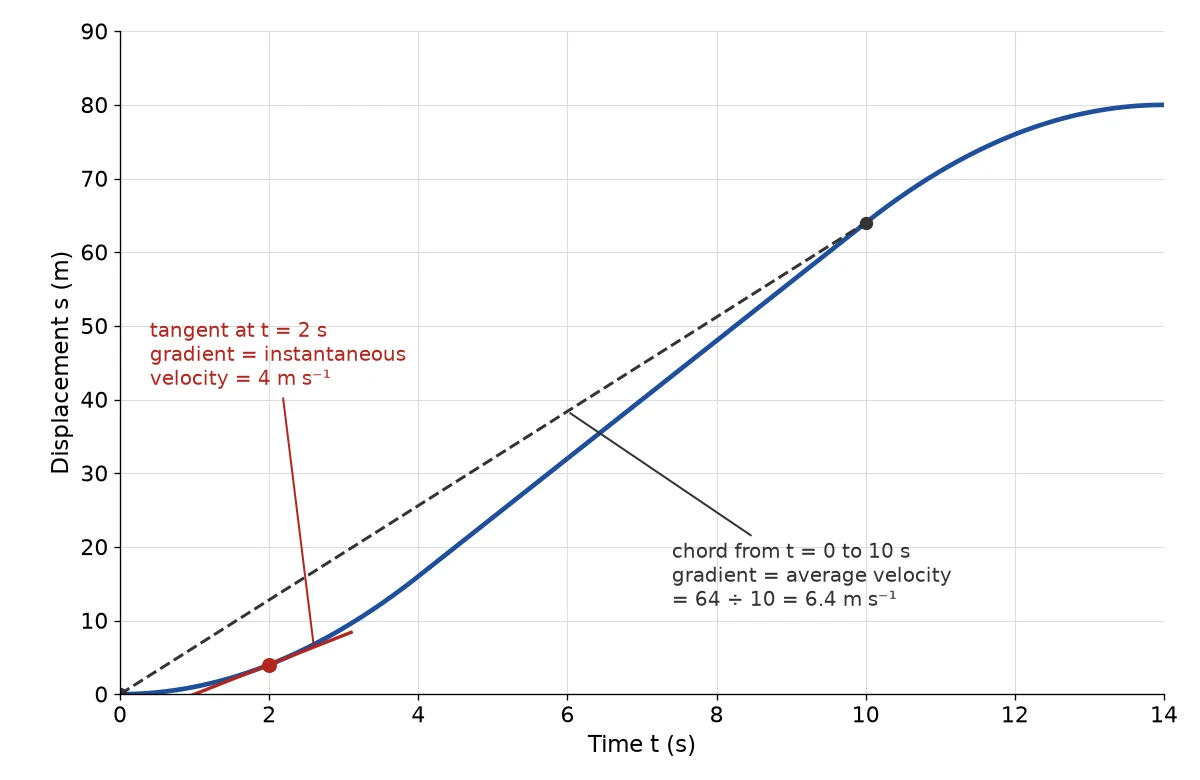
Slope equals velocity.
The y-intercept equals the initial position.
A straight diagonal line constant velocity, a curved line is acceleration and a horizontal line is rest.
A positive slope means motion in the positive direction and a negative slope means motion in the negative direction.
A peak on the graph means the object turned round
at the top of a thrown ball’s graph the gradient is zero.
The area under the curve is meaningless.
1 / 2Next ▶
Displacement-time curve with a tangent at t = 2 s and a dashed chord from t = 0 s to t = 10 s
Displacement-time graphs
◀ Previous2 / 2
Speed-time graphs
1
Slope equals acceleration.
2
The y-intercept equals the initial speed.
3
A straight line means uniform acceleration a curved line means non-uniform acceleration.
4
A positive slope means speed is increasing a negative slope means speed is decreasing
a horizontal line means constant speed.
5
The area under the curve equals the distance travelled.
1Velocity-time graphs2Velocity-time graphs
Velocity-time graphs
1
Slope equals acceleration.
2
The y-intercept equals the initial velocity.
3
A straight line means uniform acceleration a curved line means non-uniform acceleration
a horizontal line means constant velocity.
4
A positive slope means velocity is increasing in the positive direction a negative slope means velocity is increasing in the negative direction.
5
A line crossing the time axis means the velocity changes sign
so the object reverses direction.
6
The area under the curve equals the displacement.
1 / 2Next ▶
Velocity-time graph forming a trapezium, with the area split into two triangles and a rectangle labelled in metres
Velocity-time graphs

◀ Previous2 / 2
Acceleration-time graphs · A horizontal line · A straight diagonal line
Acceleration-time graphs
The slope is meaningless.
The y-intercept equals the initial acceleration.
A horizontal line
constant acceleration, and a blank graph (a line at zero) means constant velocity.
A straight diagonal line
increasing acceleration.
The area under the curve equals the change in velocity.
1Linking the graphs2Linking the graphs
Linking the graphs
Linking the graphs
Slope of the displacement-time graph gives velocity slope of the velocity-time graph gives acceleration.
Area under the acceleration-time graph gives Δv area under the velocity-time graph gives Δs.
Gradient converts a graph to the next lower one and area converts it to the next higher one.
At every join between sections the values must match velocity and displacement cannot jump instantly.
A lift that accelerates up, cruises and stops has a v-t graph that rises, stays level and falls.
Its a-t graph is a positive step, a zero section and a negative step of equal area.
1 / 2Next ▶
Three stacked graphs of one motion (displacement, velocity, acceleration against time) on a shared time axis, with stage labels
Linking the graphs

◀ Previous2 / 2
1Reading and drawing graphs accurately2Reading and drawing graphs accurately
1Kinematic Equations for Uniform Acceleration
- For motion in a straight line under constant gravitational acceleration g, kinematic equations link initial velocity u, final velocity v, acceleration a, time t,
- and displacement s.
- (e.g. v2 = u2 + 2as and s = ut + ½at2)
2Determining g with a Ball-Bearing Experiment
- In an experiment to measure acceleration of free fall, an electromagnet releases a ball-bearing from a measured height h through light gates,
- and kinematic equations are applied to the average time taken (h = ½gt2).
3Projectile Motion and Graph Interpretation
- In projectile motion, horizontal velocity remains constant while vertical velocity represents uniform acceleration; on a vertical velocity-time graph, the gradient represents gravitational acceleration g.
4Projectile
- Object moving under gravity alone in two dimensions.
5Electromagnet
- Magnet made by current through a coil around a magnetic core.
6Kinematic equations
- Equations relating displacement, velocity, acceleration and time for constant acceleration.
7Final velocity
- Velocity at the end, v.
8Projectile motion
- Two-dimensional motion with constant horizontal velocity and vertical acceleration g.
9Vector quantity
- A quantity with both magnitude and direction.
10Light gate
- A sensor that starts or stops a timer when a beam is interrupted.
Key terms
| Term | Meaning |
|---|---|
| Gradient | Change in the y-quantity divided by the change in the x-quantity. |
| Tangent | A straight line touching a curve at one point whose gradient is the rate of change there. |
| Area under a graph | The accumulated quantity, for example displacement under a v-t graph. |
| Displacement-time graph | A graph of displacement against time whose gradient is velocity. |
| Velocity-time graph | A graph of velocity against time whose gradient is acceleration and area is displacement. |
| Speed-time graph | A graph of speed against time whose area is distance. |
| Acceleration-time graph | A graph of acceleration against time whose area is the change in velocity. |
| Uniform acceleration | Acceleration shown by a straight sloping line on a velocity-time graph. |
1Avoid these mistakes2Avoid these mistakes