Curriculum
AP Physics C: Mechanics
1. Kinematics
0/45
2. Force and Translational Dynamics
0/821.1Systems, centers of mass and free-body diagrams1.2Newton’s laws: equilibrium, the third law and acceleration1.3Gravity, weight and apparent weight1.4Friction and springs as contact and elastic forces1.5Resistive forces and motion described by differential equations1.6Circular motion and orbits1.7Key equations of Unit 21.8How the topics connect1.9Key terms1.10Avoid these mistakes
3. Work, Energy, and Power
0/414. Linear Momentum
0/365. Torque and Rotational Dynamics
0/496. Energy and Momentum of Rotating Systems
0/517. Oscillations
0/441.1Unit 7 at a glance1.2The condition for SHM and its equation of motion1.3Period, frequency and the physical quantities that set them1.4Displacement, velocity, acceleration and resonance1.5Energy in oscillating systems1.6Pendulums as oscillators1.7Key equations of Unit 71.8How the topics connect1.9Key terms1.10Avoid these mistakes
Text lesson
2.8 Spring Forces
Spring Forces
2.8 Ideal springs and their force
Ideal springs and their force
Ideal springs and their force
Ideal springs and their force
- An ideal spring has negligible mass and exerts a force that is proportional to the change in its length, measured from its relaxed length.
- A nonideal spring either has a mass that cannot be neglected or exerts a force that is not proportional to its change in length.
- Most of the springs in this course are treated as ideal, and a nonideal spring must be described separately in the question.
2.8 Spring Forces · 1 / 7
2.8 Hooke’s law and the direction of the force
Hooke’s law and the direction of the force
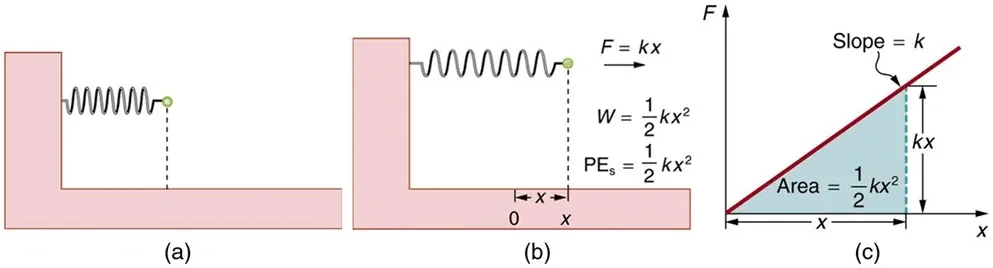
- Hooke’s law and the direction of the force
- Spring force grows linearly with displacement and the slope of the graph equals the spring constant.
- Image: OpenStax, College Physics 2e, CC BY 4.0.
- Hooke’s law and the direction of the force
- ⤢ Enlarge
- The magnitude of the force exerted by an ideal spring on an object is given by Hooke’s law:
- Fs = kΔx
- Here Fs is the magnitude of the spring force in newtons (N), k is the spring constant in newtons per metre (N/m), and Δx is the change in length of the spring from its relaxed length, in metres.
- Δx is not the total length of the spring.
- A spring with a relaxed length of 0.20 m that is stretched to 0.25 m has Δx = 0.05 m.
- 5A stiffer spring has a larger spring constant
- so it exerts a larger force for the same stretch.
- The force exerted by the spring on the object is always directed toward the equilibrium position of the object–spring system.
- 1 / 2Next ▶
- Hooke’s law and the direction of the force
- Hooke’s law and the direction of the force
- If the spring is stretched, the force on the object points back toward the relaxed position,
- and if the spring is compressed, the force points away from the relaxed position.
- In vector form, the force is Fs = −kx
- where x is the displacement of the object from its equilibrium position.
- The negative sign shows that the force always opposes the displacement.
- ◀ Previous, 2 / 2
2.8 Spring Forces · 2 / 7
2.8 Springs in series
Springs in series
Springs in series
Springs in series
- Springs are in series when they are joined end to end
- so that the same force is transmitted through each of them.
Each spring is stretched by the same force F
- but their extensions add up.
- The total extension is x = F/k1 + F/k2, and the equivalent spring constant keq satisfies F = keqx.
This gives the rule
1/keq = 1/k1 + 1/k2 + …
- The inverse of the equivalent spring constant is the sum of the inverses of the individual spring constants.
- Because each term on the right is positive, the equivalent constant is always smaller than the smallest individual spring constant.
- Adding a spring in series makes the combination softer.
2.8 Spring Forces · 3 / 7
2.8 Springs in parallel
Springs in parallel
- Springs in parallel
- 1Springs are in parallel when they are both attached to the same object and to the same fixed support
- so that each spring has the same extension Δx.
- The total force is the sum of the individual forces, F = k1Δx + k2Δx + …, and so the equivalent spring constant is
- keq = k1 + k2 + …
- 3The equivalent constant of a parallel combination is the sum of the individual constants
- so it is larger than the largest of them.
- Parallel springs share the force between them in proportion to their stiffness, with the stiffer spring carrying the larger share.
- 4The boundary of the course is that springs are combined either in series or in parallel
- but never in a mixed arrangement.
- A question with both kinds of connection in the same system is outside the scope of AP Physics C: Mechanics.
2.8 Spring Forces · 4 / 7
2.8 Worked examples
Worked examples
- Example 2: Two springs in series3Example 2: Two springs in series · Example 3: Two springs in
- Force from a stretched spring
- A spring with spring constant 120 N/m is attached to a 2.0 kg block on a frictionless surface.
- The spring is stretched 0.15 m from its relaxed length.
- Find the magnitude and direction of the spring force on the block.
- The magnitude is Fs = kΔx = (120 N/m)(0.15 m) = 18 N. Since the spring is stretched, the force on the block points back toward the relaxed position of the spring
- which is the equilibrium position of the block–spring system.
- The spring force has magnitude 18 N and points toward the relaxed position of the spring. The mass of the block does not affect the spring force, although it does affect the acceleration.
- 1 / 3Next ▶
- Two springs in series
- Two springs in series
- A spring of constant 200 N/m is joined end to end with a spring of constant 300 N/m.
- A force of 12 N is applied to the free end of the combination.
- Find the equivalent spring constant, and the extension of each spring.
- From 1/keq = 1/200 + 1/300 = (3 + 2)/600 = 5/600, the equivalent constant is keq = 600/5 = 120 N/m.
- This is smaller than 200 N/m, as the rule predicts.
- The total extension is x = 12 N/120 N/m = 0.10 m.
- Each spring carries the full 12 N
- so the 200 N/m spring extends by 12/200 = 0.060 m and the 300 N/m spring extends by 12/300 = 0.040 m.
- These add to 0.10 m.
- ◀ Previous, 2 / 3Next ▶
- Two springs in series · Example 3: Two springs in parallel
- Two springs in series
- The equivalent spring constant is 120 N/m. The extensions are 0.060 m and 0.040 m
- which total 0.10 m.
- Two springs in parallel
- The same two springs, with constants 200 N/m and 300 N/m, are attached in parallel to a block that is displaced 0.020 m from equilibrium.
- Find the equivalent spring constant, the total force on the block, and the force carried by each spring.
- The equivalent constant is keq = 200 + 300 = 500 N/m. The total force is F = (500 N/m)(0.020 m) = 10 N. Each spring has the same extension, 0.020 m
- so the 200 N/m spring carries (200)(0.020) = 4.0 N and the 300 N/m spring carries (300)(0.020) = 6.0 N. These add to 10 N.
- The equivalent constant is 500 N/m, the total force is 10 N directed toward equilibrium, and the two springs carry 4.0 N and 6.0 N. The combination is stiffer than either spring alone.
- ◀ Previous, 3 / 3
2.8 Spring Forces · 5 / 7
2.8 Key terms
Key terms
- Key terms
| Term | Meaning |
|---|---|
| Ideal spring | A spring with negligible mass that exerts a force proportional to its change in length from the relaxed length. |
| Hooke’s law | The statement that the magnitude of the force exerted by an ideal spring is Fs = kΔx. |
| Spring constant (k) |
|
| Relaxed length | The length of a spring when no force is exerted on it; Δx is measured from this length. |
| Equilibrium position |
|
| Series springs | Springs joined end to end, which carry the same force, with 1/keq = Σ 1/ki. |
| Parallel springs | Springs attached to the same object so that they have the same extension, with keq = Σ ki. |
| Equivalent spring constant (keq) | The single spring constant that gives the same force for the same extension as a combination of springs. |
2.8 Spring Forces · 6 / 7
2.8 Avoid these mistakes
Avoid these mistakes
Avoid these mistakes2→Avoid these mistakes3Avoid these mistakes
Avoid these mistakes
Avoid this
- Using the total length of the spring in Hooke’s law. The extension ΔAvoid this
xAvoid this
is measured from the relaxed length.Avoid this
Avoid this
- Adding spring constants for springs in series. Series springs use the sum of the reciprocals.Avoid this
1 / 3Next ▶
Avoid these mistakes
Avoid this
- Using the reciprocal rule for parallel springs. Parallel springs add their spring constants directly.Avoid this
Avoid this
- Claiming that the equivalent constant of springs in series is larger than each individual constant.
- It is always smaller than the smallest.Avoid this
Avoid this
- Giving the spring force a positive sign when the spring is stretched and the axis points away from equilibrium.Avoid this
◀ Previous, 2 / 3Next ▶
Avoid these mistakes
- The force points back toward equilibrium.Avoid this
Avoid this
- Assuming that the mass of the block changes the spring force.Avoid this
- The force depends on the spring constant and the extension; the mass affects only the acceleration.Avoid this
◀ Previous, 3 / 3
2.8 Spring Forces · 7 / 7
Well done! You finished this lesson
What would you like to do next?